Last updated:
Your product image is doing the job a shop assistant used to do. It answers questions the buyer has not typed yet. It closes the gap between seeing and wanting. Most stores treat it as a production task. It is a conversion lever.
Think about what happens in a physical shop. You pick the jacket up. You feel the weight of it. You check the lining. You put it on. That sequence of micro-evaluations tells you whether this is worth the price before you ever reach the till. Online, none of that happens. The image has to do all of it. Every detail it fails to show is a question the buyer cannot answer, and unanswered questions kill purchase intent.
According to the 2025 Salsify Consumer Research Report, 77% of shoppers say high-quality images and videos are important to their purchasing decision. The same report found that 71% of consumers have returned products because the actual item did not match the images. That is not just a conversion problem. Returns cost money to process, and buyers who have been disappointed rarely come back.
Why are your product images evaluated before your copy is read?
Here is a pattern that comes up constantly in store audits. A brand spends months refining their copy, pricing strategy, and ad funnel. Then they wonder why conversion is flat. The images have not changed in two years.
The reason this matters more than most founders realise is timing. The brain evaluates visual information before conscious reasoning engages. Before a buyer reads your product name, your price, or your description, they have already formed an impression from the image. That impression is not a rational assessment. It is a pattern-recognition response built from hundreds of previous experiences with quality signals: the way premium products are photographed, the backgrounds used by brands they trust, the level of detail visible at first glance.
You do not get to override that first impression with good copy. You earn it or lose it with the image before the rest of the page has a chance.
The visual evaluation of a product happens in milliseconds, before any conscious reasoning begins. By the time a buyer reads your product name, they have already formed an impression they will not consciously revise downward. The image is not presentation. It is the first and most powerful persuasion lever on the page.
You are not competing on the product. You are competing on the thumbnail.
Think about how you scan a product grid. You are not reading. You are sorting. Before you consciously register a product name or price, peripheral vision has already divided everything on screen into two piles: worth a closer look and not relevant. That sorting happens in milliseconds, before any deliberate evaluation takes place.
This is why image quality affects click-through on category pages as much as it affects conversion on product pages. A blurry, poorly lit, or compositionally confusing image loses the buyer at the browse stage before they ever reach the product detail page. By the time they have ruled you out, they have no idea why. The image just did not feel right.
Why the image has to work harder than the shop floor
Research by Ben Bushong and colleagues found that having a product physically present in front of a buyer increased what they were willing to pay for it by up to 60%, compared to seeing only a text description. An image fell somewhere between the two: better than a description alone, but nowhere near the persuasive weight of the real thing in your hands.
That gap is the core challenge of product photography. You cannot replicate the effect of physical proximity in a still image. But the tools available to close that gap have moved significantly. 360-degree rotational views let the buyer turn a product in their hands digitally, examining it from every angle before committing. Augmented reality placement tools, now available through platforms like Shopify and built into apps like IKEA Place and Houzz, let a buyer point their phone at their living room and see a sofa, a lamp, or a rug sitting in their actual space at actual scale. Research from Northwestern University's Medill School found interactive product imagery reduces return rates by 22% compared to traditional static galleries. The return reduction alone often justifies the implementation cost.
Run the thumbnail test. View your primary product image at the size it appears in a category grid on a phone. If the product's key quality signal does not read clearly at that scale, you are losing buyers at the browse stage before they ever reach your detail page. Fix the primary image first.
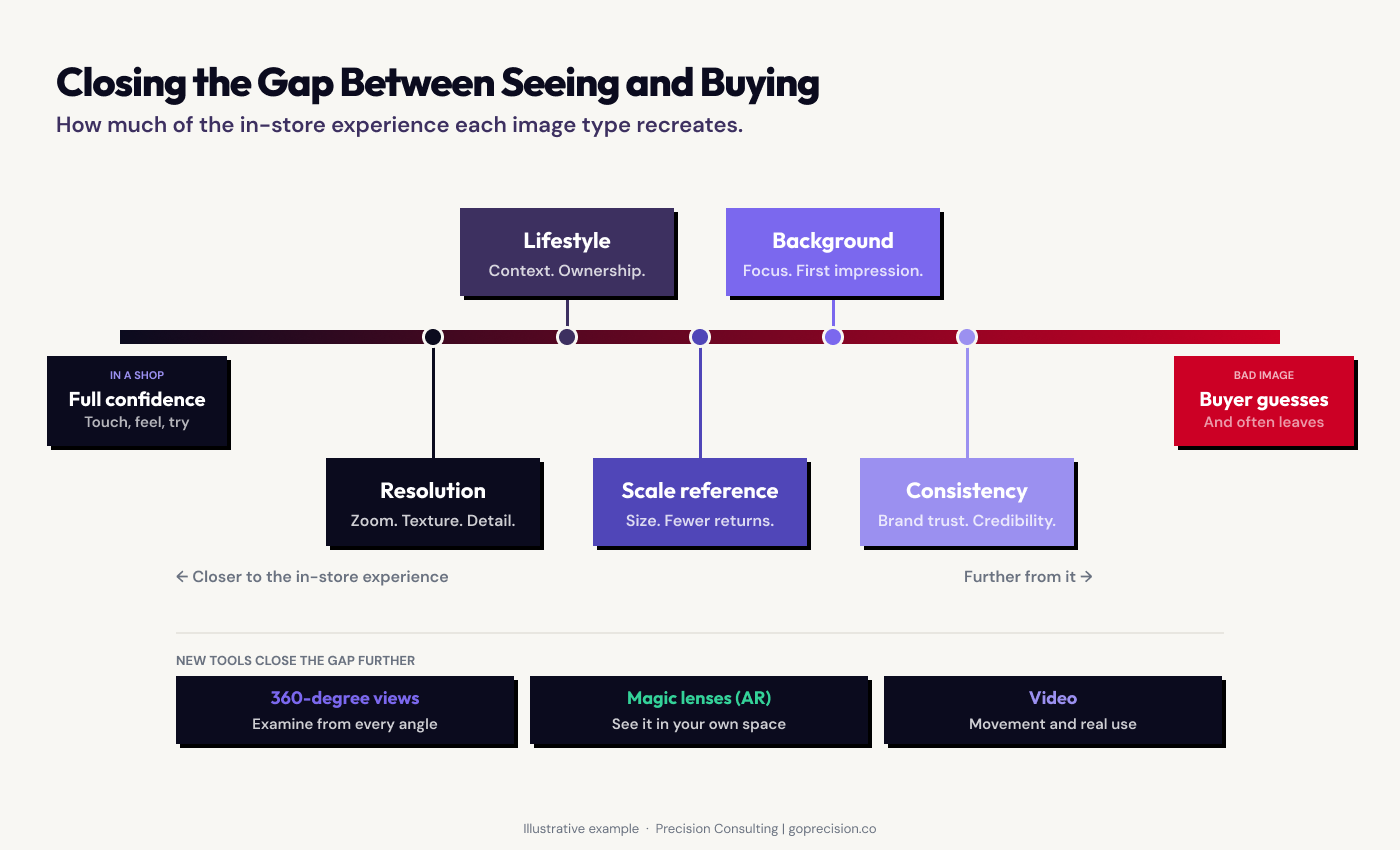
The gap product images need to close: from seeing to buying. The tools that narrow it include high-resolution zoom, lifestyle context, scale references, and interactive formats.
Knowing what good product images look like is one thing. Checking your own pages is another. The Product Page checklist in the CRO Leak Finder kit is a fillable PDF with three sections: above the fold, proof in reach, and kill the doubt. Tick what applies, fix what is flagged. Get the kit.
What does the data show about product images and conversion?
A 2024 e-commerce analytics compilation found that high-quality product photos convert at rates 94% higher than low-quality images across electronics, apparel, home goods, and beauty categories. For a store doing 2,000 orders a month, that gap is the difference between 2,000 orders and 3,880. It is not a marginal improvement. It is the difference between two fundamentally different businesses.
Research across more than 240 e-commerce sites found that four to six high-quality images is the optimal range for most categories. Each additional image up to that range increases conversion probability by approximately 5% to 8%. Beyond six, most categories see diminishing returns. For higher-consideration purchases such as furniture, luxury goods, or complex electronics, seven to nine images continued to show positive impact.
360-degree product views show particularly strong results on returns. Research from Northwestern University's Medill School indicates that interactive product imagery reduces return rates by 22% compared to traditional static galleries. A 22% reduction in returns from one image format change is a profitability improvement as much as a conversion one.
The 94% conversion uplift from high-quality images is not an aesthetic preference. It is a vividness effect. The more clearly a buyer can mentally simulate owning and using a product, the higher their willingness to pay and the lower their likelihood of returning it. Better images reduce both conversion cost and post-purchase cost simultaneously.
Start with your top 10 highest-traffic product pages. Check image count (target 4 to 6), resolution quality, and whether at least one shot shows the product in real-world context. Most revenue gains from image improvements come from a small number of pages that carry disproportionate traffic weight.
Which image variables have the biggest impact on conversion rate?
1. Resolution: the moment the buyer tries to check your work
The ability to zoom into a product and see real detail is a trust signal. When a buyer zooms into a leather bag and sees the stitching clearly, the brand is silently communicating: we are not hiding anything. When zoom reveals a blurry, pixelated mess, confidence dissolves. Most buyers could not tell you why they lost interest. They just did.
High resolution is not about looking premium. It is about giving the buyer the ability to evaluate something they cannot physically hold. That evaluation is what replaces the in-store experience. If they cannot see the thing properly, the gap between the image and the real product stays wide, and wide gaps produce hesitation.
2. Background and composition: give the product room to speak
A noisy background is not neutral. It actively competes with the product for the buyer's attention at the exact moment they are trying to form a first impression. Research on e-commerce image preferences consistently shows that buyers respond better to products on clean backgrounds with the product centred and the surrounding area simple or blurred. The mechanism is attention direction. Everything in the frame that is not the product is friction.
White backgrounds are the standard for primary shots because they provide maximum contrast and minimum distraction. The risk is using white background images as your only images. A single clean but context-free shot on a product with any complexity does not give the buyer enough visual information to make a confident decision. Clean is necessary. Complete is separate.
3. Lifestyle imagery: from evaluating an object to imagining a life
A buyer looking at a lamp on a white background is evaluating an object. A buyer looking at the same lamp in a styled living room is imagining it in their space. That shift from evaluating to imagining is where purchase intent jumps.
For fashion in particular, lifestyle imagery showing the garment on a real person in a real context significantly outperforms flat-lay or hanger shots. It allows buyers to evaluate fit, drape, and scale in a way that a flat image simply cannot communicate. Research by Chrimes, Boardman, Vignali, and McCormick confirmed that the number and type of product images, alongside zoom functionality, significantly affect how accurately consumers judge clothing fit before buying. Fewer surprises at the door, fewer returns in the post.
4. Scale indicators: the return that should never have happened
Pull your returns data and look at the reason field. "Not as expected" and "different size than shown" are some of the most consistent return reasons across e-commerce categories. And almost all of them were preventable. The buyer bought the wrong size not because they misread, but because the image gave them no honest reference point.
Scale indicators do not have to be measurement overlays or technical diagrams. A hand holding the product, a lifestyle shot with recognisable objects nearby, or a secondary image alongside something familiar all do the same job. The goal is simple: a buyer who knows exactly how large this thing is before they commit. Research by Dang and Nichols in 2023 confirmed that size referents reduce purchasing errors and post-purchase regret. The fix is cheap. The alternative costs you the product plus the return processing plus the buyer's trust.
5. Consistency: the signal the buyer reads before they know they are reading it
Most stores have a mixed-photography problem. Some products were shot professionally with consistent lighting, clean backgrounds, and multiple angles. Others were photographed on a kitchen table three years ago, and nobody has gotten around to updating them. The result on a category grid is an involuntary visual hierarchy: buyers' eyes go to the best-photographed products regardless of relevance. Conversion clusters around the products that look the most professional, not the ones that best match what the buyer came looking for. That is a revenue problem masquerading as a production backlog.
The brand signal matters too. When a catalogue has some products shot beautifully and others clearly done on the cheap, the message to the buyer is that the brand applies inconsistent standards. That perception extends to the product itself. It should not. But it does. The image set is not just a sales tool. It is a brand statement about whether you take quality seriously.
Buyers cannot tell you why they lost confidence in a product page. The zoom that returned a pixelated image, the hanger shot that gave no sense of drape, the image with no scale reference: these are not consciously noted as failures. They register as friction and resolve as hesitation. Hesitation becomes abandonment.
Review your returns data for each product alongside its image set. A spike in "not as described" or "different size than expected" returns on a specific product is a direct signal that the images are creating a gap between expectation and reality. Fix the images before investing in any other retention or returns reduction programme.
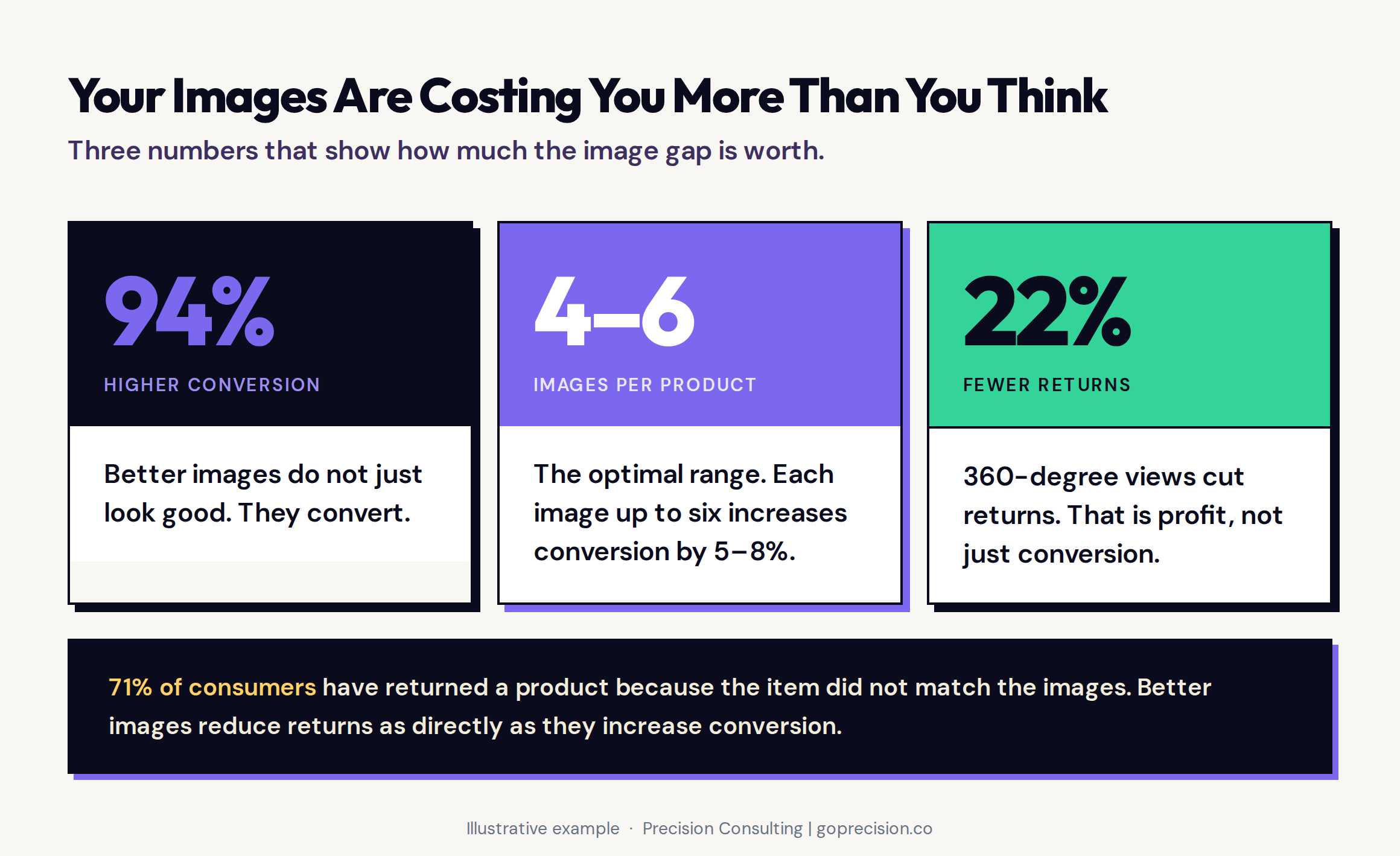
What low-quality product images are costing your business: the conversion, revenue, and return rate impact across e-commerce categories.
How do you audit your product images?
You do not need a professional photographer to run this audit. You need honest eyes, your own phone, and about an hour on your highest-traffic pages.
The five questions to answer for each product
Does the primary image show enough detail to allow confident quality evaluation? Are there enough angles and context images to answer the questions a buyer would ask before purchasing? Does the image set give an honest, accurate representation of the product's actual scale? Is the visual quality consistent with the other products in the same category grid? And if you look at the primary image at thumbnail size, the size it appears on a category page on a phone, does it read clearly enough to earn a click?
Products that fail more than two of these questions are losing conversions they should be holding. Start with your highest-traffic products, not the easiest or cheapest to reshoot. The priority is where the traffic is.
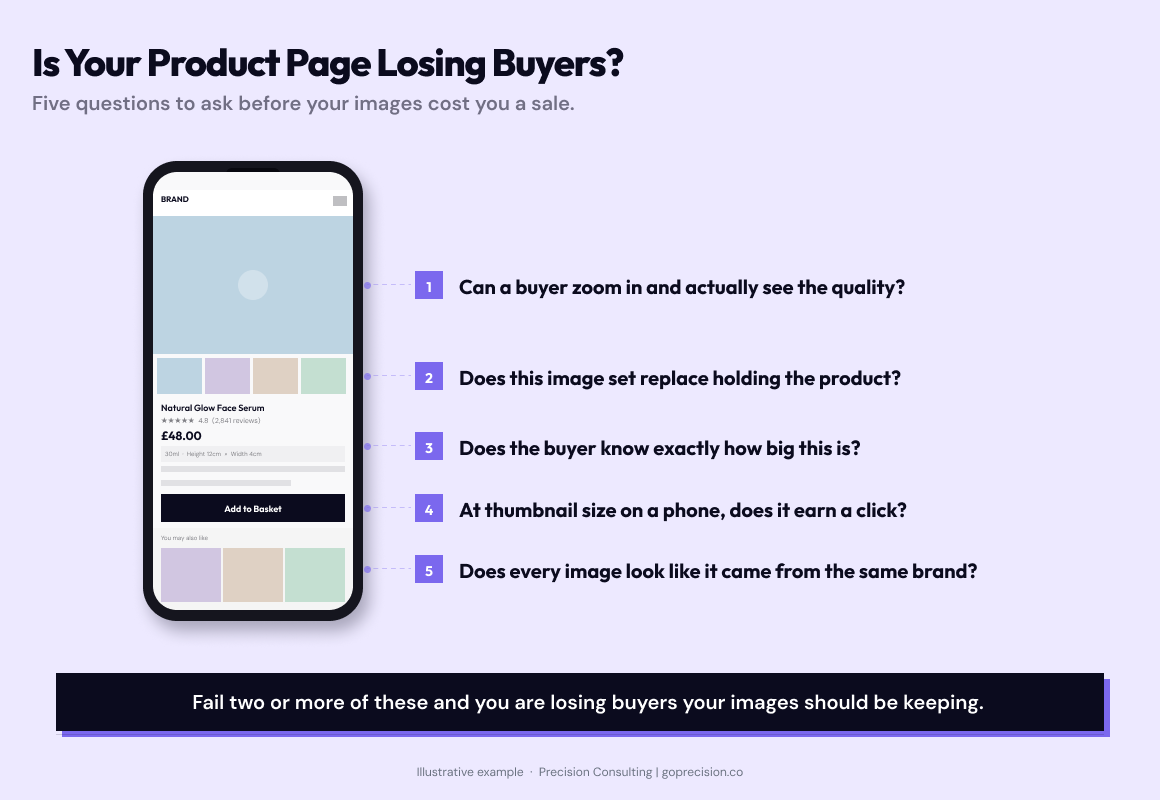
The five-question image audit: how to identify which product pages are losing buyers before they reach the purchase decision.
What your returns data is already telling you
Your returns data is one of the most honest sources of image quality feedback you have. A spike in returns citing "not as described" or "different size than shown" in a specific category is a direct signal that the image set is creating a gap between expectation and reality. You are not just losing conversion from those returns. You are paying to process them, and the buyers who come back disappointed rarely come back at all.
Most product pages that underperform on conversion have not been properly diagnosed. Brands look at traffic and checkout data and miss the point where buyers lose confidence. It almost always happens on the product detail page, in the first few seconds, and almost always involves the image set.
Prioritise your image audit by traffic, not by ease of reshoot. The products that are easiest to photograph are rarely the ones driving most of your revenue. Start where the traffic is heaviest and work backwards. A reshoot on a high-traffic product with a poor image set recovers conversions immediately and often pays for itself within days.
- High-quality product images convert at up to 94% higher rates than low-quality images. The gap is not about aesthetics. It is about the psychological work the image does in place of a physical product the buyer cannot hold.
- Visual evaluation happens before conscious reasoning begins. By the time a buyer reads your product name or price, they have already formed an impression from the image. You earn or lose the sale at thumbnail, before the detail page loads.
- Four to six high-quality images is the optimal range for most e-commerce categories. Each additional image up to that range increases conversion probability by 5% to 8%. High-consideration products such as furniture and luxury goods benefit from seven to nine.
- Vividness drives purchase intent. The more clearly a buyer can mentally simulate owning and using the product — through detail, scale, lifestyle context, and multiple angles — the higher their willingness to pay and the lower their likelihood of returning it.
- 71% of consumers have returned products because the actual item did not match the images. Better images reduce returns as directly as they increase conversion. Returns cost money to process, and buyers who come back disappointed rarely come back again.
- Resolution is a trust signal. When buyers zoom in and see detail clearly, the brand communicates that it has nothing to hide. When zoom returns a pixelated image, confidence dissolves — often without the buyer knowing why.
- Inconsistency across a product range signals quality standards to the buyer. Conversion clusters around the best-photographed products in a category grid, regardless of which products best match what the buyer came looking for.
- Your returns data is one of the most honest sources of image quality feedback available. A spike in "not as described" returns on a specific product is a direct signal to fix the image set before investing in traffic.
Frequently Asked Questions
How much do product images affect conversion rate?
A 2024 e-commerce analytics compilation found that high-quality product images convert at rates 94% higher than low-quality images. A Photoroom 2024 report found that 96% of e-commerce brands experienced higher conversion rates after upgrading their product imagery. The impact is consistent across categories and price points.
How many product images should an e-commerce product page have?
Research across more than 240 e-commerce sites found that four to six high-quality images is the optimal range for most categories, with each additional image increasing conversion probability by 5% to 8% up to that range. High-consideration products such as furniture, luxury goods, and complex electronics benefit from seven to nine. Beyond that range, most categories see diminishing returns.
What types of product images convert best?
A combination of clean primary shots on a simple background, detail images showing texture and finish at high resolution, lifestyle images showing the product in real context, and scale reference shots performs best across most categories. For fashion, on-model images significantly outperform flat lays for both conversion and return rates.
Do product images affect return rates?
Yes. The 2025 Salsify Consumer Research Report found that 71% of consumers have returned products because the actual item did not match the images or description. NRF and Happy Returns 2024 data shows US return rates hit 16.9% of total retail sales, with a significant share attributable to inaccurate or incomplete product imagery.
What is the psychology behind product image quality and buying decisions?
High-quality images increase vividness: the buyer's ability to mentally simulate owning and using the product. Research by Ben Bushong and colleagues showed that products physically present in front of buyers were valued up to 60% more than those seen only in descriptions. Well-executed product photography closes that gap by providing the detail, context, and scale the buyer needs to feel confident in a product they cannot touch.
If you want to understand where your product pages are losing buyers and what your image set is actually costing you in conversion and returns, see how a Precision conversion audit works.
100 Things Every Designer Needs to Know About People by Susan Weinschenk covers the visual psychology behind how people process images, including peripheral vision, pattern recognition, and the role of visual detail in forming rapid quality judgements. Predictably Irrational by Dan Ariely covers the psychology of perceived value and how presentation context affects what buyers are willing to pay. Influence by Robert Cialdini covers how liking, trust, and authority affect buying decisions.
