Last updated:
Here is a pattern that comes up in almost every store audit I run at Precision. Average order value (AOV), or average basket value (ABV) if you are in the UK and Europe, is underperforming. Not by a dramatic amount. Enough to matter.
The symptom is usually single-item orders. The customer found what they were looking for, bought it, and left. No second item, no bundle, no upgrade. The store's response is typically to add a upsell widget, run a free shipping promotion, or create a bundle. Those tactics are not wrong. They are just usually implemented without understanding the psychology that makes them work, or fail.
Dan Ariely's research on arbitrary coherence shows that people systematically undervalue what is already in front of them unless given a reason to reconsider. The same principle applies to basket value. Customers do not naturally think about buying more. You have to create the conditions where buying more feels like the obvious, rational choice. This guide explains how.
AOV is one of the three levers of e-commerce revenue alongside traffic and conversion rate. You can meaningfully grow profit without acquiring a single new customer if you get the basket right.
Why standard AOV tactics underperform (and what to do instead)
Standard AOV tactics underperform because they are built around the store's economics (margin) rather than the customer's experience (relevance). The fix is to invert that. Place upsells where the buyer has already committed, and pair them by relevance, not by what makes the most money for you.
Your upsell widget is showing the wrong things
Most upsell widgets are configured by margin, not by relevance. The store surfaces whatever has the highest profit contribution and calls it "customers also bought." The customer looks at a completely unrelated product and ignores it. The widget converts at a low rate, the conclusion is that upsells do not work, and nothing changes.
The problem is not upselling. The problem is cognitive load. When a recommendation makes obvious sense, the customer does not have to work to understand why it is there. When it does not, they have to evaluate it from scratch, and most of the time, that evaluation ends with "no."
Relevance and Cognitive Load: The brain takes the path of least resistance. A recommendation that clearly pairs with what the customer just added requires no mental effort to evaluate. An irrelevant recommendation creates friction, not just indifference. The customer's decision-making bandwidth is finite, and wasting it on an irrelevant suggestion makes the whole experience feel harder.
Configure one curated pairing per product rather than a generic widget. Add a one-sentence rationale for why the pair works ("Most customers who buy this also grab X to avoid needing to order it separately"). Relevance with a reason converts dramatically better than a widget driven by margin logic alone.
Your free shipping threshold is set at a number no one calculated
Ask most store owners where their free shipping threshold came from and the honest answer is: it felt right, or it matched what a competitor was doing. That is not a threshold. That is a guess. A threshold set below the median order value does not incentivise anyone to spend more. The customer is already there. A threshold set too far above it feels unachievable and gets ignored entirely.
The goal is to create a gap that is visible, motivating, and closeable. Not a gap that is so large it feels pointless.
Goal Gradient Effect: People accelerate effort as they approach a goal. A progress bar showing "You are £6 away from free shipping" does not just inform. It creates momentum. The closer the customer gets, the more motivated they are to close the gap. The same psychology that makes loyalty card stamps effective works here.
Set your free shipping threshold at 20 to 25 percent above your current median order value. Then make the gap visible and dynamic in the cart. A progress bar showing exactly how much more the customer needs to spend, updating in real time as they add items, turns a static threshold into an active motivator.
Your bundles have no anchor
A bundle price shown on its own is just a number. £49 for three items means nothing without context. The customer has no frame of reference for whether that represents value. But £49 for three items that would cost £67 individually is an obvious saving. The customer can see the gap and the saving feels concrete and real.
Most bundle pages skip the anchor entirely. They show the bundle price and expect the customer to do the maths. Most customers do not. They just see a large number and hesitate. For a deeper look at how anchoring works across your pricing, the psychology of pricing guide covers the mechanisms in detail.
Anchoring Bias: The first number a customer sees sets the reference point for everything that follows. Show individual item prices before the bundle total and the total feels like a discount. Show only the bundle price and the total feels like a cost. The information is identical. The framing changes what the brain does with it.
Always display the individual item prices before the bundle price, and state the saving in a currency amount rather than a percentage. "Save £18" lands harder than "Save 27%." Show the original prices crossed out next to the bundle total. Give the customer's brain something to anchor against before it sees the number you want it to accept.
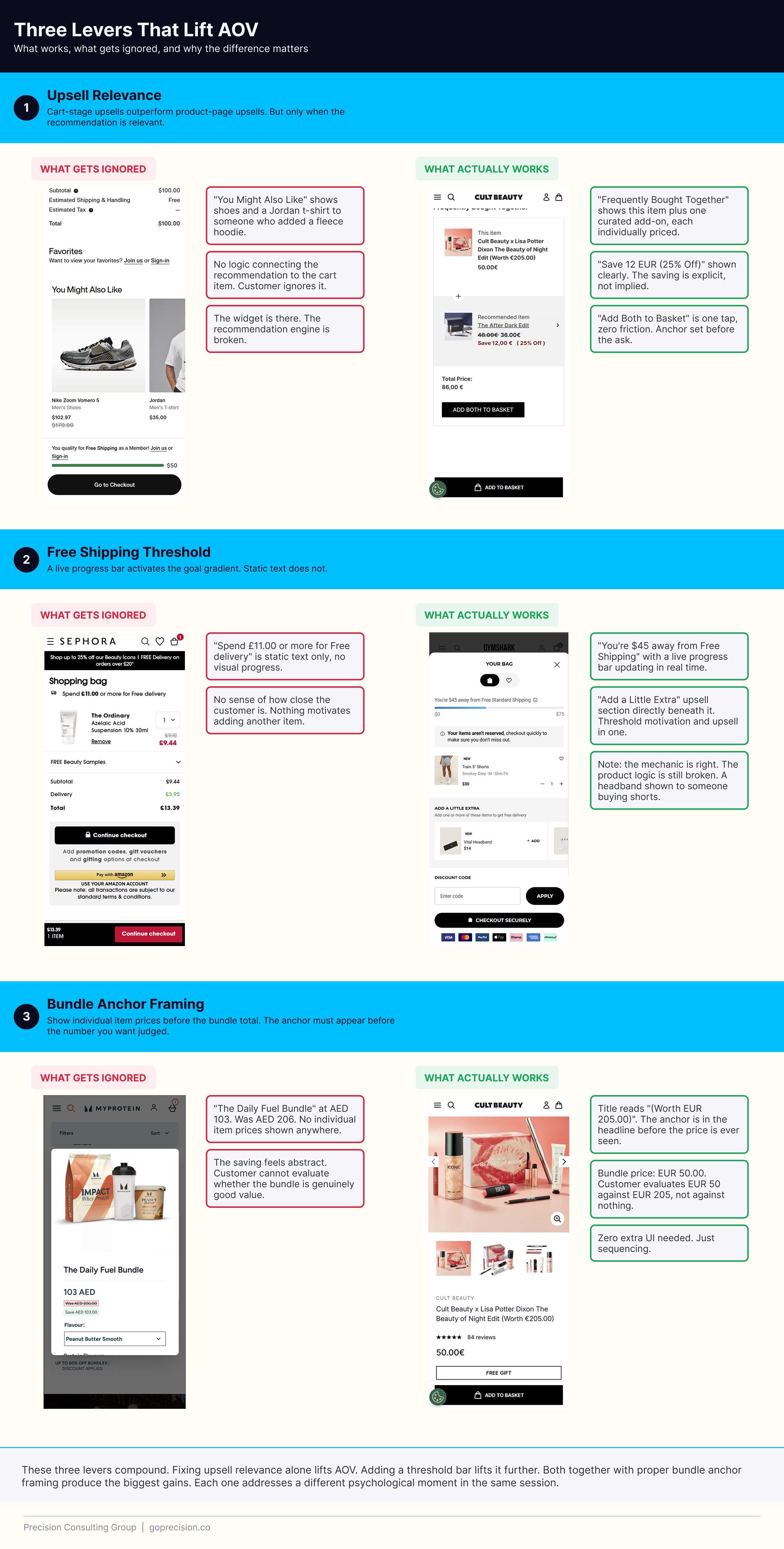
The three AOV levers: upsell relevance, threshold placement, and bundle framing, with the mechanism behind each and what a realistic lift looks like.
Why some buyers spend more: the psychology behind a high basket value
Some buyers spend more because they have crossed a psychological threshold, not because they planned to. Commitment, momentum, and perceived value all shift once a customer is in the cart. The decision frame has changed. The job of high-AOV stores is to design for that change.
The cart is a better place to upsell than the product page
Most stores put their upsell on the product page. The logic makes sense: the customer is engaged, they are evaluating the product, show them something complementary. The problem is timing. At the product page stage, the customer has not yet committed. They are still deciding. Adding an upsell at that moment introduces a new decision before the first one is finished.
Move the most relevant upsell to the cart page and the psychology changes. The customer has already committed to buying. They have already crossed the mental threshold. The resistance to adding one more item is lower because the frame is different: they are no longer deciding whether to buy, they are deciding whether to optimise what they are already buying.
Sunk Cost Psychology: Once a customer has added items to the cart, they have made a psychological investment in the purchase. That investment changes how they evaluate additional suggestions. The mental effort of deciding is largely over. A relevant upsell in the cart feels like a useful addition to a decision already made, not a new decision from scratch.
Identify the one product that most naturally extends or completes the most common cart combination in your store, and place it as a single cart-page upsell. Keep the recommendation to one item. Multiple upsells in the cart create the same cognitive load problem as irrelevant product page widgets. One well-chosen suggestion, at the right moment, outperforms three mediocre ones placed anywhere.
Lead with your most expensive option
Most product variant selectors order options from cheapest to most expensive. It feels logical: start low and let the customer upgrade. In practice, the first option they see anchors their sense of what the product costs. The cheapest variant becomes the reference price, and every higher option gets evaluated as an expensive upgrade from that baseline.
Reversing the order changes the anchor. The customer sees the premium option first, understands its full value, and then evaluates the cheaper options as deliberate downgrades. Some will still choose the lower-priced option, but a meaningful share will stay with the premium one because their reference point was set differently from the start.
Anchoring Bias on Variant Ordering: The same product, presented in a different order, produces a different purchase distribution. Research consistently shows that leading with the highest-priced option increases average revenue per transaction, not because customers are tricked but because their sense of what is reasonable to pay shifts upward before they choose.
Reorder your product variants to lead with the most premium option. Make the value of that option visible, not just the price but what the customer gets for it. Test this against your current order on your highest-traffic products. The lift is often immediate and requires no design changes beyond reordering the options.
Let customers do the selling on the order size
A store telling a customer to buy the larger size is a sales pitch. A store showing a customer that most other customers choose the larger size is data. Those two things land very differently. One creates resistance. The other reduces it.
Social proof on order size is underused. Most stores apply it to product quality ("4.8 stars from 2,400 reviews") but not to quantity decisions ("Most customers buy the 3-pack"). The latter is often more useful at the decision moment, because it answers the specific question the customer is trying to resolve: how much should I actually get?
Social Proof on Order Size: When people are uncertain about how much to buy, they look at what people like them have done. A label showing "Most popular" or "Most customers choose this" on your 3-pack or mid-tier quantity option shifts the default choice without requiring any discount or incentive. It is not pressure. It is permission to make the same rational choice others have made.
Add a "Most popular" or "Most customers choose this" label to the quantity or bundle option that most customers actually select. If you do not have that data yet, default to the mid-tier option as the starting point. Combine this with the variant ordering fix above and you have two levers pulling in the same direction without touching your pricing or margins.
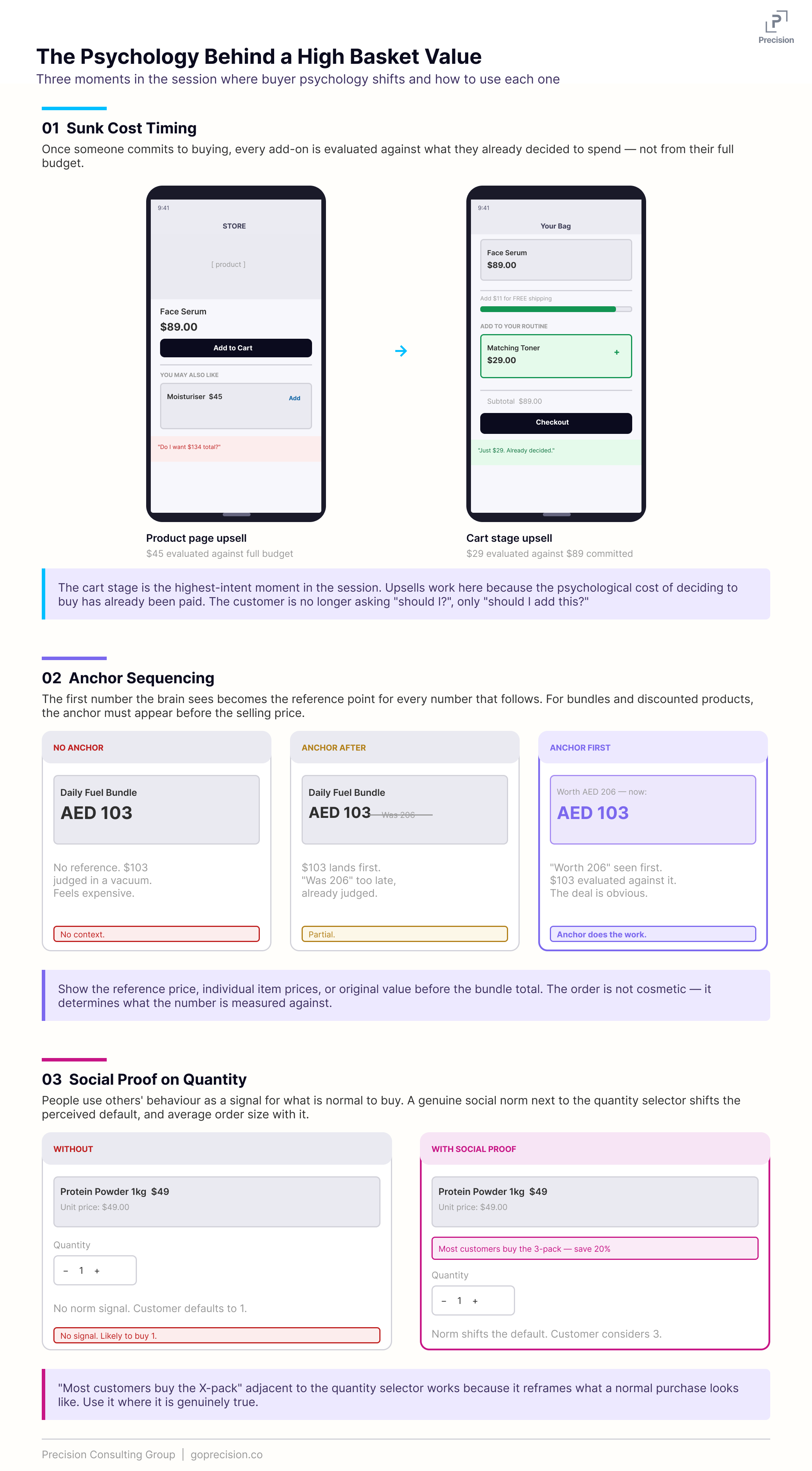
How sunk cost timing, anchor sequencing, and social proof on order size each shift what the customer ultimately buys.
This is the kind of analysis we run in a Precision Deep Dive Audit. If you want to see exactly where your store is leaking revenue, request your free audit and we will walk through it together.
How do you actually fix a low average order value?
Once you understand why your AOV is underperforming, the fix is matching the right tactic to the right diagnosis. Free shipping thresholds work when buyers are abandoning below your median spend. Cart-page upsells work when single-item orders dominate. Bundle anchoring works when bundles exist but barely get picked. Each tactic has a specific job, and applying the wrong one to the wrong diagnosis is exactly why standard AOV efforts underperform.
The full playbook of psychology-backed AOV strategies, with the mechanism behind each and the situations where each one works best, lives in our guide on how to increase average order value. Read that next, with the diagnosis above in hand, and pick the strategies that match what is actually broken in your store.
Want help mapping your specific AOV gap to the tactics that will close it? See how Precision works with e-commerce brands, or book a free strategy call and we will look at your AOV data together.
Dan Ariely's Predictably Irrational explains anchoring and arbitrary coherence in depth, the mechanisms behind why your first number matters so much. Robert Cialdini's Influence covers social proof and the psychology of how people decide what is normal to buy. For a practical framework on applying anchoring and price framing directly to your store, the psychology of pricing guide covers the implementation side.
Key Takeaways
- AOV and ABV measure the same thing. The term changes by market; the diagnostic logic does not.
- Standard AOV tactics underperform because they get applied without diagnosis. The same widget that lifts one store's AOV does nothing for another store with a different underlying problem.
- Single-item orders, low bundle take-up, and unused free-shipping thresholds each point to a different psychological gap in your funnel. Diagnose the gap before picking the fix.
- The cart, not the product page, is where buyers shift from evaluation to commitment. Most stores miss that moment entirely. If your data shows the gap is here, that is where the work belongs.
- Anchoring, sunk cost timing, and social proof on order size are the three psychological levers that shape what a buyer is willing to spend. Knowing which is failing in your store determines which fix matters most.
- Discounting compresses AOV over time. The lift from psychology-backed work compounds. Diagnose first, then act, and the playbook for action is in our guide on how to increase AOV.
Frequently Asked Questions
What is the difference between average order value and average basket value?
They are the same metric. Average order value (AOV) is the term used primarily in North America and in most analytics platforms. Average basket value (ABV) is the equivalent term used more commonly in the UK and Europe. Both are calculated the same way: total revenue divided by the number of orders in a given period. The tactics that move one move the other.
What is a good average order value benchmark?
There is no universal benchmark. AOV varies significantly by category, price point, and customer segment. A useful internal benchmark is 20 to 25 percent above your current median order value. If a meaningful share of orders already reach that level naturally, your floor is higher than your average. The gap between median and mean in your own data tells you more than any industry figure.
Will discounting increase my average order value?
Sometimes in the short term, but discounting typically compresses AOV over time rather than growing it. A discount that requires a minimum spend (for example, 15 percent off orders over £75) can push AOV up temporarily. But training customers to wait for discounts lowers the baseline and erodes margin. Psychology-backed AOV work moves the number without touching your prices, and it compounds rather than decays.
How do I track which change is responsible for an AOV increase?
Change one variable at a time and give each test a minimum of two to four weeks, depending on your order volume. Your analytics platform should allow you to segment by order value distribution, not just the mean. Watch the median as well as the average. If the median rises, real behaviour is shifting. If only the mean rises, a small number of high-value orders may be skewing the result. Stop the test early only if results invert; otherwise wait for the full window so seasonal noise washes out.
Do post-purchase upsells count toward average order value?
It depends on how your platform handles them. If the post-purchase offer creates a new transaction, it generates a second order with its own AOV contribution. If it is added to the original order (as some platforms allow), it increases the original order value directly. Check how your platform records these before assuming they are lifting your AOV. Either way, they are worth testing. Post-purchase offers convert at a higher rate than most pre-purchase upsells because the buying decision is already made.
