Last updated:
Why is Google making less money per customer than most apparel e-commerce stores?
When we analysed the Google Merchandise Store as a case study, we found something surprising: its Average Order Value was 68% lower than apparel e-commerce benchmarks. Not because their products were cheap. Because they were doing almost nothing to increase average order value. No cart-page upselling. No personalised recommendations. No bundle offers. No free shipping threshold. Nothing.
This is the AOV problem. And it is one of the most overlooked levers in e-commerce. Most founders obsess over conversion rate (getting more visitors to buy) while completely ignoring how much each buyer spends. The maths is straightforward: if you can lift AOV by 35% alongside an improvement in conversion rate, the revenue impact compounds dramatically.
At a leading food delivery platform, we tackled AOV head-on with intelligent cart-page upselling. Result: +35% increase in Average Order Value, contributing to +58% total revenue growth over six months. No extra ad spend. No new traffic. Just more value per transaction from the customers already buying.
Before picking a tactic, it is worth knowing why your AOV is underperforming in the first place. Our AOV diagnostic guide walks through why standard tactics fail and how to read your own store's data. With that diagnosis in hand, the seven strategies below become a playbook to act on, not a list of things to try.
Here are 7 strategies that actually work, each grounded in a specific behavioural psychology principle.
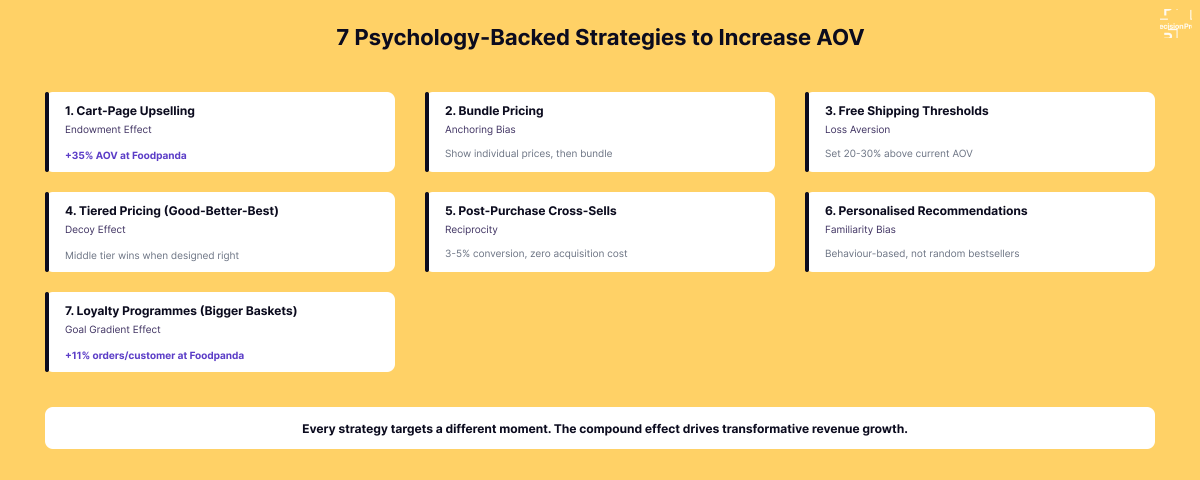
The 7 AOV strategies with their psychology principle and implementation priority.
How does intelligent cart-page upselling increase average order value?
Once someone adds items to their cart, they have psychologically committed. Their guard is down. They are in buying mode. This is the Endowment Effect at work, and it is the highest-leverage moment to suggest complementary products. For a detailed breakdown of how to build this out, see our guide on cart page optimisation.
This was the centrepiece of our AOV work at a leading food delivery platform. We added a "Popular with your order" carousel on the cart page, using market basket analysis to identify products frequently bought together. Not random promotions. Data-driven suggestions: eggs and bread in the cart meant they would see milk and butter. Result: +35% AOV. The keys were timing (cart page, when ownership psychology is strongest), relevance (data-driven), and simplicity (one-tap add, no friction).
Add a recommendation module to your cart page. Use purchase data to identify complementary products. Label it "Frequently bought together" or "Complete your order." Single-click add, no page reload. Test placement above vs. below the order summary.
Why does bundle pricing with visible savings increase AOV?
Anchoring Bias means the first price a customer sees becomes the reference point for everything after. When you show individual item prices before the bundle price, the savings feel real because they are measured against a higher anchor.
A skincare brand selling a cleanser ($28), moisturiser ($35), and serum ($42) individually creates a natural anchor of $105. Offer the same three as a "Complete Routine Bundle" for $89, and the $16 savings feels concrete. Without the individual prices first, $89 is just a number, not a deal.
Create 2-3 bundles from your bestsellers. Always display individual prices alongside the bundle with savings explicitly stated ("Save $16"). Place offers on product pages, category pages, and the cart. Test "Build Your Own Bundle" options where customers pick 3-4 items from a curated selection at a discount.
How do free shipping thresholds drive customers to spend more?
Loss Aversion. People feel the pain of losing something roughly twice as intensely as the pleasure of gaining it, according to Daniel Kahneman and Amos Tversky's foundational research on prospect theory. Paying for shipping feels like a loss. Earning free shipping by spending a bit more feels like a gain. When a customer is $12 away from the threshold, the mental calculation is not "Should I spend $12 more?" It is "Should I lose $7.99 on shipping or get $12 more in products?"
The optimal threshold sits just above your current AOV. If your AOV is $45, set free shipping at $55-$60. Close enough to feel achievable, far enough to drive incremental spend. Too high and customers ignore it entirely. These pricing framing principles extend well beyond shipping. The psychology of pricing guide covers anchoring, charm pricing, the Decoy Effect, and loss framing across the full product and checkout experience.
Set the threshold 20-30% above your current AOV. Add a dynamic progress bar to the cart ("You are $12.50 away from free shipping!"). Suggest specific products that would push them over the edge. This single tactic consistently lifts AOV by 10-15%.
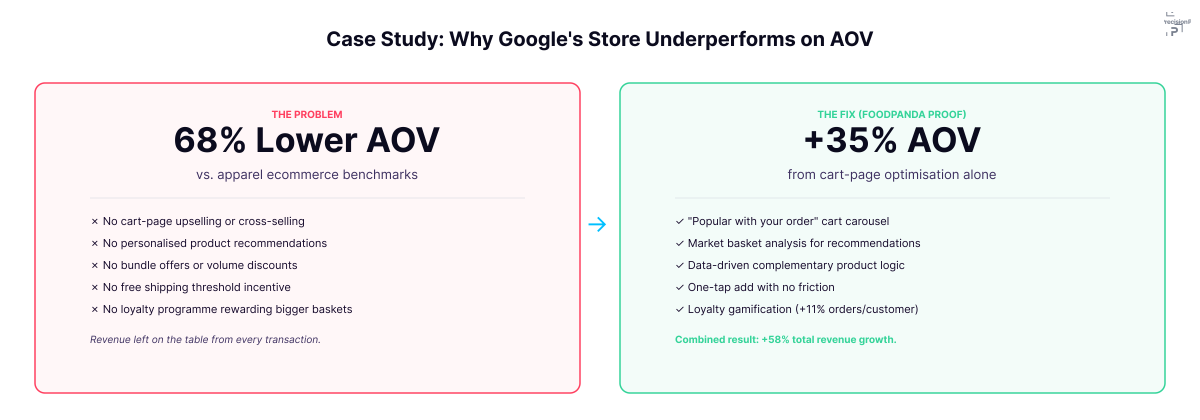
Google Merchandise Store AOV diagnosis: 68% below apparel benchmarks, with the gaps and fixes.
How does tiered pricing push customers toward higher-value options?
The Decoy Effect. When people see three options, they gravitate toward the middle one, especially when the lowest feels insufficient, and the highest feels excessive. Classic example: small coffee $3, medium $5, large $5.50. Almost nobody buys the small. Almost nobody buys the large. The medium wins because it is "the reasonable choice." Your medium should be the option you want most customers to buy.
Structure products as three tiers. Price the bottom high enough that it feels like poor value per unit. Price the top slightly above the middle so it draws attention but makes the middle feel sensible. Label the middle "Most Popular" or "Best Value." Works for subscriptions, product sizes, service packages, and physical bundles.
Why are post-purchase cross-sells a high-converting AOV tactic?
Post-purchase cross-sells convert at significantly higher rates than pre-purchase upsells because the buyer is at peak commitment with no decision friction left. Right after a purchase, the customer feels good. They have made a decision, they are pleased with themselves, and if you have followed the Peak-End Rule, they are in a positive emotional state. This is reciprocity territory. Offer a complementary product at a small discount as a "thank you," and the conversion rate is surprisingly high.
Post-purchase offers appear on the confirmation page or in the confirmation email. The transaction is already complete, so there is no risk of cart abandonment. Typical post-purchase cross-sells convert at 3-5%, according to e-commerce benchmarks from platforms including Shopify and Bold Commerce. That is pure incremental revenue at zero acquisition cost.
Add a one-click cross-sell to your confirmation page. Offer a genuinely complementary product at 10-15% off, available only for 30 minutes. Frame it as "A thank-you from us" rather than another pitch. One recommendation, not a catalogue.
Why do personalised product recommendations increase average order value?
Familiarity Bias. People prefer things they recognise. When a returning customer sees products related to their browsing history or past purchases, those products feel familiar and trustworthy, even if the customer has not seen them before. The recommendation engine creates artificial familiarity.
Generic "You might also like" modules showing random bestsellers are a missed opportunity. They treat every customer the same. Personalised recommendations based on actual behavioural data perform significantly better because they make customers feel like the store understands them.
At a minimum, implement "Recently Viewed" and "Based on Your History" modules on your homepage and product pages. For returning customers, recommend replenishment products ("Time to restock?") or complementary items. Even basic segmentation (new vs. returning) dramatically improves relevance.
How do loyalty programmes increase average order value?
The Goal Gradient Effect. People spend more when they can see how close they are to the next reward. The key is making progress visible and the next reward achievable.
At a food delivery platform, we designed a gamification system with branded badges and tiered rewards, built to offset a delivery fee increase by giving customers a reason to keep ordering. Clear progress toward the next badge, rewards attainable within 2-3 orders. Result: +11% orders per customer.
Design a points system in which higher-value purchases earn disproportionately more points. Show a progress bar at every touchpoint. Make the first reward easy (within 1-2 orders) so customers feel the Goal Gradient early. Crucially, reward basket size, not just order frequency.
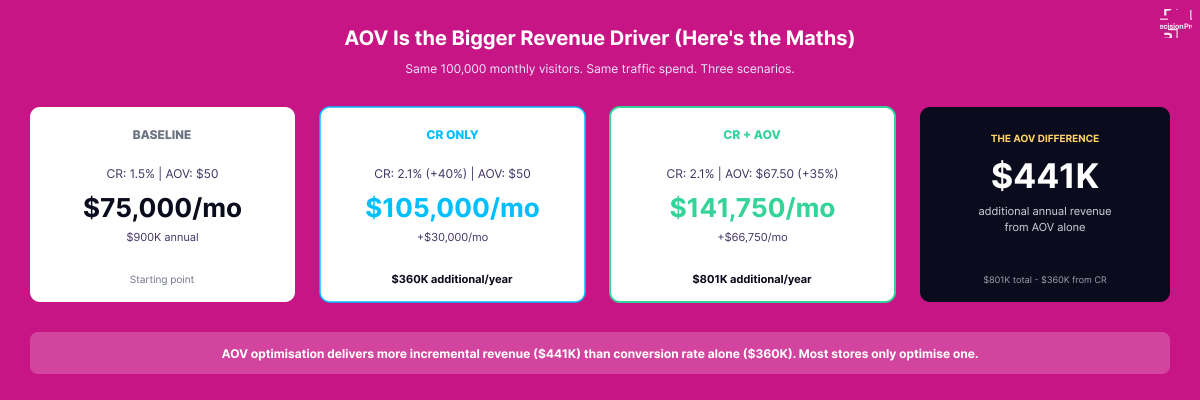
How AOV compounds with conversion rate: $75K baseline to $141.75K/month. AOV is the bigger revenue driver.
This is the kind of analysis we run in a Precision Deep Dive Audit. If you want to see exactly where your store is leaking revenue, request your free audit and we will walk through it together.
Why does AOV have a bigger revenue impact than conversion rate?
AOV has a bigger revenue impact than conversion rate for most e-commerce stores because lifting AOV is usually cheaper, faster, and compounds with every visitor you already convert. Here is the calculation most businesses never do.
100,000 monthly visitors, 1.5% conversion, $50 AOV = $75,000/month.
A 40% improvement in conversion adds $30,000/month.
But add a 35% AOV lift on top, and you are at $141,750/month.
That is an additional $66,750 every month from the same traffic. $801,000 in additional annual revenue.
The CR improvement contributed $360,000. The AOV improvement contributed $441,000. AOV is actually the bigger revenue driver, yet almost nobody prioritises it.
This is why AOV optimisation is central to everything we do at Precision. Revenue has two variables: how many people buy and how much they spend. Optimising only one is leaving money on the table.
Want to find the AOV opportunities hiding in your store? See how Precision works with e-commerce brands, or book a strategy session for a psychology-driven audit of your revenue per customer.
Key Takeaways
- AOV is the most overlooked lever in e-commerce. Most businesses focus exclusively on conversion rate and ignore how much each buyer spends.
- 7 highest-impact strategies: cart upselling, bundle pricing, free shipping thresholds, tiered pricing, post-purchase cross-sells, personalised recommendations, and loyalty programmes.
- Each strategy is grounded in psychology: the Endowment Effect, Anchoring, Loss Aversion, the Decoy Effect, Reciprocity, Familiarity Bias, and the Goal Gradient.
- Real results: +35% AOV from cart upselling, +11% orders/customer from loyalty, contributing to +58% total revenue.
- AOV improvements compound with CR improvements. On a $75K baseline, the combined impact is $801K in additional annual revenue.
Frequently Asked Questions
What is a good AOV for e-commerce?
Varies by industry. Apparel averages $90-120, electronics $150-200, beauty $50-70, food delivery $25-40. More important than hitting a benchmark is whether you are actively optimising. If you have not implemented any AOV strategies, your current number is almost certainly below potential.
Which strategy should I implement first?
Free shipping thresholds. Minimal technical effort, works across every category. Set the threshold 20-30% above your AOV, add a progress bar, and measure for two weeks. Cart upselling is the highest-impact overall but needs more implementation work.
How do I increase AOV without annoying customers?
Relevance and timing. Recommendations that are genuinely useful add value. Irrelevant upsells, aggressive pop-ups, and forced add-ons destroy trust. Every suggestion should pass one test: would the customer thank you for it?
Can AOV optimisation hurt conversion rate?
Poorly executed, yes. Aggressive checkout pop-ups create friction. But well-designed AOV tactics, such as cart recommendations and free-shipping thresholds, typically improve both metrics. The results prove this: +35% AOV alongside +40% conversion.
