Last updated:
Product bundling psychology explains why presenting products together increases what buyers spend, without requiring a price reduction. The mechanism is not about discounts. It is about the number of decisions the buyer has to make.
Most stores that bundle do it wrong in the same way. They attach a saving. Buy two, get 20% off. The saving drives the bundle take-up, but it also teaches buyers that bundles are a discount mechanism, not a value proposition. Take the discount away, and the bundle stops performing. What I consistently see at Precision is stores that have trained their customers to wait rather than spend.
A well-structured bundle at full price can outperform a discounted one on both conversion rate and margin. The question is how to build one.
This guide explains the psychology of why bundles work, how to structure one that does not need a discount, where to place it in the buying journey, and the two formats that consistently outperform discounted bundles in my work with growth-stage e-commerce brands.
Why bundles increase AOV without a price reduction
Bundles increase AOV by collapsing multiple buying decisions into one and reducing the psychological cost of each individual purchase. They do not need to make items cheaper. The grouping changes how buyers process value, not what each item costs.
Every time a buyer has to evaluate whether to add something, there is a real chance they will say no. The friction is not irrational. The brain treats each payment as a small loss, even when the purchase is wanted. Three separate items mean three separate loss moments. A bundle means one. That is the mechanism. Not the discount.
You are asking your buyer to make three decisions instead of one
Think about the last time you were choosing between three items on a menu, each with its own description and price. By the time you had read all three, you were more tired than when you started. That is not a food preference problem. That is the brain registering the cost at each item and accumulating the discomfort of spending.
The same thing happens in your store. When products are bought individually, each purchase triggers its own evaluation. The buyer considers whether the serum is worth €28. Then, whether the moisturiser is worth €32. Then, whether the eye cream is worth €24. Three separate questions, each carrying its own friction.
When those same products are bundled, the buyer evaluates the total as a whole. The individual prices become less visible. The question changes from "is each of these worth it?" to "is this skincare kit worth €74?" One question instead of three. Dan Ariely's work in Predictably Irrational documents this effect: the brain registers each payment as a small loss even when the purchase is wanted, and bundling converts multiple loss events into one.
Your buyer does not want to do the research you are making them do
Someone building a skincare routine for the first time does not know which products work together. Someone assembling a photography starter kit does not know which accessories are compatible. Someone setting up a home office is not excited about cross-referencing desk heights with monitor arm specifications. They are trying to solve a problem, not become an expert in your product range.
A bundle that presents a complete, credible solution removes that research burden entirely. The buyer is not comparing SKUs. They are being handed an answer. That answer has genuine monetary value because the alternative is time and effort they would rather not spend.
What I consistently see is that well-curated bundles at full price outperform individually priced items when the buyer is new to the category. Not sometimes. Consistently. The bundle is not selling more products. It is selling the absence of a decision they did not want to make.
How a bundle is presented matters as much as what is in it. The Price Presentation Playbook in our kit of 9 PDFs shows how to anchor one honestly: what the parts cost bought apart, then the saving spelled out. Get the kit on Etsy.
How to structure a bundle that does not need a discount
A bundle works at full price when it is named after the outcome it creates, anchored to a product the buyer was already considering, and presented next to the individual item prices that act as a reference point. Most failed bundles miss one of these three. Each one is fixable in an afternoon, but you have to know which problem you are solving.
You named the bundle after what is in it instead of what it does
The most common bundling mistake I see is naming a bundle after its contents. "Moisturiser + Serum + Eye Cream Bundle" describes what is in the box. "The Complete Anti-Ageing Routine" names what the buyer gets out of it. Those are not the same thing, and the difference in conversion rate is not small.
From the buyer's position, they are not trying to acquire three products. They are trying to get a specific result. The bundle name that speaks to the result is doing the buyer's motivational work for them. The bundle name that lists contents makes the buyer do that work themselves.
The name should answer one question: what problem does this solve, or what state does the buyer move into? "The Beginner Photography Bundle", "The Morning Routine Kit", "The Home Office Setup". Each of these describes a destination. That is more compelling than a list of SKUs.
Your bundle is not built around something the buyer already wants
Think about how a good waiter upsells a side dish. They do not recommend a side when you have not yet ordered your main. They wait until you have decided what you want, and then they add to that decision. "That pairs really well with the roasted potatoes." The main course is the anchor. The side is the addition.
Every bundle works the same way. The anchor is the product the buyer was already considering. The other items are additions to a decision already being made. If the anchor is a product the buyer has no interest in, the bundle does not convert because the primary decision has not yet been made.
Build bundles around your highest-traffic, most-considered products. A buyer already considering a €45 item is receptive to a bundle that adds a €20 complement. That is a €20 question layered onto a decision already made, not a €65 decision being made fresh. The difference in friction is significant. For the wider set of levers that move basket value beyond bundling, the AOV optimisation guide covers post-purchase upsells, free shipping thresholds, and volume incentives in detail.
You are not showing the comparison that makes the bundle feel like value
If you want the bundle to feel like value without a formal discount, show what the items would cost individually. Moisturiser €28. Serum €32. Eye Cream €24. Bundle: €74. The buyer does the arithmetic. The individual total is €84. The bundle saves €10 without you having to discount anything.
The individual prices create a reference point against which the bundle price is evaluated. This is anchoring at work. The order in which you show numbers changes what buyers are willing to pay. The number they see first sets the frame for every number they see next. Show the individual prices first, always.
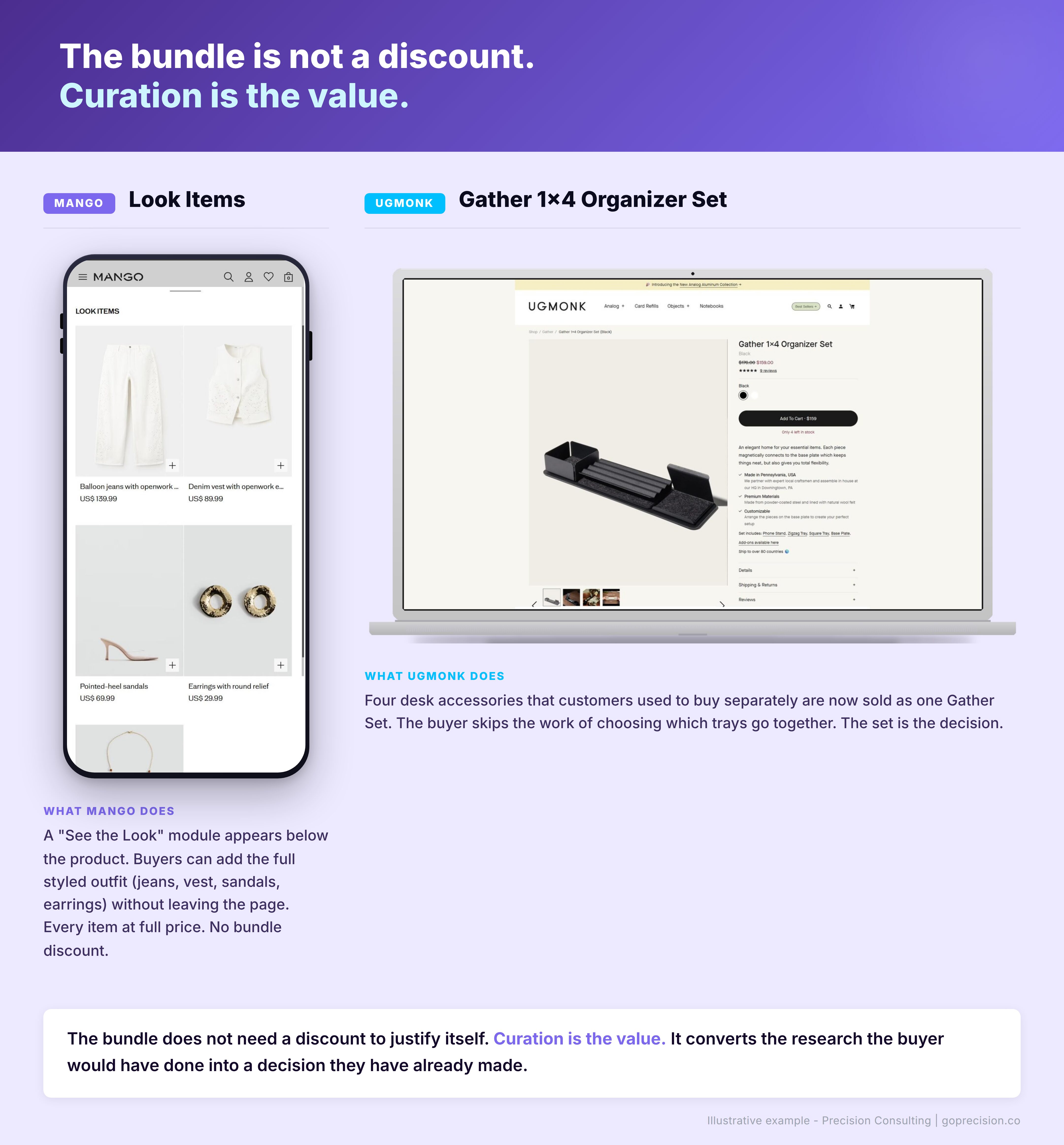
How to curate a value bundle: name, anchor, and price comparison are the three structural levers that make a full-price bundle feel like value.
Where in the buying journey to show bundles
Bundles convert in three places: below the Add to Cart button on the product page, as a single completion offer in the cart, and as a relevant complement on the order confirmation page after purchase. Placement determines who sees the bundle and what state of mind they are in when they see it. The wrong placement does not just fail to convert. It actively reduces conversion on the primary item.
I have seen stores place bundles above the Add to Cart button in an attempt to increase AOV, and watch their single-item conversion rate drop as a result. The bundle did not add revenue. It cost it.
You are showing the bundle above the Add to Cart button
A bundle presented above the Add to Cart button competes with the primary decision. The buyer who was about to add a single item now has to decide between the item and the bundle. Some will choose the bundle. A meaningful number will choose neither, because you introduced a choice at the exact moment momentum existed to take an action.
Place product page bundles in a "Complete the Set" or "Frequently Bought Together" section below the main product content. At that point, the buyer has already decided they want the anchor product. The bundle is now an addition to a decision already made, not a competitor to it. That is a fundamentally different psychological position, and it converts differently. The cart page optimisation guide covers how the same principle applies once the buyer reaches the basket stage.
Your cart page bundle is trying to replace the buyer's decision, not complete it
A buyer viewing their cart has made their decisions. They are in a review mindset, not a deciding mindset. Put yourself in that position: you have chosen what you want, you are checking the total, and the page suddenly presents you with an alternative configuration of products. That is not helpful. It is disorienting.
A bundle suggestion at the cart stage should be framed as completion rather than replacement. "You have the serum. Add the moisturiser that completes the routine for €22." Not "also consider this other product." The framing is: you are nearly there, here is what makes what you already chose more complete.
Keep cart page bundle suggestions to one. Multiple suggestions at this stage create choice paralysis in a place where you want the buyer to move forward to payment, not sideways through options.
You are not using the highest-converting placement on your store
The moment immediately after a purchase is confirmed is unlike any other point in the journey. The anxiety about the decision has resolved. The buyer is in a positive state about what they just did. The credit card is already out. An offer of a relevant complement at this moment is the least threatening and most likely to convert of any placement on the site.
Response rates of 5 to 15% on relevant post-purchase bundle offers are typical for stores that have set this up properly. The margin on these sales is among the best in the store because no acquisition cost was spent to generate them. Most stores have not built this. That is the gap.
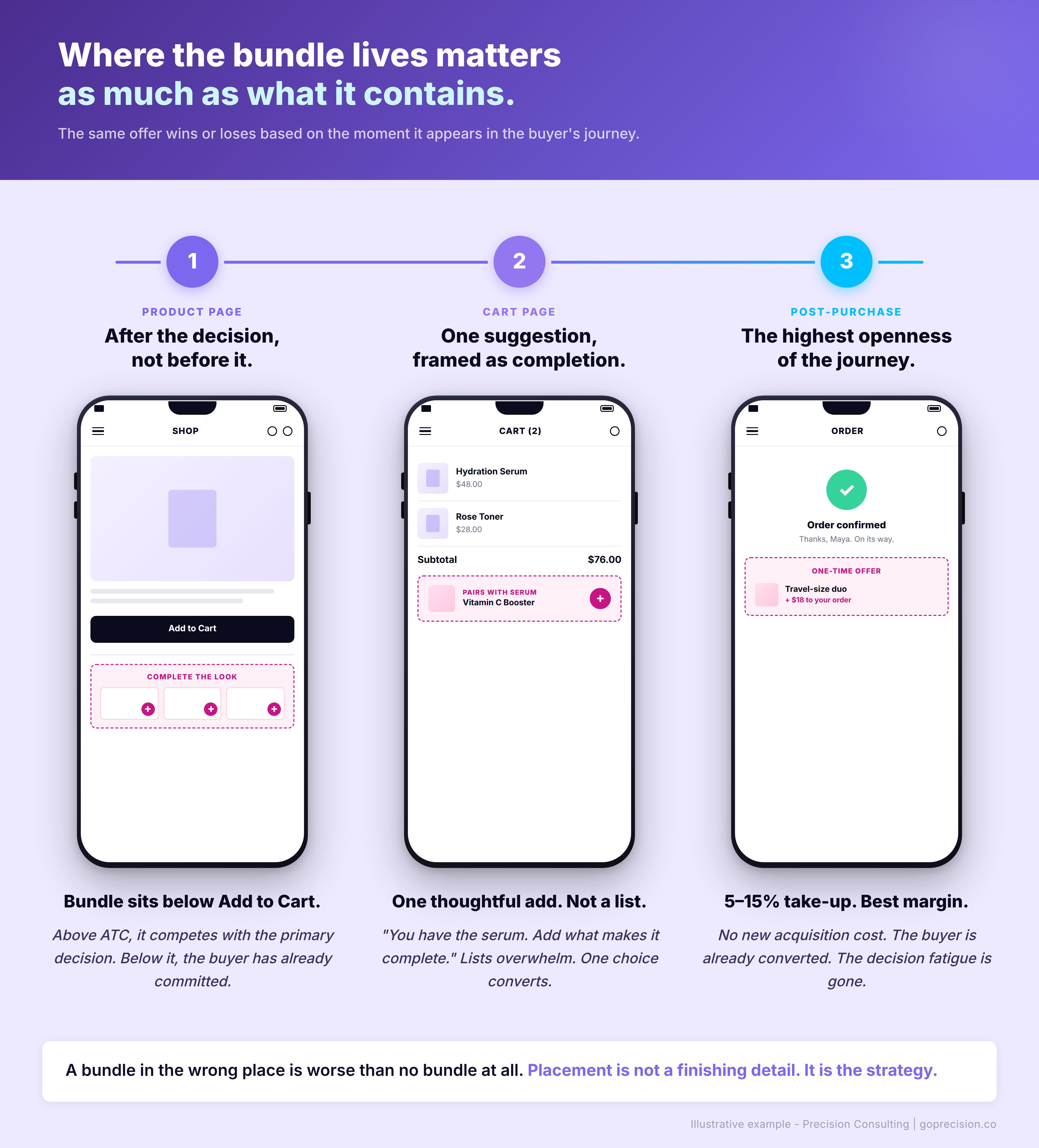
Where to place bundles in the customer journey: product page completion, cart-page completion, and post-purchase complement, with the buyer's mindset at each stage.
Which bundle formats work without discounting
The two bundle formats that work consistently at full price are curated sets and experience bundles. Both sell the value of someone else having done the work, not a saving. The buyer is paying for the curation itself: the absence of effort they would otherwise have to spend figuring out what goes together.
The curated set: sell your expertise, not your SKUs
A curated set bundles products that belong together by use case and presents them as a complete solution. "The Beginner Watercolour Kit", "The Capsule Skincare Routine", "The Home Desk Setup". The value is not the savings. The value is that someone else has done the compatibility research.
Think about why people pay for a personal stylist. Not for the discount. A stylist does not get you 20% off at Harrods. You pay for the stylist because they turn up already knowing what works, lay out a complete answer, and remove the decision entirely. That is the service. The absence of the work you would otherwise have to do yourself.
Your curated bundle can do exactly that. Before the buyer even realises they need guidance, you have already worked out what goes together and why. You present the complete answer. No extra charge. That is more useful than any discount you could offer, and it is worth more to the right buyer. Price your curated sets at the sum of the individual items. Stores that discount their curated sets are giving away the value that makes them work.
The experience bundle: sell the moment, not the contents
An experience bundle groups products around a moment or ritual rather than a category. "The Sunday Morning Routine", "The Book Club Hosting Kit", "The Weekend Away Bag". The framing is not about what the products are. It is about the context in which they will be used and how that context feels.
The buyer is not comparing specifications. They are imagining the situation. Someone buying The Weekend Away Bag is not evaluating a travel pillow, a sleep mask, and a lip balm. They are imagining the version of themselves who is prepared and comfortable on that flight. That imagining is more persuasive than any feature list, and it operates entirely independently of what the individual items cost.
This is the format I reach for first when working with lifestyle and gifting stores. The name does the heaviest lifting. Get the name right, and the products almost do not matter. Get it wrong, and you are back to a list of SKUs, which is what you were trying to escape. The psychology of e-commerce conversions guide covers the broader set of emotional and cognitive mechanisms that shape these decisions.
Where do you start with bundling in your store?
Start with one bundle, built around your single highest-traffic product, named after the outcome it creates rather than its contents, with the individual item prices shown as the anchor. Place it below the Add to Cart button on that product page. That is the lowest-effort, highest-confidence test you can run, and it will teach you more about how your buyers respond to bundling than any abstract framework.
Bundling is one lever in a wider set. The full guide on how to increase average order value walks through the others, with the situations where each one tends to work best.
Want help working out which bundle, where, and at what anchor would move the most revenue in your store? See how Precision works with e-commerce brands.
Dan Ariely's Predictably Irrational covers the pain of paying effect and anchoring in full, the two mechanisms that make bundles work without a price reduction. Robert Cialdini's Influence covers commitment and consistency, which explains why post-purchase bundle offers convert at materially higher rates than pre-purchase ones.
- Bundles do not need discounts to increase AOV. The grouping changes how buyers process value by collapsing multiple decisions into one and reducing the psychological cost of paying.
- Name bundles after the outcome they create, not their contents. "The Complete Morning Routine" outperforms any list of product names because it answers what the buyer gets, not what is in the box.
- Every bundle needs an anchor item that the buyer was already considering. Additional items are additions to that decision. A €20 question on top of a decision already made converts differently from a €65 decision made fresh.
- Show individual item prices before the bundle price. The reference point creates perceived savings through anchoring without requiring a formal discount.
- Product page bundles belong below the Add to Cart button. Above it, they compete with the primary decision and cost you conversions on a single item.
- Post-purchase bundle offers reach buyers at their highest psychological openness. 5 to 15% take-up is typical for relevant offers, with margin among the best in the store.
- One cart page bundle suggestion outperforms three. Choice at the cart stage creates hesitation where you need momentum toward payment.
Frequently asked questions
What is product bundling psychology?
Product bundling psychology refers to the cognitive mechanisms that explain why buyers spend more when products are grouped together than when presented individually. The two key mechanisms are the pain of paying effect, which reduces the psychological cost of multiple purchases by converting them into one, and decision fatigue reduction, which removes the effort of researching which products go together.
Do product bundles need to be discounted to increase AOV?
No. Bundles do not need a price reduction to increase average order value. Showing individual item prices alongside the bundle price creates perceived value through anchoring, and the grouping itself reduces decision friction and the psychological cost of purchasing. Well-structured full-price bundles can outperform discounted ones on both conversion rate and margin.
Where should product bundles be placed on an e-commerce site?
On product pages, bundles belong below the Add to Cart button to avoid competing with the primary purchase decision. Cart page bundle suggestions work as completion offers for buyers who have already committed. Post-purchase bundle offers on the thank-you page reach buyers at peak psychological openness and typically convert at 5 to 15% for relevant offers.
How do I name a product bundle?
Name the bundle after the outcome it creates or the problem it solves, not after its contents. "The Complete Anti-Ageing Routine" converts faster than "Moisturiser + Serum + Eye Cream Bundle" because it answers what the buyer gets rather than what is in the box.
What is an anchor item in product bundling?
The anchor item is the product the buyer was already considering purchasing. All other items in the bundle are additions to that existing decision, not new decisions the buyer has to make. A bundle converts best when the anchor is a high-traffic, frequently considered product, and the complementary items are naturally relevant and lower in individual price.
What response rate should I expect from a post-purchase bundle offer?
Relevant post-purchase bundle offers on the order confirmation page typically convert at 5 to 15% of orders. The rate depends heavily on how relevant the complementary offer is to what was just purchased and how the offer is framed. "This completes the routine you just started" outperforms a generic "You might also like" format.
