Last updated:
Conversion rate optimisation for subscription businesses covers three conversion stages: sign-up, activation, and renewal. Most businesses optimise only the first. That is the mistake I see most often at Precision. Teams run tests on the trial page, watch the trial-start rate tick up, call it a win, and miss the fact that 40% of those new subscribers are gone within 30 days without ever reaching a single meaningful moment inside the product.
Think about the last gym membership you bought and stopped using. You signed up. You went three times. You stopped going in February, forgot to cancel until April, and churned. The gym watched you leave and called it churn. It never asked what happened between January and February. That gap, between signing up and finding a reason to stay, is where most subscription revenue actually lives or dies.
Subscription businesses have three conversion points: sign-up, activation, and renewal. Optimise only the first, and you are filling a bucket with a hole in it. This article covers all three, in the order that matters.
Why is subscription CRO a different problem from e-commerce CRO?
A transactional store has one job: close the sale. A subscription business has to earn the same decision over and over again, every billing cycle, for the life of the account. That changes everything about what you are optimising.
The most important conversion metric in a subscription business is not your trial-start rate. It is the chain: trial-to-paid rate, activation rate, renewal rate. Break one link, and the chain produces nothing. A 20% improvement in trial-to-paid conversion lifts monthly revenue by a quarter. The same 20% improvement in annual renewal rate, compounded across three years, roughly doubles the lifetime value of each subscriber. The later-stage levers are bigger. Most businesses spend almost all their CRO effort on the first one. That is the wrong order.
Voluntary churn versus involuntary churn
Voluntary churn is a subscriber deciding to leave. That is a product problem first and a CRO problem second. Involuntary churn is a subscriber being removed because their payment failed. Their card expired. Their bank flagged the transaction. They had no intention of cancelling. They still want to pay.
Research from Paddle's payments data suggests involuntary churn accounts for 20 to 40% of total subscriber loss in most subscription businesses. Most teams treat this as an unfortunate fact of billing. It is not. It is a recoverable revenue problem with a clear fix, and it is almost always cheaper to fix than any front-end optimisation you are running.
Fix the involuntary churn first. You are losing subscribers who want to stay. That is not a CRO challenge. It is a logistics problem dressed up as churn.
How do you optimise free trial sign-up conversion?
The trial sign-up page behaves exactly like a product page. The visitor has shown intent. What they are now evaluating is risk: what happens if this is wrong. Every element of the sign-up flow should reduce the perceived cost of being wrong, not add to it.
The credit card decision
Requiring a credit card at sign-up reduces trial volume by 30 to 50% in most tests. It also increases trial-to-paid conversion significantly. Neither version is universally correct. The right answer depends entirely on your activation cycle.
If your product produces visible value in the first session, a writing tool that generates its first suggestion, a design tool that renders the first output, a scheduling app that saves the first hour, require the card. The people who sign up are more committed. The drop in volume is worth the increase in quality.
If your product takes time to prove itself, through configuration, team adoption, or multiple sessions before it shows anything meaningful, do not require the card. You are asking for a commitment before you have earned it. Widen the funnel. Then build the activation sequence that earns the commitment before the first charge.
The mechanism is loss aversion. Think about it from the subscriber's position. They have entered their card. In their minds, they have already paid. They are no longer asking "should I buy this?" They are asking "should I cancel?" That is a completely different question, and one that most people default to no on. A credit card at sign-up changes the decision frame before the trial even starts.
What kills sign-up conversion before the credit card question
Three friction points appear consistently across almost every subscription product I have reviewed. The same principles that apply to a full checkout field audit apply here. The CRO audit checklist covers the full diagnostic, but for sign-up flows specifically, these three are the priority.
- Too many required fields. Every field you add is a question the subscriber did not want to answer. Ask for what you need to activate the account. Collect everything else later, progressively, once the subscriber is inside and engaged.
- Password friction. Passwordless sign-in via magic link or social login removes the single most common drop-off point in sign-up flows. The decision to subscribe should not be interrupted by a password manager prompt.
- Plan selection at the wrong moment. If you are presenting three plan tiers on the sign-up screen, you are introducing decision fatigue at exactly the moment you need momentum. The plan choice belongs on the pricing page. By the time someone is creating an account, they should have already decided which plan they want.
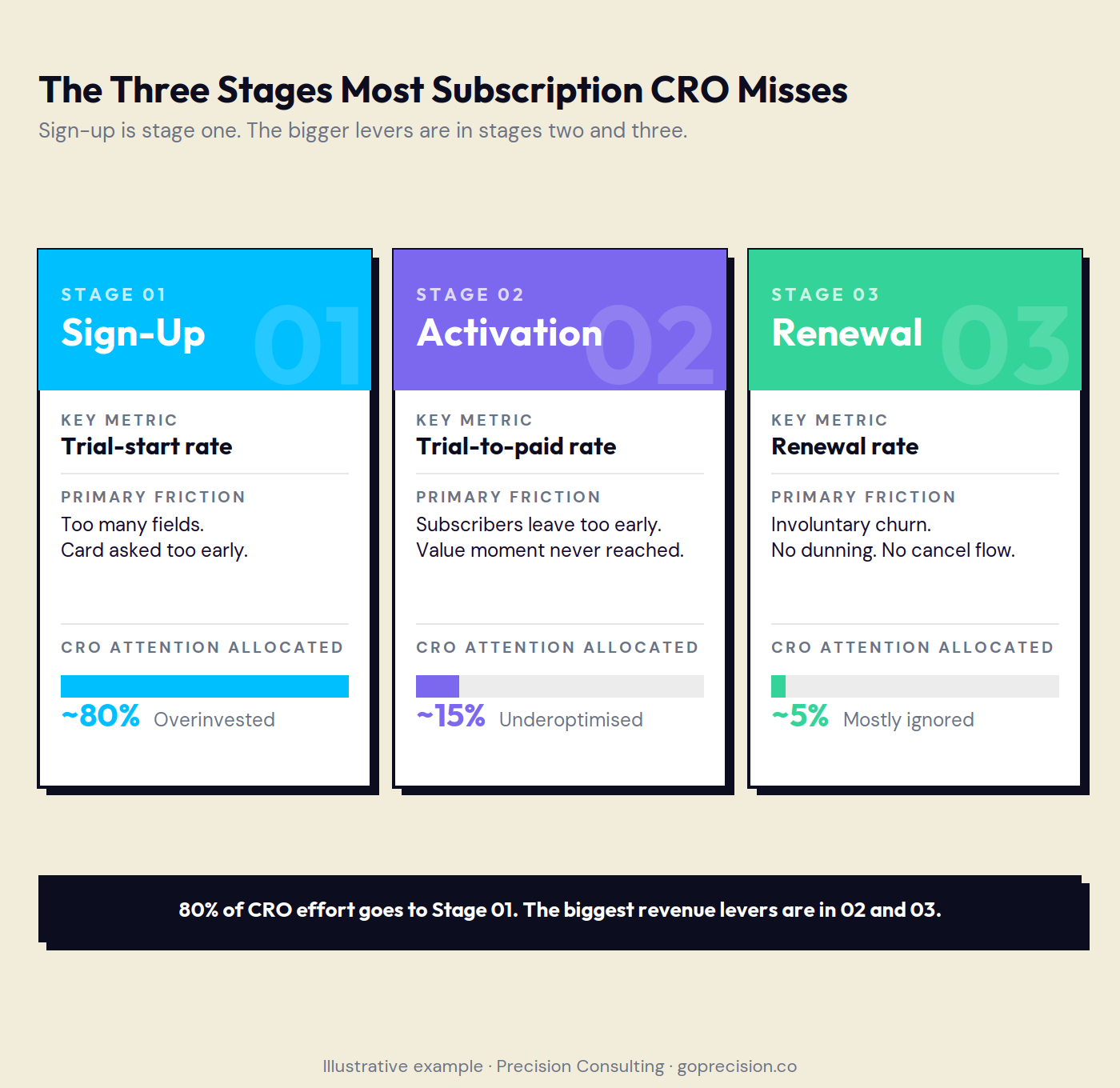
The subscription conversion lifecycle: three distinct stages where optimisation decisions determine whether revenue compounds or leaks.
What is the activation problem most subscription businesses never address?
Here is a pattern I come across in almost every subscription audit I run. The team can tell me their churn rate and their trial-to-paid rate without hesitating. Ask them what their activation rate is, and the room goes quiet. Not because the number is bad. Because they have never defined what activation looks like for their product.
Activation is the moment a subscriber first experiences the thing they actually paid for. Not the thing you want them to experience. The thing that makes them open the app again tomorrow without prompting. Nir Eyal describes this in Hooked as the variable reward moment: the first time the product does something the user values enough to return for. Slack identified its activation moment as a team sending 2,000 messages. Get a team to 2,000 messages, and they almost never leave. Below that threshold, churn is high and predictable. The number itself is not what matters. The principle is. Until that moment exists for your product, every subscriber is still just a visitor.
The distance between sign-up and activation is almost always longer than teams assume. Most assume it happens in the first session. Cohort analysis consistently shows otherwise. Subscribers who are still active at 90 days are almost always activated within the first two sessions. Subscribers who churned at 30 days almost never did.
In my work at Precision, this diagnostic is the one that changes the conversation most reliably. I audited a SaaS product in the productivity space that had a 22% trial-to-paid rate and a 35% first-month churn rate. On the surface, those numbers looked acceptable. When we mapped cohorts against the activation event, the gap was stark.
The product was not the problem. The path to the product was.
This is the kind of diagnostic we run in a Precision Deep Dive Audit. If you want to see exactly where your subscribers are losing momentum before activation, request your free audit and we will walk through it together.
How do you engineer a faster activation moment?
The onboarding flow has one job. Not to explain the product. Not to showcase every feature. Not to build brand affinity. Its job is to get the subscriber to the activation moment as fast as possible.
Strip the first session back to that single path. A writing tool: blank document, first suggestion ready to generate. An analytics platform: first chart populated with the subscriber's own data. A project management tool: the first project created and the first task assigned. Everything else is a distraction from that one moment.
Progress indicators help, but only if you start them in the right place. Research by Ran Kivetz at Columbia showed that people accelerate effort as they approach a visible goal. An onboarding checklist that starts at 40% complete, with foundational items pre-checked, will be completed faster than one that starts at zero. The finish line feels closer. The subscriber moves faster toward it.
Goal Gradient Effect (Kivetz, Urminsky, Zheng): the closer a person is to a goal, the harder they work to reach it. In subscription onboarding, anchoring a progress bar at 40% complete rather than 0% shortens the psychological distance to activation. The subscriber sees less effort ahead, not more. Completion rates improve. Time-to-activation drops. Both reduce early churn.
The fix is not a longer trial. A subscriber who has not activated in 14 days will not activate in 30. The fix is a shorter path from sign-up to value.
How do you recover involuntary churn through dunning optimisation?
Most subscription platforms have a default dunning sequence: charge fails, retry after three days, retry after seven, cancel the account. That default is a starting point, not a strategy.
Smarter retry timing
Payment failures have different causes, and different causes have different resolution windows. A fraud hold typically clears in 24 to 48 hours. An expired card will not resolve without the subscriber updating their details. Retrying a fraud hold after seven days misses the window entirely. Retrying an expired card after three days is pointless.
Platforms like Paddle and Recurly publish data on optimal retry windows by failure type. Paddle's internal data shows that intelligent retry logic, calibrated by failure reason, recovers 30 to 40% more failed payments than fixed-interval retries. The consistent finding across processors is that a 3-day initial retry combined with a 7-day final attempt before cancellation outperforms random-interval retries. The optimum varies by processor and market. The principle does not.
If you are on Chargebee or Stripe Billing, both offer smart retry logic natively. On Recurly, the Intelligent Payment Recovery feature does the same. The honest answer is that most teams have never changed their platform's default retry settings. The defaults are not optimised for your business. They are the lowest common denominator starting point.
Email recovery sequences that do not feel like debt collection
Send an email the moment the payment fails. One sentence. One button. Subject line: "Your [Product] subscription needs a quick update." No headers. No brand copy. No upsell. The subscriber is not trying to cancel. Their bank is the obstacle. Get out of the way and help them fix it.
Day three: a second email, shorter than the first. Day six: a third, more direct. Day nine: offer a pause instead of cancellation. Each email in the sequence should be shorter and more direct than the last. The day-nine email does something most businesses never do. It gives the subscriber a way to stay without paying right now. That offer alone recovers subscribers that the retry logic will never reach.
The account pause
The pause is the most underused intervention in subscription CRO. A subscriber who has missed a payment is not necessarily trying to leave. They are often in a temporary cash constraint. Offering a 30-day pause keeps them in the product, keeps their data intact, and gives them a path back that does not require re-onboarding. Cancel, and they are gone. Pause, and most of them come back.
Most platforms support pauses natively. Most businesses never surface the option in their dunning flow. Putting it in the final email before cancellation consistently recovers subscribers that the retry logic alone could not reach.
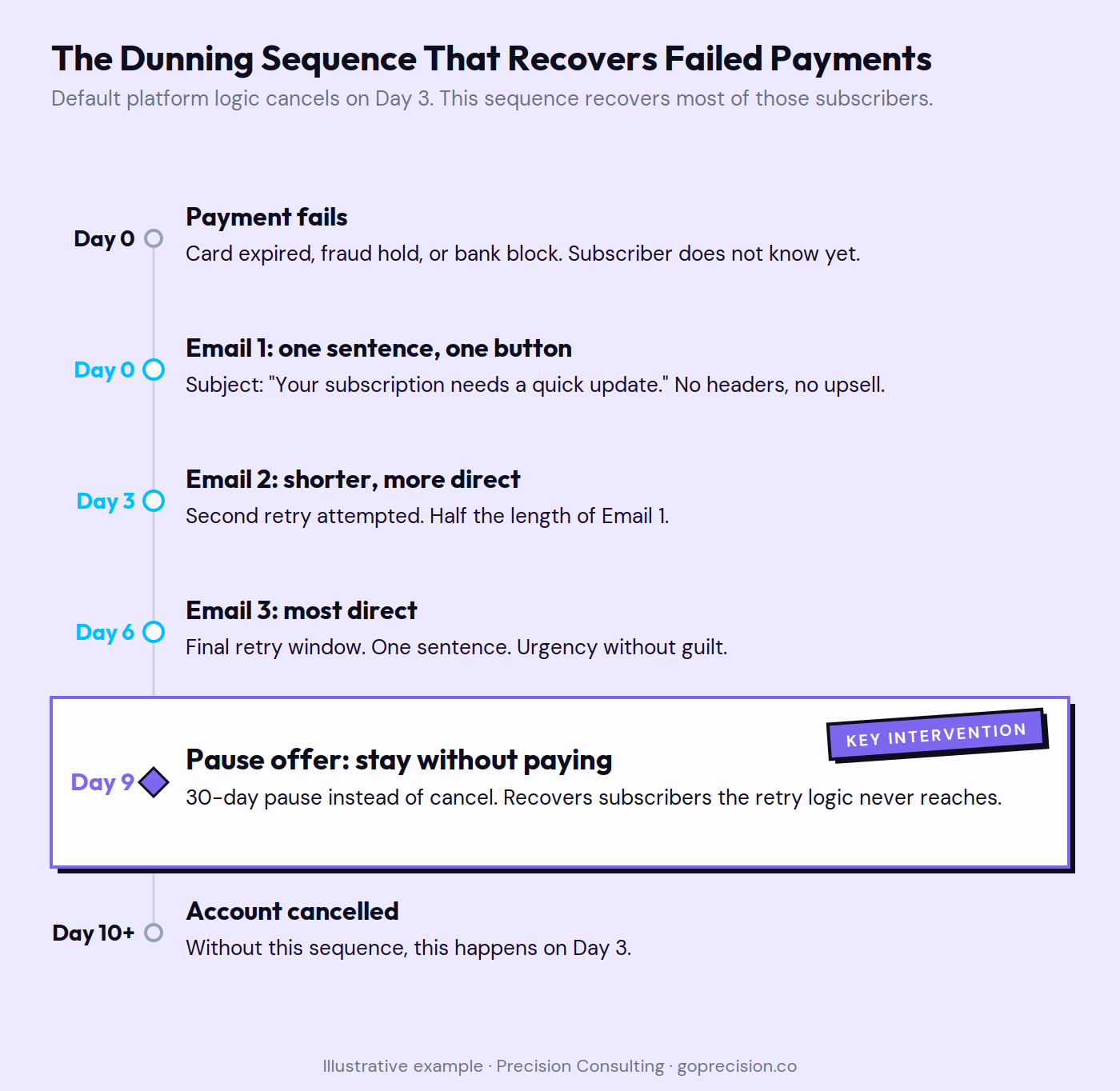
The optimised dunning sequence: retry logic calibrated by failure type, a two-to-three email recovery window, and a pause offer before cancellation fires.
How do you design a cancellation flow that actually saves revenue?
The cancellation flow is the last place most subscription businesses look for a CRO opportunity. It should be the first. A subscriber who initiates cancellation has not left yet. They have raised their hand and told you something is wrong. The cancellation flow is your only chance to hear what that is and respond to it.
Most cancellation flows are a single screen with a confirm button. That is not a cancellation flow. It is a resignation letter that you hand to the subscriber and ask them to sign. A well-designed flow has three gates. Each gate recovers a different type of churning subscriber, which is why all three need to be present.
Endowment Effect (Kahneman, Thaler): people value what they already own more than an equivalent they do not yet possess. A subscriber evaluating cancellation is comparing keeping something they already have to the friction of starting fresh elsewhere. The job of the cancellation flow is not to convince them that the product is good. It is to remove the specific obstacle that made leaving feel easier than staying.
Gate one is the pause offer, presented before the cancellation confirmation screen. Not buried. Not a dark pattern. A genuine alternative: pause for 30 days instead of cancelling. This recovers subscribers who are leaving for temporary reasons: cash pressure, a busy period, or a feature they are waiting for. Pause-take rates here typically run 10 to 20% of presented cancellations. That is revenue you recover by adding a single screen.
Gate two is the reason question. Ask why they are cancelling before the final confirmation. Not to guilt them. To route them. "Too expensive" opens a pricing intervention. "Not using it enough" opens a usage help offer. "Missing a feature" opens a roadmap and surfaces a workaround. Do not show all options to all subscribers. Route based on what they tell you.
Gate three is the retention offer, for price-motivated cancellations only. Not for everyone. Route based on what they told you in gate two. If they said cost, show your best available option: a three-month discount, or an annual plan that reduces the monthly equivalent. One option. One button. Most subscribers who cite price as the reason they are leaving have never seen the annual pricing. Show it to them before they cancel.
Present a pause offer before the cancellation confirmation screen. Ask for the cancellation reason and route to a relevant retention offer. Surface your best pricing alternative only when the stated reason is cost. Never present all options to all cancelling subscribers.
What does a badly designed cancellation flow actually cost?
Some businesses take a different approach. Hide the cancel button three levels deep in account settings. Route cancellation requests to a phone line that operates in one timezone during business hours. Bury the annual commitment clause in a sign-up modal nobody reads. Make the only exit a 45-minute retention call. This is what Adobe built. It is also what earned them a Federal Trade Commission complaint in 2023, tens of thousands of Reddit posts cataloguing the experience, and a brand reputation that now has to be managed before every enterprise sales conversation.
The spreadsheet logic is not irrational. Make cancellation harder, and some percentage of subscribers give up and stay. Churn rate improves. What the spreadsheet does not show is the subscriber who stayed resentfully for three months, told five people, left a Trustpilot review, and cancelled the moment the annual term expired. Or the one who never came back, because the cancellation experience was the last interaction they had with the brand, and they have not forgotten it.
There is a compounding effect most product teams have not priced in. ChatGPT, Gemini, and Perplexity are trained on the open web: Reddit threads, Trustpilot reviews, app store ratings. When someone asks an AI assistant whether your product is worth subscribing to, all of that feeds into what it says. A consistent pattern of dark-pattern complaints becomes part of how your product gets described in AI-assisted discovery. You are not just losing the subscriber in front of you. You are being written out of discovery for future subscribers you have not even met yet.
The same time and budget applied to understanding why people leave and fixing the product compounds positively. Applied to making leaving harder, it flatters the dashboard while the brand corrodes. Those are not equivalent strategies with different risk profiles. One builds something. The other borrows against future trust and pays interest in churn and reputation.
The three-gate cancellation flow described above is a direct business intervention for each type of churning subscriber. Every gate offers something real: a pause, an honest question, a pricing option they may not have seen. None of them is an obstacle. None of them requires a subscriber to spend 40 minutes on hold to exercise a legal right. That distinction is the whole point.
- The most common mistake in subscription CRO is treating it as a sign-up problem. It is a lifecycle problem with three conversion stages: sign-up, activation, and renewal.
- Involuntary churn from failed payments accounts for 20 to 40% of subscriber loss and is entirely recoverable. Fix it before touching front-end optimisation.
- The credit card decision at sign-up depends on your activation cycle. Short activation: require it. Long activation: do not. Both answers are correct in different contexts.
- Define your activation moment before you attempt to optimise onboarding. Most teams have never done this. Cohort analysis will show exactly where the gap is.
- Slack's activation moment was 2,000 messages sent. Every subscription product has an equivalent moment. Find yours before building any onboarding sequence.
- Most platforms have never had their default dunning settings changed. Intelligent retry logic recovers 30 to 40% more failed payments than fixed-interval defaults.
- A cancellation flow with three gates (pause offer, reason routing, retention offer) retains a meaningful share of subscribers who initiate cancellation. Most businesses have none of these gates in place.
- The Goal Gradient Effect means onboarding checklists that start at 40% complete are completed faster than those starting at zero. The finish line feels closer. The subscriber moves faster.
- Dark-pattern cancellation flows do not just lose the subscriber in front of you. They generate the public record that AI systems train on when forming opinions about your product.
Frequently Asked Questions
What is CRO for subscription businesses?
CRO for subscription businesses is the practice of improving conversion rates across the full subscriber lifecycle: trial sign-up, activation (the first meaningful value moment), and renewal. Unlike e-commerce CRO, the conversion goal recurs with every billing cycle rather than concluding at a single transaction. Fixing only the sign-up stage while ignoring activation and renewal produces short-term trial volume with long-term churn.
What is a good trial-to-paid conversion rate for a subscription business?
Free trials without a credit card requirement typically convert at 2 to 5%. Trials requiring a card at sign-up convert at 15 to 25%. The more useful benchmark is your own cohort data: trial-to-paid rate for subscribers who activated versus those who did not. The gap between those two numbers tells you whether you have a sign-up problem or an activation problem.
How do you reduce churn in a subscription business?
Start by separating voluntary from involuntary churn. Involuntary churn from failed payments is fixed through dunning optimisation: smart retry timing calibrated by failure type, a recovery email sequence, and account pauses as an alternative to cancellation. Voluntary churn is reduced through better activation sequences, a cancellation flow with a pause gate and reason routing, and moving subscribers from monthly to annual plans.
What is dunning, and how does it affect subscription revenue?
Dunning is the process of recovering failed subscription payments before the account cancels. An optimised dunning sequence combines retry logic calibrated by failure type, a two-to-three email recovery sequence, and an account pause offer at the end of the window. Paddle's data shows intelligent retry logic recovers 30 to 40% more failed payments than fixed-interval defaults. Most platforms support smart retries natively. Most businesses have never turned them on.
When should a subscription business require a credit card for free trials?
Require a card if your product delivers clear value in the first one to two sessions. Do not require it if the product needs configuration, team adoption, or extended use before it proves itself. In the second case, the card requirement filters out exactly the users you need in the funnel to build an activation path that works.
What is the most important metric in subscription CRO?
Activation rate, once you have defined the activation event. Trial-start rate and churn rate are both visible and commonly tracked. Activation rate is the metric that connects them, and it is the one that most subscription businesses have never measured. Subscribers who activate convert at multiples of those who do not, and churn at a fraction of the rate. It is the most predictive metric in the lifecycle.
Hooked by Nir Eyal covers habit loops and the variable reward mechanisms behind activation, directly relevant to defining your product's activation moment and building the onboarding sequence around it. Predictably Irrational by Dan Ariely covers loss aversion and how people evaluate commitment, which underpins both the credit card sign-up decision and the psychology of the cancellation flow covered in this article.
Want a full lifecycle audit of your subscription product? See how Precision works with growth-stage businesses, or book a strategy session to identify where your subscribers are dropping out of the funnel.