Last updated:
Conversion Rate Optimisation (CRO) is the systematic process of increasing the percentage of website visitors who take a desired action. That is the textbook definition. Here is the one that actually matters:
CRO is how you make more money from the traffic you already have, without spending another dollar on ads.
If your store gets 100,000 monthly visitors and converts at a 1.5% rate, you have 1,500 customers. If CRO moves that to 2.1%, you have 2,100 from the same traffic. At an average order value of $50, that is an extra $30,000 per month. Add AOV optimisation on top, and it grows further.
These are not hypothetical. At a leading food delivery platform, a systematic CRO programme delivered +58% revenue, +40% conversion rate, and +35% AOV over six months. No increase in marketing spend.
This guide explains CRO from a commercial leader's perspective, not a marketer's. No jargon. No vanity metrics. Just what it is, how it works, what results look like, and when you are ready for it.
What is conversion rate optimisation, and what is it not?
CRO is a revenue strategy, not a marketing tactic. This distinction matters. It determines how you think about it, how you budget for it, and how you measure success.
Marketing brings traffic. CRO turns that traffic into revenue. They are complementary but fundamentally different. Most e-commerce businesses invest 80-90% of their growth budget in traffic acquisition (ads, SEO, influencer partnerships) and less than 10% in optimising what happens after the click, a spending imbalance documented consistently in Econsultancy's annual Conversion Rate Optimisation Report. The result is a leaky bucket: you keep pouring water in while the holes at the bottom get bigger.
CRO is not changing button colours. It is not redesigning your homepage because someone on the team thought it looked dated. It is not implementing whatever "best practice" a SaaS tool is selling this quarter. Those are tactics, not strategy. Real CRO is a data-driven process: find where your funnel leaks, figure out why, test solutions, scale what works.
Think of it this way: if your conversion rate is 1.5% and the industry average is 2.5-3% (as benchmarked in Contentsquare's annual Digital Experience Benchmark Report), there is a mathematical certainty that fixable problems exist on your site. CRO is the discipline of finding and fixing them. For a detailed breakdown of what a good e-commerce conversion rate actually looks like by category, the conversion rate benchmarks guide puts the numbers in context.
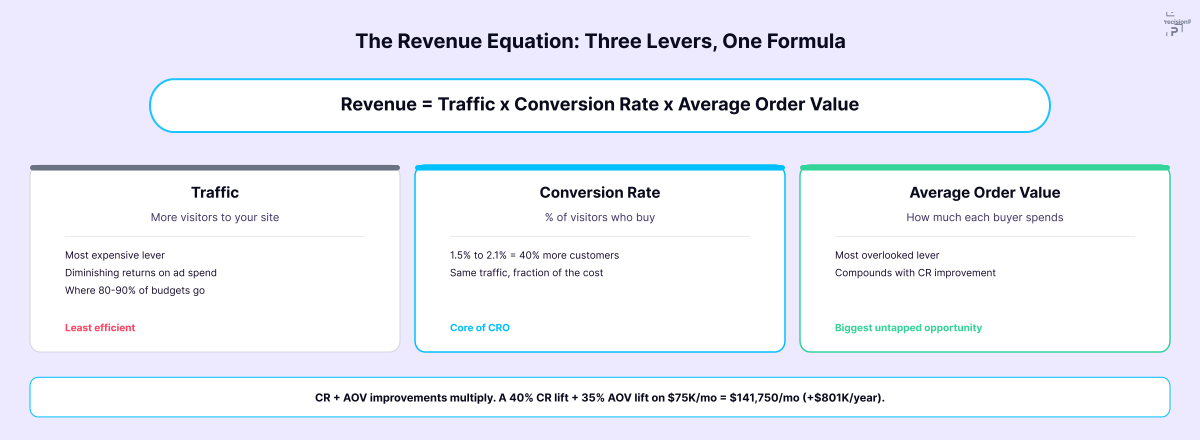
The revenue equation: Traffic x Conversion Rate x AOV. Why optimising all three levers compounds growth.
What are the three levers of e-commerce revenue?
The three levers of e-commerce revenue are traffic, conversion rate, and average order value. Revenue is the product of all three, but most businesses only optimise one of them. Usually traffic.
Revenue = Traffic x Conversion Rate x Average Order Value
Traffic is where 80-90% of budgets go. Getting more visitors to your site. It is the most expensive lever and has diminishing returns. Doubling your ad spend does not double your revenue.
Conversion rate is the percentage of visitors who make a purchase. Moving from 1.5% to 2.1% means 40% more customers from the same traffic. The cost of that improvement is a fraction of the equivalent increase in traffic.
Average order value is how much each customer spends. Cart upselling, bundle pricing, free shipping thresholds, loyalty programmes. All increase AOV without needing more traffic or a higher conversion rate.
Here is the thing most people miss: these levers multiply, not add.
A 40% conversion lift and a 35% AOV lift do not combine to 75%. They compound.
On a $75,000/month baseline, the combined impact is $66,750 extra per month.
That is $801,000 per year.
How does the CRO process actually work?
The CRO process works in four phases: a deep-dive audit, quick fixes, big-swing A/B tests, and fine tuning. It is a structured methodology, not a random list of tips you found on a blog. At Precision, we use a framework called the Conversion Accelerator, built from running programmes at major platforms across Asia and the Middle East, and with growth-stage partners.
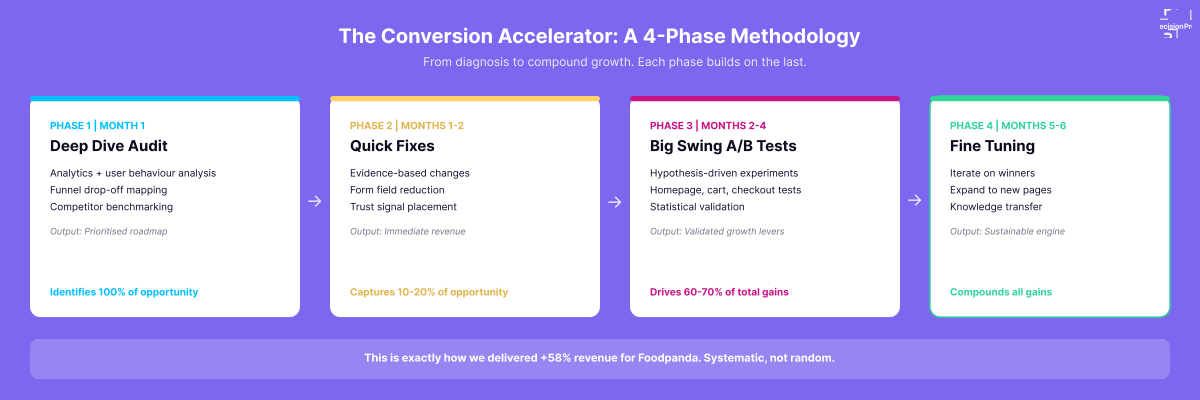
The Conversion Accelerator: 4-phase methodology from Deep Dive Audit through Fine Tuning.
Phase 1: Deep dive audit
Every engagement starts here. Not a surface-level review. We are talking funnel drop-off analysis, heatmaps, session recordings, checkout flow assessment, mobile vs. desktop gaps, competitor benchmarking, and customer feedback. The output is a prioritised roadmap ranked by estimated revenue impact and implementation effort. This is where 100% of the opportunity gets mapped.
Phase 2: Quick fixes
The audit almost always reveals low-hanging fruit. Changes that can go live immediately without A/B testing because the data is so clear that testing would be a waste of time. Removing unnecessary form fields. Adding trust signals next to the CTA. Fixing mobile usability issues. Quick fixes typically capture 10-20% of the total opportunity within the first 30 days.
Phase 3: Big swing A/B tests
This is where the significant gains happen. We design experiments that test specific hypotheses about user behaviour. Each one has a clear hypothesis, a success metric, and a rollback plan. For a step-by-step guide to running these properly yourself, the A/B testing guide for founders covers everything from hypothesis to statistical significance. Examples from our work:
- Redesigning homepage layout (+40% HP-to-PDP at a leading food delivery platform)
- Cart-page upselling with data-driven recommendations (+35% AOV)
- Loyalty gamification (+11% orders/customer)
- Newsletter redesign (+80% CTR)
This phase drives 60-70% of total gains.
Phase 4: Fine tuning
Once big swings are validated, the final phase compounds them. Iterating on winners, testing secondary variations, expanding patterns to other pages, and building internal playbooks so your team can keep optimising after the engagement ends. This is where +58% revenue becomes a sustainable engine rather than a one-time spike.
This is the kind of analysis we run in a Precision Deep Dive Audit. If you want to see exactly where your store is leaking revenue, request your free audit and we will walk through it together.
What kind of results can CRO realistically deliver?
What CRO realistically delivers depends on how far below potential a store currently is. A store at 0.8% with no trust signals and a 6-step checkout has far more upside than one already at 2.5% with a clean funnel. That is the honest answer to the most common question founders ask.
That said, here are real results from our work:
- +58% total revenue (leading food delivery platform, 6-month engagement)
- +40% conversion rate (homepage and product discovery)
- +35% Average Order Value (cart-page upselling)
- +11% orders per customer (loyalty gamification)
- +80% newsletter CTR (newsletter redesign)
- +90% search-to-PDP CTR (search optimisation at a major e-commerce marketplace)
- -20% customer churn (segmentation-based CRM at a regional e-commerce operator)
Common thread: systematic diagnosis, psychology-driven experimentation, rigorous measurement. Not random changes.
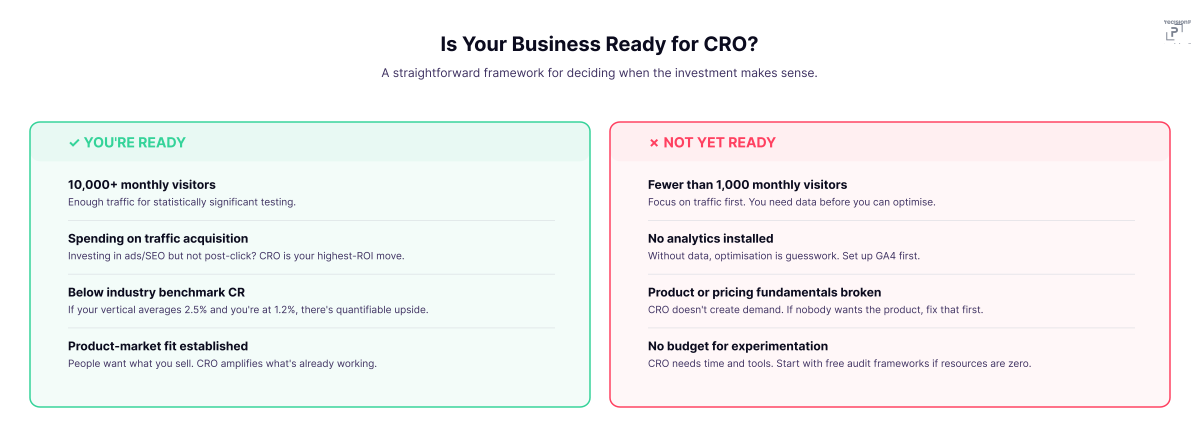
CRO Readiness Checklist: signals that you are ready vs. not ready for conversion optimisation.
When is your business actually ready for CRO?
Your business is ready for CRO when you have at least 10,000 monthly visitors, are spending on traffic acquisition, and have product-market fit. Below those thresholds, the bigger lever is somewhere else. CRO is not for every business at every stage.
You are ready if:
- You have 10,000+ monthly visitors. Below this, you do not have enough traffic to run statistically significant tests.
- You are spending on traffic acquisition. If you are investing in ads or SEO but not optimising post-click, CRO is your highest-ROI move.
- Your conversion rate is below the benchmark. If your vertical averages 2.5% and you are at 1.2%, there is quantifiable upside to grab.
- You have product-market fit. CRO amplifies what is working. It does not create demand from nothing.
You are not ready if:
- Fewer than 1,000 monthly visitors. Focus on traffic first.
- No analytics installed. You need data before you can optimise.
- Product or pricing is broken. CRO does not fix a product nobody wants.
Why does CRO almost always beat spending more on traffic?
CRO almost always beats spending more on traffic because the same revenue lift costs a fraction of the ad budget, and the gains keep paying out long after the work is done. Most founders increase ad spend when revenue plateaus. Intuitive, but mathematically inefficient.
Double your traffic from 100,000 to 200,000 visitors, and revenue doubles from $75K to $150K. But doubling traffic usually means doubling your ad budget. That could be $50K+ in additional monthly spend.
Alternatively, keep the same 100,000 visitors but improve conversion to 2.1% from 1.5% and AOV to $67.50 from $50. Monthly revenue jumps to $141,750.
Nearly the same result. A fraction of the cost. And the improvements are permanent. You do not keep paying for them month after month like ad spend.
Before you invest another dollar in traffic, make sure the traffic you already have is converting as well as it can. The ROI of fixing your funnel is almost always higher than the ROI of filling it faster. Unsure whether to prioritise CRO or SEO given where your business is right now? The CRO vs SEO guide breaks down exactly when to focus on each.
Where should you start with CRO?
If this has you thinking CRO is worth exploring, here is where to start:
- Check your conversion rate. Open Google Analytics, look at the last 90 days, and compare to your industry benchmark. Gap? CRO can close it.
- Walk your own store. Open it on your phone. Try to buy something. Note every moment of friction. Those are your opportunities.
- Find your biggest leak. Product page? Cart? Checkout? Wherever the biggest drop-off is, that is where to focus first. Use the CRO audit checklist to work through the 10 most common revenue leaks systematically.
Want a professional assessment? See how Precision works with e-commerce brands, or book a strategy session for a personalised audit of your conversion funnel.
Key Takeaways
- CRO is a revenue strategy that increases the money you make from existing traffic. Not button colour tests.
- Revenue has three levers: traffic, conversion rate, and AOV. Most businesses pull only one, and it is the most expensive.
- Effective CRO follows a process: audit, quick fixes, big swing tests, fine tuning. Random changes without data are not CRO.
- Real results: +58% revenue, +40% conversion, +35% AOV from systematic experimentation.
- You are ready if you have 10K+ visitors, are spending on acquisition, and have product-market fit.
Frequently Asked Questions
What is the difference between CRO and UX design?
UX makes a product pleasant to use. CRO makes a website effective at driving revenue. Big overlap, but CRO is explicitly tied to business metrics and uses A/B testing to validate changes. UX relies more on qualitative research and design principles.
How long until I see results?
Quick wins from an audit: 2-4 weeks. A/B testing gains: 2-3 months. Full programme with compounding improvements: 4-6 months for maximum impact. The +58% result was driven by a 6-month engagement.
How much does CRO cost?
Ranges from one-time audits ($2,000-$10,000) to ongoing programmes ($5,000-$20,000+/month). The real question is not cost. It is opportunity cost. If you are converting at 1.5% instead of 2.5%, that is 40% of potential revenue left on the table every single month.
Should I hire a consultant or build in-house?
Depends on expertise and bandwidth. In-house works if you have CRO experience, the right tools, and the capacity. A consultant brings specialised expertise, an external perspective (no internal biases), and a proven methodology. Most growth-stage businesses start externally, build the foundation, and then transition in-house.
