Last updated:
Most e-commerce businesses are investing in both CRO and SEO and getting the order wrong. They are scaling traffic into a funnel that is not ready to receive it, which is why ad spend efficiency keeps declining even as the numbers go up. Founders ask me this question more than almost any other in my work at Precision. They want a cleaner way to think about where to put their energy.
Here is the honest answer: CRO and SEO are not competing priorities. They target different constraints, work on different timelines, and compound differently. The question is not which one is better. The question is which one your business needs more right now.
There is also a cost reality most brands ignore. On average, brands spend $92 on traffic acquisition for every $1 spent on conversion optimisation (Eisenberg). That imbalance is why most stores see declining ROAS as they scale. They keep filling a leaky funnel instead of fixing it.
This article breaks both disciplines down clearly so you can make the right call for your stage.
What does each one actually do?
SEO and CRO do different jobs. SEO gets more of the right people to your site. CRO gets more of the people on your site to actually buy. Both grow revenue, just from opposite ends of the funnel.
SEO: getting more of the right people to your site
Search engine optimisation is the work of making your site rank higher in organic search results. Done well, it brings a consistent stream of high-intent visitors without paying for each click. It is a traffic play. The better your SEO, the more people arrive at your front door.
The core levers are: content that matches what your target customers are searching for, technical foundations that let Google crawl and index your site properly, and authority built through links from other credible sites.
CRO: turning more of your existing visitors into customers
Conversion rate optimisation is the work of improving what happens after someone arrives. It targets the 97 or 98 people out of every 100 who currently leave without making a purchase. Done well, it increases the revenue you generate from your existing traffic without increasing what you spend to acquire it.
The core levers are: understanding where and why people drop off, redesigning those points to reduce friction and build trust, and testing changes systematically so you know what is actually working. CRO and UX overlap significantly here: the distinction between CRO and UX in e-commerce is worth understanding before you decide which discipline to invest in. For a full breakdown of the CRO process itself, our guide to what CRO is covers it from first principles.
One fills the top of the funnel. The other improves what happens inside it. Both matter. Neither replaces the other.
How do CRO and SEO compound differently?
SEO compounds slowly through accumulated authority. CRO compounds quickly through stacked test wins. Both keep paying out, but on very different timelines.
SEO compounds through authority over time
SEO takes time to work. You publish content, build links, fix technical issues, and then wait. According to Ahrefs' analysis of over two million pages, only 5.7% of newly published pages reach the top 10 of Google within a year. For most e-commerce sites, a structured SEO programme takes six to twelve months before meaningful organic traffic growth shows. The payoff is long-term and durable: once you rank for the right terms, that traffic keeps arriving without ongoing per-click spend.
The compounding mechanism is authority. Every piece of quality content and every inbound link builds on the last. After two or three years of consistent SEO work, an established site is very difficult for a newer competitor to displace.
CRO compounds through efficiency over time
CRO works faster. A well-run audit can identify quick wins that show measurable revenue impact within weeks. According to Econsultancy, businesses that systematically invest in CRO are twice as likely to see a large increase in sales than those that do not.
The deeper compounding comes from building an understanding of your customers: what motivates them, what makes them hesitate, what language resonates. Each test adds to that knowledge base. Every improvement to your conversion rate means each future visitor, whether they come from SEO, paid, or email, is worth more to you. CRO multiplies the return on everything else you do.
Why fix conversion before scaling traffic?
Because the maths makes CRO the higher-ROI lever before traffic scales. Same outcome, far less effort and budget.
Scenario 1: Scale traffic only. Say you have 50,000 monthly visitors and a 1.5% conversion rate. That is 750 customers a month. If you double your SEO traffic to 100,000 visitors while keeping the same conversion rate, you get 1,500 customers.
Scenario 2: Improve conversion only. Keep 50,000 visitors but improve conversion to 3%, and you also get 1,500 customers. Same result. Completely different effort and cost.
Scenario 3: Do both. 100,000 visitors at a 3% conversion rate equals 3,000 customers. That is four times where you started, not two.
This is why improving conversion rate before scaling traffic is almost always the higher-ROI move. You are fixing a leaking bucket before turning the tap up higher. The Baymard Institute's research gives a concrete sense of how much room most stores have: the average checkout has 14.88 unnecessary form fields that could be removed. That friction is the easiest place to start.
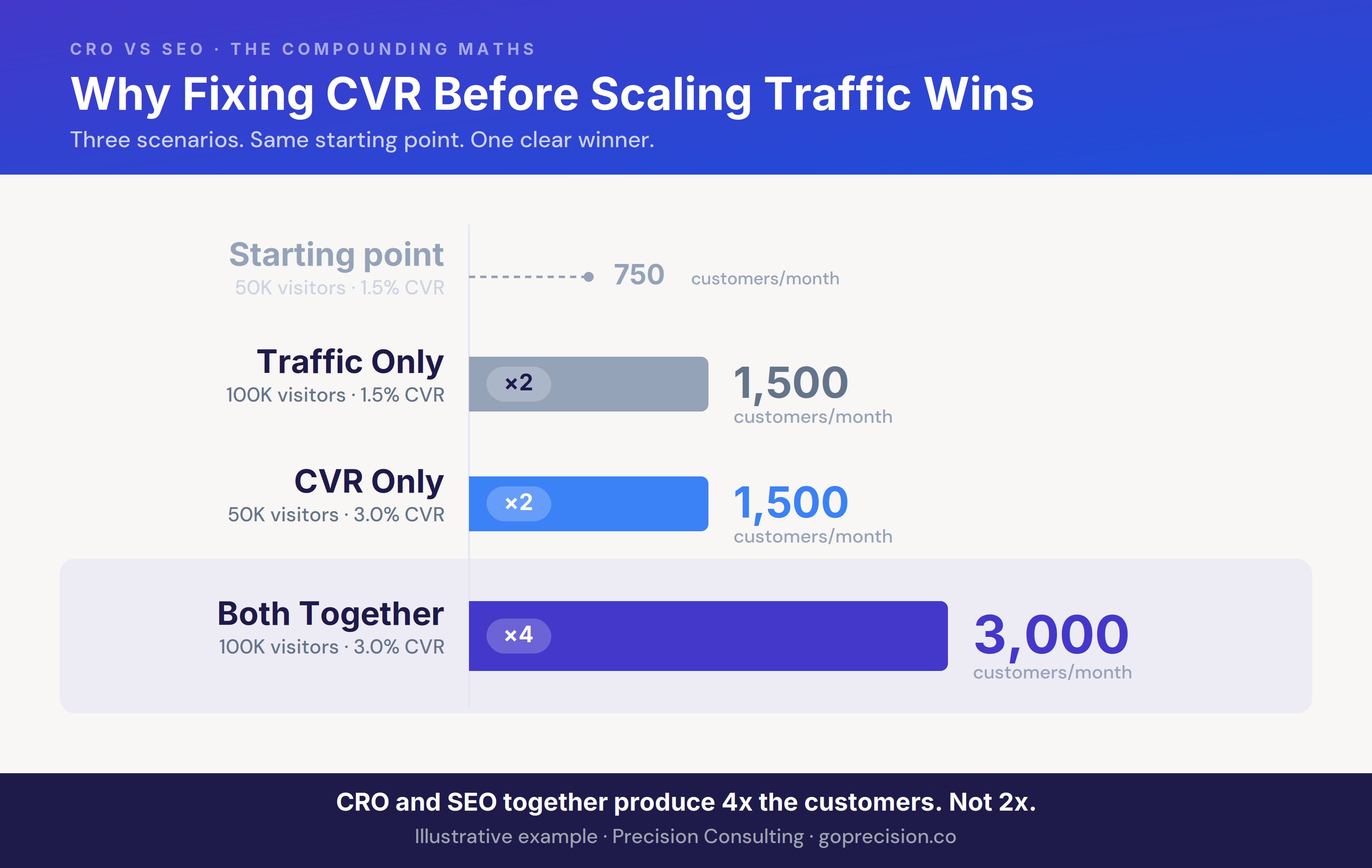
The compounding maths: same starting point, three growth strategies, and why CRO almost always pays back first.
How do CRO and SEO compare side by side?
CRO and SEO differ on goal, time-to-results, cost structure, and risk profile. The table below maps the differences across nine dimensions.
| SEO | CRO | |
|---|---|---|
| Primary goal | More traffic from organic search. | More revenue from existing traffic. |
| Time to results | 6 to 12 months typically (Ahrefs, 2023). | Weeks for quick wins; ongoing for full impact. |
| What it changes | How many people find your site. | How many of those people buy. |
| Works on | Search rankings, content, and site authority. | UX, copy, trust signals, funnel flow. |
| Cost structure | Ongoing investment in content and links. | Audit and testing programme; pays back fast. |
| Effect on paid ads | Reduces dependence on paid acquisition over time. | Improves ROAS immediately. |
| Compound mechanism | Authority and domain strength over time. | Customer insight and conversion efficiency over time. |
| Risk | Algorithm changes can affect rankings. | Low risk if tests are run properly. |
| Best when | You need more top-of-funnel volume. | You have traffic that is not converting. |
How does the decision change by store type?
The generic answer is that CRO comes before SEO for most growth-stage businesses. But the specifics change depending on where your store sits right now. Here is how to read your situation.
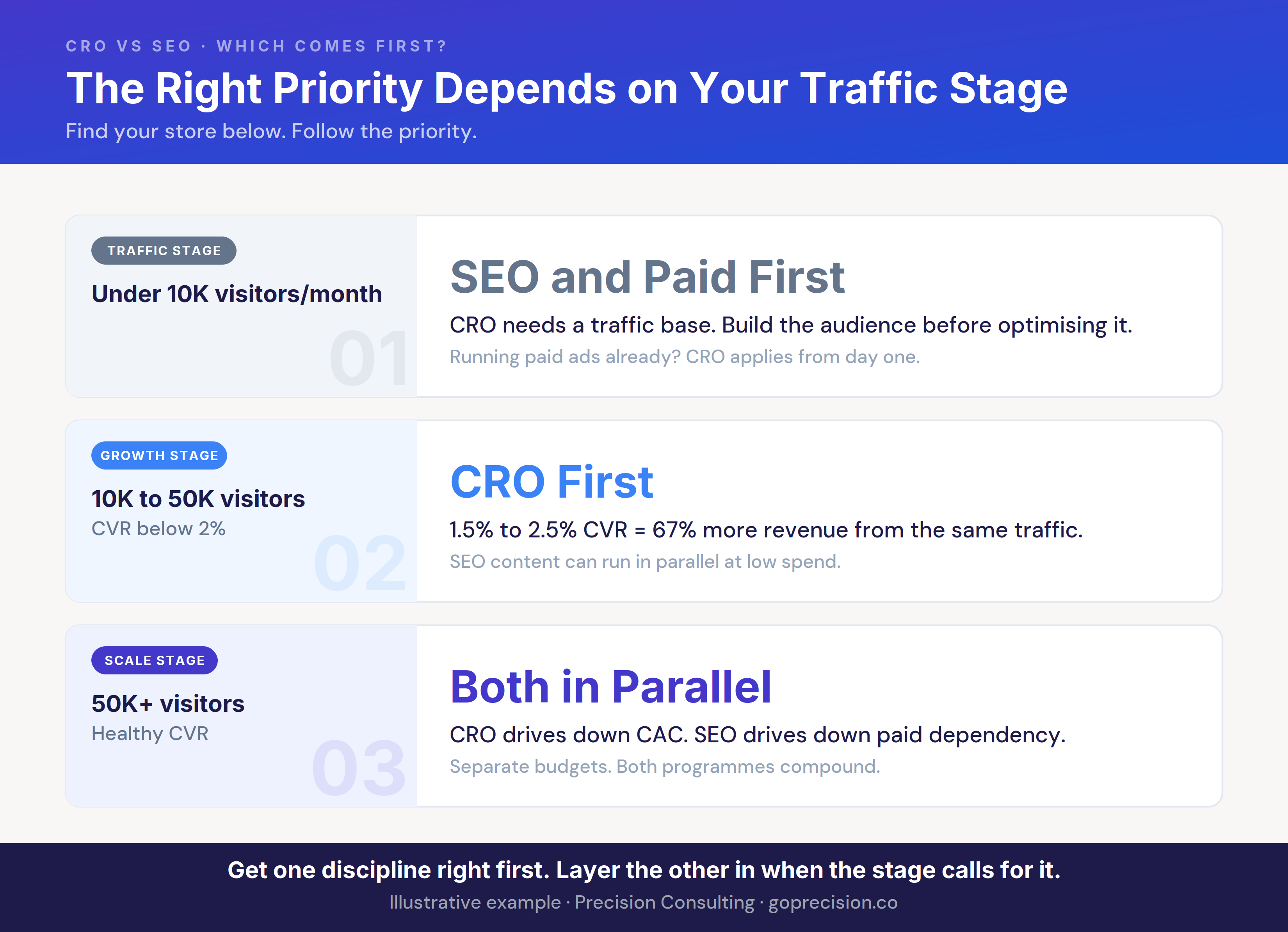
The right priority depends on where your store sits today: traffic stage and current conversion rate decide which lever pays back first.
New store (under 10,000 monthly visitors)
SEO is the priority. Not because CRO is unimportant, but because CRO has nothing to work with. You cannot optimise a checkout that 200 people a month visit. The sample sizes are too small for any test to reach statistical significance.
The exception is paid traffic. If you are already running paid ads and spending meaningful budget to bring visitors in, CRO applies from day one. Every improvement to your conversion rate improves the return on your ad spend immediately.
Growth-stage store (10,000 to 50,000 monthly visitors, conversion rate below 2%)
CRO almost always comes first. A store at 30,000 monthly visitors and a 1.5% conversion rate is generating 450 customers a month. Fixing the conversion rate to 2.5% produces 750 customers a month from the same traffic. That is a 67% revenue increase without a single additional visitor.
Getting that same lift from SEO alone would require doubling organic traffic, which takes 12 to 18 months and significant ongoing investment. The CRO route is faster, cheaper, and compounds into the SEO investment when you eventually scale it.
Established store (50,000 or more monthly visitors, healthy conversion rate)
Both should run in parallel. At this scale, you have enough traffic to run meaningful A/B tests and enough revenue to fund a proper SEO content programme at the same time. CRO efficiency keeps driving down your cost to acquire each customer. SEO authority keeps reducing your dependence on paid spend. Neither cannibalises the other's budget at this stage because the returns from each are clear enough to justify the investment separately.
When should you layer in each discipline?
The most useful way to think about this is in stages. The roadmap below uses traffic thresholds rather than calendar months, because traffic grows at different rates for different stores.
| Stage | Traffic threshold | Priority action |
|---|---|---|
| Stage 1: Launch (Month 0–3) | Under 5,000 visitors | SEO foundations and paid. Set analytics up properly. Do not invest in CRO until you have meaningful data to act on. |
| Stage 2: Early Growth (Month 3–6) | 5K to 20K visitors | Start your CRO audit. Quick wins phase. Small budget, high impact. Keep SEO content running in parallel. |
| Stage 3: Scale (Month 6–12) | 20K to 100K visitors | Full CRO programme alongside structured SEO content strategy. A/B testing every four to six weeks. |
| Stage 4: Compound (Month 12+) | 100K+ visitors | Both disciplines compound. CRO efficiency drives down CAC. SEO authority reduces paid dependency. This is the position you are building toward. |
Where do CRO and SEO overlap?
CRO and SEO overlap in three places: page experience as a Google ranking signal, content that answers real customer questions, and engagement metrics like dwell time and bounce rate. Improve one and the other usually moves with it.
Page experience is a ranking signal
Google uses Core Web Vitals and page experience as part of its ranking algorithm. A fast, well-structured, mobile-friendly page ranks better. Those are also the foundations of a high-converting page. Improving your site's UX for conversion purposes tends to lift SEO performance at the same time.
Content that answers real questions converts and ranks
The best-performing SEO content answers the specific questions your customers are searching for. That same content, when written well, builds trust and reduces buying friction. A page that uses the customer's own language, answers their actual objections, and avoids promotional framing performs measurably better on both fronts: longer dwell time (an SEO signal) and higher conversion rate (a revenue signal).
Robert Cialdini's liking principle is the mechanism. People are more likely to buy from sources they perceive as similar to themselves and genuinely helpful. Content written for that outcome earns both conversions and rankings, because Google's engagement signals reflect how well a page meets user intent.
Dwell time and bounce rate send signals to Google
When visitors land on your site and leave immediately, it signals to Google that the page did not answer what the visitor was looking for. A page that holds attention, answers questions clearly, and guides the visitor further into the site performs better on both dimensions. CRO work that reduces bounce rate directly supports your SEO rankings.
This is the kind of analysis we run in a Precision Deep Dive Audit. If you want to see exactly where your store is leaking revenue, request your free audit and we will walk through it together.
Which one should you focus on first?
The answer depends on where your bottleneck is.
Focus on CRO first if:
- You already have meaningful traffic (10,000 or more monthly visitors) but a low conversion rate.
- You are spending on paid ads and your ROAS is disappointing.
- Your analytics show people arriving and leaving without taking action.
- You want faster returns. CRO can show measurable uplift within weeks. The CRO audit checklist is the right place to start.
Focus on SEO first if:
- You have little to no organic traffic and are fully dependent on paid channels.
- You are in a category where your target customers start with a Google search.
- You want to reduce your cost per acquisition over a 12 to 24-month horizon.
- You are building a content moat that compounds independently of ad spend.
Most businesses I work with are doing both, but without enough focus on either. They publish occasional content without a keyword strategy. They tweak their homepage without a testing framework. Neither compounds meaningfully because neither is being done with enough intention.
Better to get one right first. In most cases, for e-commerce businesses at the growth stage, that means CRO. Fix the conversion rate. Then scale the traffic. In that order.
What should you spend on CRO vs SEO?
One of the most searched sub-questions in this space is how to split budget between CRO and SEO. Most brands get this badly wrong.
A useful starting point for a growth-stage e-commerce brand spending in the range of £10,000 per month on digital marketing: allocate 60 to 70% toward traffic acquisition (SEO plus paid) and 30 to 40% toward conversion optimisation. Most brands are closer to 90/10, which is why their ad spend efficiency keeps declining as they scale. They are buying more visitors for a funnel that does not improve.
Before setting a CRO budget, establish what a one-percentage-point improvement in conversion rate is worth in monthly revenue. At 50,000 monthly visitors and an average order value of £60, moving from 1.5% to 2.5% conversion is worth £30,000 per month in additional revenue. A CRO programme costing £3,000 per month pays back in weeks, not quarters. That calculation changes the budget conversation entirely.
On whether to hire in-house or use an agency: SEO content can be built in-house if you have the editorial bandwidth to publish consistently. Technical SEO and link building are usually better outsourced until you have the traffic to justify a full-time hire. CRO is better run by a specialist at the start, because getting the testing methodology right from the beginning prevents wasted test cycles. Most growth-stage stores do not yet have the testing volume to justify a full-time in-house CRO function. If you are building the testing infrastructure yourself before that stage, our guide to the best CRO tools for e-commerce covers which analytics, testing, and behaviour platforms are worth the investment.
How do CRO and SEO work best together?
Once both are running properly, they reinforce each other in a way that is hard to replicate through either discipline alone.
SEO brings in high-intent visitors who are actively looking for what you sell. CRO ensures more of them convert on arrival. Higher conversion rates mean more data for testing. More data means faster learning. Faster learning produces better results across both programmes.
There is also a financial loop. CRO improves the unit economics of your paid acquisition. Better unit economics mean you can afford to bid higher on paid terms, which often overlap with your organic targets. Better-paid performance funds more content investment, which improves SEO. The two disciplines, when properly resourced, make each other more effective.
From the work: CRO first, then traffic
The thesis of this article is not theoretical. Here is what it looks like in practice.
At a major food delivery platform operating across multiple markets in Asia and the Middle East, the first engagement was entirely CRO-focused. No additional paid budget. No new traffic sources. The work covered checkout friction, trust signals at the payment stage, and the information hierarchy on product pages.
The result was a 58% increase in revenue from existing traffic before a single additional visitor was added to the funnel. Once that baseline was established, the SEO and paid investment that followed was significantly more efficient because every visitor arrived at a funnel that was already optimised to convert them.
That sequence, CRO first to establish the baseline, then traffic to scale it, is the right order for most businesses. Reversing it means spending more to acquire visitors for a funnel that is not yet ready to receive them.
How do I decide which to prioritise right now?
Ask yourself three questions.
1. Where is my traffic coming from right now?
If most of your traffic is paid, you are already spending money to get people to your site. CRO will improve the return on that spend immediately. SEO will take time to have any effect on your paid acquisition costs.
2. What is my current conversion rate versus my category benchmark?
E-commerce conversion rates vary by category, but a general benchmark is 2 to 3%. If you are below 2%, your funnel has a conversion problem that more traffic will not solve. Fix that first.
3. What is my growth horizon?
If you need to show revenue growth in the next three to six months, CRO is the faster lever. If you are building for a 12 to 24-month horizon and want to reduce dependence on paid acquisition, SEO is the right parallel investment to start now.
Not sure which one is right for where your business is right now? See how Precision works with e-commerce brands, or book a strategy session for a direct assessment of your bottleneck and the right place to start.
Key takeaways
- CRO and SEO are not competing. SEO fills the funnel. CRO improves what happens inside it.
- Brands spend an average of $92 on traffic acquisition for every $1 on conversion optimisation (Eisenberg). That imbalance explains why most stores see declining ROAS as they scale.
- CRO works faster. Measurable uplift is possible within weeks. SEO takes six to twelve months to show meaningful impact (Ahrefs).
- For most e-commerce businesses at the growth stage, CRO comes first. Fix the conversion rate before scaling the traffic.
- Store type matters. Under 10K visitors: SEO and paid first. 10K to 50K with low CVR: CRO first. 50K-plus: run both in parallel.
- A growth-stage brand should allocate 30 to 40% of digital marketing budget to conversion optimisation. Most brands are at 10%, which is why efficiency declines as they scale.
- CRO multiplies the return on SEO. Every improvement to conversion rate makes each organic visitor worth more.
- The two disciplines share ground: page experience, content quality, and dwell time matter for both. Running both poorly is worse than running one well.
Frequently asked questions
What is the difference between CRO and SEO in e-commerce?
SEO focuses on bringing more visitors to your store through higher organic search rankings. CRO focuses on turning more of the visitors you already have into customers. SEO is a traffic lever. CRO is a conversion lever. Both affect revenue, but through completely different mechanisms and on different timelines.
Is CRO or SEO the better next move for scaling an e-commerce store?
It depends on your current traffic volume and conversion rate. For stores with 10,000 or more monthly visitors and a conversion rate below 2%, CRO almost always comes first. The revenue gain from fixing a 1.5% to 2.5% conversion rate is equivalent to a 67% increase in traffic, at a fraction of the cost and time. For stores under 10,000 monthly visitors with no paid traffic running, SEO and paid are the priority because CRO needs a meaningful traffic base to work from.
Can CRO and SEO work together to boost e-commerce revenue?
Yes, and together they compound in a way that neither achieves alone. SEO brings high-intent visitors. CRO converts more of them on arrival. Higher conversion rates improve the unit economics of paid acquisition, which funds more content investment, which improves SEO authority. The loop is real. The right sequence is to get CRO working first, then scale traffic into a funnel that is already optimised to receive it.
Can CRO hurt SEO?
Done properly, no. CRO improvements that reduce bounce rate, improve dwell time, and make pages more useful will generally support SEO. The risk is that changes remove content Google uses to understand the page, or slow page load speed. A well-run CRO programme accounts for these factors.
Does improving conversion rate help SEO rankings?
Indirectly, yes. The conversion rate itself is not a direct Google ranking signal. But many of the things that improve conversion rate, including faster pages, better content, clearer structure, and lower bounce rates, do influence ranking signals. Treat them as aligned goals rather than separate ones.
How do I know if my issue is traffic or conversion?
Open your analytics. If you have fewer than 10,000 monthly visitors, your primary issue is almost certainly traffic. If you have over 10,000 monthly visitors but fewer than 2% are converting, your issue is conversion. If you have both problems, fix conversion first, because bringing more traffic to a leaking funnel just increases the waste.
Is CRO worth investing in if my SEO is not set up yet?
Yes, if you already have traffic from another source. CRO improves the return on all traffic, not just organic. If you are running paid ads, social campaigns, or email, CRO will improve the experience for visitors when they arrive. You do not need organic traffic to make CRO worthwhile.
How much should I spend on CRO vs SEO?
A useful starting framework for a growth-stage e-commerce brand: 60 to 70% of digital marketing budget toward traffic acquisition (SEO plus paid) and 30 to 40% toward conversion optimisation. Most brands are closer to 90/10. Before setting a CRO budget, calculate what a one-percentage-point improvement in conversion rate is worth in monthly revenue. That number usually reframes the conversation.
What comes after getting both CRO and SEO right?
Retention. Once you are converting well and acquiring customers cost-effectively through organic search, the next lever is increasing the lifetime value of each customer. Email, loyalty, and post-purchase experience become the compounding mechanisms at that stage.
Influence by Robert Cialdini covers the trust and liking principles that explain why customer-language content converts across both SEO and CRO. Predictably Irrational by Dan Ariely maps the irrational patterns behind search behaviour and buying decisions, which inform both disciplines.
