Last updated:
Every purchase your customer makes is irrational. Not in a chaotic, random way, but in a predictable, systematic way that behavioural scientists have been mapping for decades. The question is not whether e-commerce psychology influences your conversion rate. It does. The question is whether you are designing for it or against it.
Most e-commerce stores are designing against it. They overload visitors with choices, bury trust signals below the fold, and treat checkout as a data-collection form rather than the final moment of the purchase experience. The result is the industry average: a 2-3% conversion rate, meaning 97 out of 100 visitors leave without buying.
At Precision, psychology is not something we layer on top of CRO. It is the foundation. Every experiment we design starts with a hypothesis rooted in a specific cognitive bias. That approach delivered +58% revenue, +40% conversion rate, and +35% AOV for a major delivery platform over six months.
Here are the 10 biases that have the biggest impact on e-commerce, along with real-world applications and results for each.
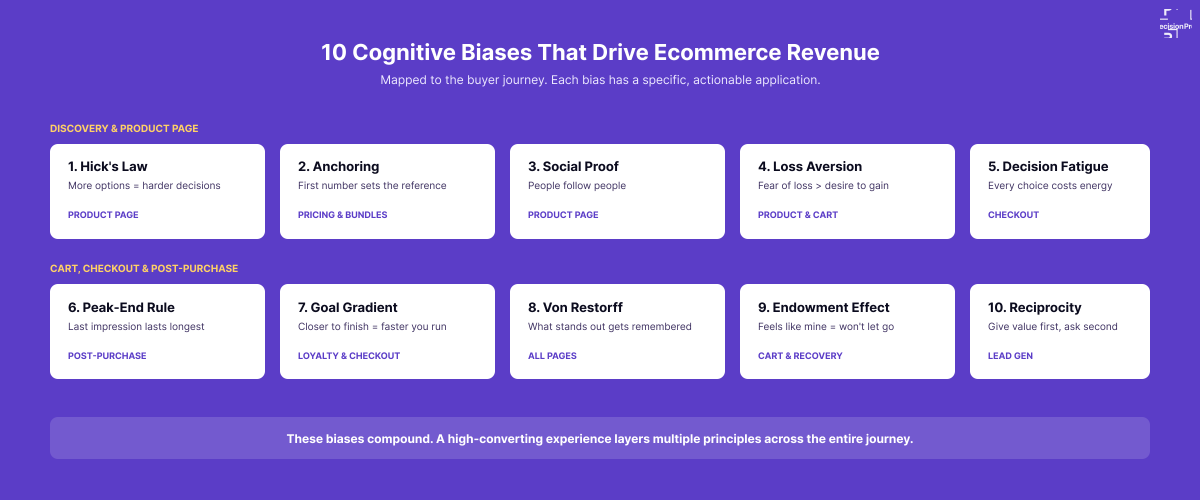
The 10 cognitive biases that drive e-commerce conversions, grouped by funnel stage.
1. Hick's Law: How Does Choice Overload Reduce Conversions?
The time it takes to make a decision increases with the number of options available. Every extra CTA, variant selector, or navigation element on a page makes it harder for visitors to decide, and easier for them to leave. Think about it this way: if someone gave you 8 different jams to choose from at a tasting, you would probably get overwhelmed and leave the store with none. The same principle applies to your product page.
This is one of the most commonly violated principles we see. Product pages routinely present 10+ clickable elements all fighting for attention: Add to Cart, Buy Now, Wishlist, Compare, Share, variant pickers, and related products. Each one adds cognitive load. Each one reduces the probability of the one action you actually want.
Audit your top product pages and count the interactive elements above the fold. More than 3-4 CTAs visible at once? You are working against Hick's Law. Reduce secondary actions to subtle icons. Make your primary CTA visually dominant. And here is one people overlook: your CTA text and colour should remain consistent throughout the site, so your user can simply see the button on subsequent pages and click it without a second thought.
When we simplified product discovery at a major delivery platform, grouping by user intent rather than internal taxonomy, homepage-to-product-page conversion improved measurably.
2. Anchoring Bias: Why Does the First Price a Customer Sees Shape Everything After?
People rely disproportionately on the first piece of information they see. In pricing, the first number a customer encounters becomes the reference point against which everything else gets judged.
This is why showing a "Compare at" price next to a sale price works. The higher number anchors value perception. The discount then feels like a gain, not a cost. It is also why tiered pricing works: the premium option anchors the mid-tier as the "reasonable" choice.
Always show the reference price before the actual price. On bundle offers, display individual item prices first, then the bundle price. At a leading food delivery platform, we used anchoring on the cart page by showing original prices alongside "Popular with your order" suggestions. Result: +35% increase in Average Order Value.
Make sure you do not hike up the original price to appear higher or to showcase fake discounts. This automatically creates distrust with your customer, and rightfully so. You do not just lose that customer. Based on their review and word of mouth, you lose potential customers, too.
The Buyer Psychology Playbook in the CRO Leak Finder kit covers the six mental shortcuts that drive how shoppers decide, including anchoring, loss aversion and social proof. It explains each by mechanism, so you can apply it to your own pages. Get the kit.
3. Social Proof: Why Do Other Customers' Choices Drive Purchase Decisions?
When visitors see evidence that others have purchased, reviewed, or endorsed a product, their confidence goes up. Social proof reduces perceived risk. Simple as that.
But here is the thing most stores get wrong: placement matters as much as existence. A review count buried at the bottom of a product page does almost nothing. The same review count, placed directly beneath the product title and visible without scrolling, can meaningfully impact add-to-cart rates.
Place your strongest social proof (star rating, review count, or "Bestseller" badge) in the first viewport of every product page. If you have fewer than 10 reviews on a product, prioritise getting reviews over getting more traffic. And if your platform can support image reviews, that is even better. Customers love knowing they will get what they see in the product pictures, not a toned-down version of the goods. For a full breakdown of where each element should sit on the page, see product page design: the behavioural science behind pages that convert.
The data backs this up: shoppers who interact with customer photos on product pages convert at roughly double the rate of those who only see text reviews, with Yotpo research showing a 106% lift in conversion from photo reviews compared to text-only reviews.
4. Loss Aversion: Why Do Customers Fear Losing More Than They Value Gaining?
People feel the pain of losing something roughly twice as strongly as the pleasure of gaining something of equivalent value. This is why limited-time offers, low-stock warnings, and expiring discounts work. They frame the decision as a potential loss.
The ethical application of loss aversion is one of the biggest distinctions in psychology-driven CRO. Fake countdown timers and fabricated scarcity destroy trust. Real inventory levels, honest sale end dates, and cart reservation timers respect the customer while creating appropriate urgency.
Show real inventory when stock is genuinely low. Use cart abandonment emails that remind customers what they are about to lose. Set free shipping thresholds just above your current AOV. The framing should always be honest. Customers who feel manipulated do not come back.
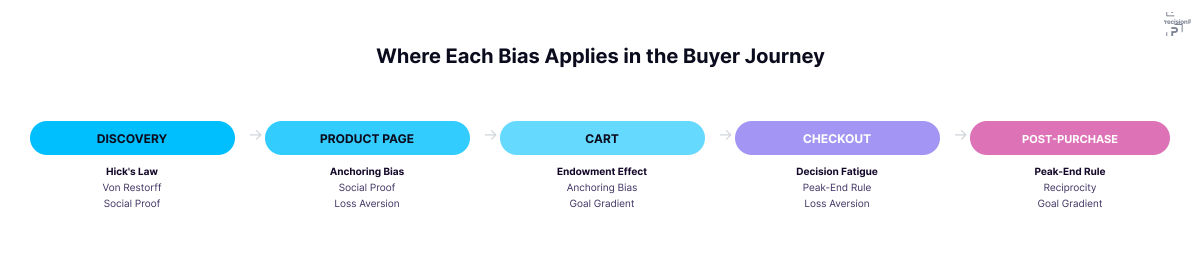
Which cognitive biases apply at each stage of the e-commerce funnel.
5. Decision Fatigue: How Does a Long Checkout Flow Kill Conversions?
Making repeated decisions depletes mental energy. In e-commerce, long checkout flows kill conversions. Every form field, every page transition, every "Are you sure?" prompt uses up the customer's willingness to continue.
Baymard Institute's large-scale checkout usability research found the average e-commerce checkout has 23 form elements, while the optimised ideal is 12-14. That is 9-11 unnecessary decisions between "I want this" and "I bought this." Each one is an exit opportunity.
Map every decision point in your checkout. Remove anything that is not essential. Enable guest checkout. Auto-detect location from postal code. Pre-select the most common shipping option. The path from cart to confirmation should feel effortless, not interrogative.
6. Peak-End Rule: Why Does Your Post-Purchase Experience Shape Brand Loyalty?
People judge an experience by its most intense moment and how it ended. In e-commerce, the checkout, order confirmation, and post-purchase communication disproportionately shape customers' perceptions of your brand.
Most stores invest heavily in acquisition and almost nothing in post-purchase. The confirmation page is generic. The shipping email is a system notification. This is a massive missed opportunity. A delightful ending creates repeat customers. A frustrating ending creates refund requests.
Design your confirmation page as a celebration, not a receipt. Include a personalised thank-you, expected delivery timeline, and a reason to return (a discount code, a referral link, or content they would find useful). Make your shipping notifications branded and helpful, not generic system emails. The peak of the experience should be delight, not anxiety. Stores that nail the post-purchase experience see measurably higher repeat purchase rates and lower return rates.
7. Goal Gradient Effect: How Does Showing Progress Increase Checkout Completion?
People accelerate their effort as they approach a goal. Progress indicators, loyalty trackers, and completion bars measurably increase engagement.
At a leading food delivery platform, we built a loyalty system with branded badges and tiered rewards. The programme visualised progress toward the next reward, keeping users coming back. Result: +11% orders per customer.
Add a progress bar to checkout. Show loyalty members how close they are to the next reward. For free shipping thresholds, show a dynamic bar in the cart ("You are $12 away from free shipping!"). The closer the goal feels, the more motivated people are to hit it.
8. Von Restorff Effect: Why Does Your CTA Need to Be the Only Element in Its Colour?
When similar items sit together, the visually distinctive one gets noticed and acted on. This is the scientific basis for contrasting CTA colours, "Most Popular" badges, and highlighted pricing tiers.
When we redesigned a client's newsletter, the old layout featured generic banners identical to those in every other marketing email. The new design showcased top products with clear pricing and visual hierarchy. Result: +80% click-through rate and +20% open rate.
Your primary CTA should be the only element on the page in its colour. If "Add to Cart" is green, nothing else should be green. On pricing pages, visually distinguish your recommended plan. Use "Staff Pick" or "Best Seller" badges sparingly so they genuinely stand out.
9. Endowment Effect: How Does Ownership Language Reduce Cart Abandonment?
People value things more once they feel ownership. The moment a customer adds an item to their cart, it stops being a product on a shelf and starts being something they own.
This is why "Your items are waiting" beats "Come back and shop" in cart recovery emails. The customer already feels ownership. You are reminding them of a loss, not making a new pitch.
Use ownership language: "Your cart," "Your selection," "Items you chose." Enable wishlists and saved carts. For abandoned cart emails, frame it as a reminder of what they have, not a fresh sales pitch.
10. Reciprocity: How Does Giving Value First Increase Customer Lifetime Value?
When someone receives something of value, they feel an obligation to return the favour. Free shipping, free samples, free guides: these are not costs. They are investments in reciprocity. A customer who gets a free size guide is more likely to buy. One who receives free shipping is more likely to accept an upsell.
Lead with value at every stage. Offer a free checklist before requesting an email address. Send a helpful tip after purchase before asking for a review. The sequence matters: give, then ask.
How does e-commerce psychology drive higher conversion rates through these cognitive biases?
No single bias drives a purchase in isolation. A high-converting product page layers multiple principles: Hick's Law keeps it clean, Social Proof reduces uncertainty, Anchoring frames value, Von Restorff makes the CTA impossible to miss, Loss Aversion creates urgency, and Endowment kicks in the moment the item hits the cart.
This is why isolated tactics fail. Changing a button colour does not fix a page that violates Hick's Law. A countdown timer does not help if there is no Social Proof to build trust first. Psychology-driven CRO works because it treats the experience as a system rather than a collection of individual tweaks.
At Precision, this systems approach is the core of our Conversion Accelerator. We audit the full journey through the lens of these principles, find the highest-impact violations, and design experiments that address root causes. That is how we consistently deliver results like +58% revenue and +40% conversion. For a focused look at how these same principles apply to pricing specifically, the psychology of pricing guide covers anchoring, loss framing, and the Decoy Effect in the context of your product and checkout pages. And for the psychology behind why 70% of carts get abandoned and how to recover them, the cart abandonment guide applies many of the same principles to the critical final step. The tools needed to run that experimentation systematically are covered in our guide to the best CRO tools for e-commerce, from behaviour analytics to testing platforms.
Want to see which biases your store is violating? See how Precision works with e-commerce brands.
Key Takeaways
- Every e-commerce purchase is shaped by cognitive biases. Designing for them is not manipulation. It is removing friction and building trust.
- The 10 highest-impact biases: Hick's Law, Anchoring, Social Proof, Loss Aversion, Decision Fatigue, Peak-End Rule, Goal Gradient, Von Restorff, Endowment Effect, and Reciprocity.
- Placement matters as much as presence. Social proof below the fold is functionally invisible.
- These biases compound. Layer them across the entire journey for transformative results.
- Honesty builds long-term relationships. Dark patterns generate short-term conversions and long-term churn.
Frequently Asked Questions
What are cognitive biases in e-commerce?
Systematic patterns in how people decide. They influence which products visitors click, whether they trust the site, and whether they complete a purchase. Understanding them lets you design with human behaviour, not against it.
Is using psychology in e-commerce manipulation?
When applied ethically, no. Every design decision influences behaviour. The line is transparency: real inventory levels, honest timelines, genuine value. The goal is to reduce friction, not to deceive.
Which bias has the biggest impact?
Depends on your leak. Overwhelmed visitors? Hick's Law. Trust issues? Social Proof. Cart abandonment? Decision Fatigue and Loss Aversion. Diagnose your funnel first.
Where should I start?
Walk through your own store as a customer. The three highest-impact areas: product page (Hick's Law + Social Proof + Von Restorff), checkout (Decision Fatigue + Peak-End Rule), and cart (Anchoring + Endowment + Loss Aversion).
