Last updated:
There is a study I keep coming back to. Robert Cialdini describes it in Influence. Researchers sent visitors to an online furniture store. Half landed on a page featuring soft, fluffy clouds. The other half landed on a page showing coins. Same store. Same products. Completely different behaviour.
The cloud group decided comfort was what mattered most and chose comfortable furniture. The coin group decided price was what mattered most and chose the cheapest options. The landing page image did not just set a mood. It rewired what people cared about. This is landing page optimisation at its most fundamental level. A landing page is not a homepage — it is built around a single intent and stripped of anything that does not serve it.
I think about this every time I audit a landing page. Because most e-commerce brands treat their landing page like a brochure. Here is our logo, here is our story, here is a rotating banner that tries to say everything and ends up saying nothing. A stock photo that was chosen because it looked "professional," not because it would prime the visitor to feel something specific.
Meanwhile, the visitor's brain is doing something very simple: scanning for reasons to stay or leave. As Chip and Dan Heath put it in Made to Stick, the most basic way to get attention is to break a pattern. Your visitor has seen hundreds of landing pages this month. If yours looks, reads, and feels like all the others, their brain files it under "more of the same" and moves on. You have got about 3 seconds before that happens.
This framework is what we use at Precision when building or auditing landing pages. Seven sections, each grounded in a specific cognitive bias, with the psychology behind why each one works.
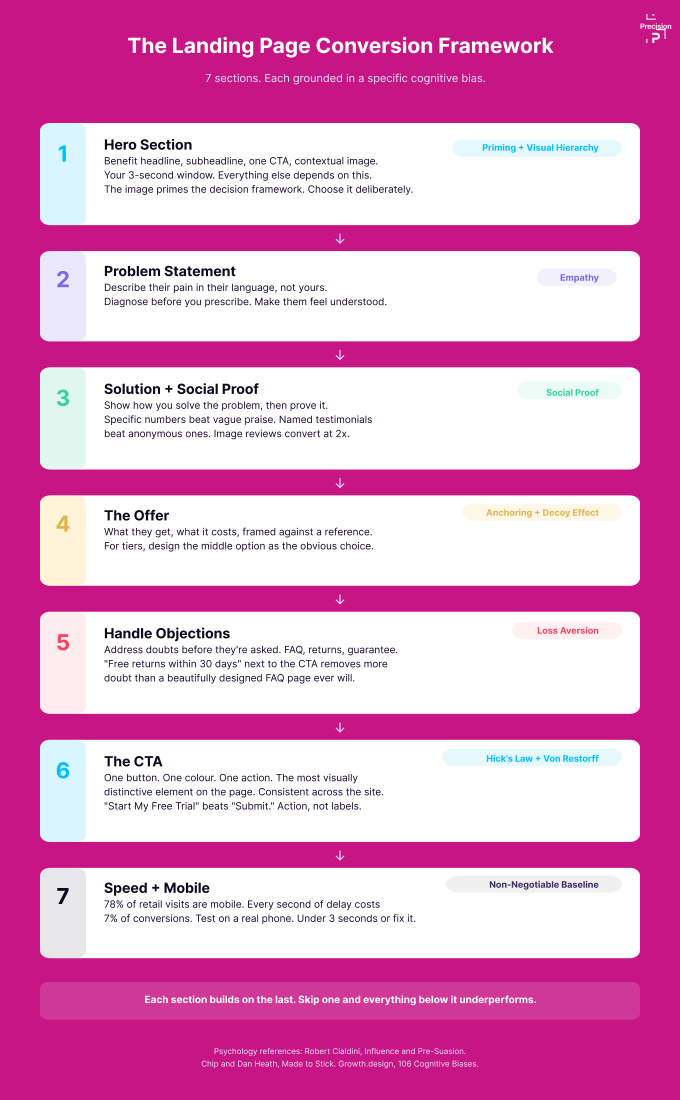
The landing page conversion framework: 7 sections from hero to CTA, with the psychology principle behind each one.
Step 1: What should your hero section accomplish in the first 3 seconds?
Your hero section needs to answer one question in the first 3 seconds: "Is this for me?" That is the only thing the visitor's brain is checking. The hero section is not just the top of the page. It is the experiment that determines whether everything below it even gets seen.
Visual Hierarchy determines what gets processed first. The human eye follows a predictable scan pattern: the largest element (your headline), then the supporting text, then the CTA. If any of these are unclear, cluttered, or missing, the brain defaults to the easiest decision: leave.
But here is where Cialdini's research becomes directly relevant to your landing page. Whatever image and headline your visitor sees first does not just capture attention. It primes the frame through which they evaluate everything that follows. A hero image showing someone using your product in a real-life context primes them to imagine owning it. A hero showing the product on a white background primes them to evaluate specifications. Choose the frame deliberately.
What good looks like
- Headline: One clear benefit statement. Not your company name. Not a pun. Not "Welcome to our store." The benefit the customer gets. "Same Traffic. More Revenue." beats "Precision Consulting: Your Growth Partner."
- Subheadline: How you deliver that benefit, in one sentence. This is where you get slightly more specific about the method or proof.
- CTA: One primary action. Not two, not three. One button that tells the visitor exactly what happens next.
- Visual: A product-in-context image, lifestyle shot, or demo that shows the outcome. Remember the Cialdini study: this image primes the entire decision framework.
Open your landing page and cover everything except the top 600 pixels. Can a stranger tell what you sell, who it is for, and why it matters? If not, rewrite the hero.
And one thing I see constantly: do not overengineer the headline. If your hero statement sounds very clever but does not actually explain anything, you have annoyed the visitor immediately.
Here is what follows from that. They either leave or, worse, they continue browsing with a negative sentiment. Once that frame is set, even if the subsequent sections do explain your value clearly, the visitor is not absorbing it. They have already decided you are not for them. Your headline's job is clarity, not cleverness.
Step 2: Why does your problem statement need to come before your solution?
Your problem statement comes before your solution because the visitor needs to feel understood before they will trust you to fix anything. Lead with the solution and they read it as marketing. Lead with the problem in their language and they read on to find out how you solve it.
Unity and the Empathy Gap: When a visitor reads a description of their exact frustration, their brain responds with "This brand understands me." That is the foundation of trust. And trust is the foundation of conversion.
Most landing pages skip this entirely and jump straight to the solution. That is like a doctor prescribing medication before asking about symptoms. The customer needs to feel diagnosed before they will trust the treatment.
What good looks like
Lead with the customer's pain, not your product. "You are spending thousands on ads, but your sales dashboard tells a different story" resonates more than "Our platform helps optimise conversions." Use their words. If customers describe their problem as "too many abandoned carts," use that phrase, not "suboptimal checkout flow efficiency."
Read your last 20 customer support tickets or survey responses. Find the phrases they actually use to describe their frustration. Write the problem statement in those words.
Step 3: How do you prove your solution rather than just claiming it?
You prove your solution rather than just claiming it by leading with social proof: real customer reviews, named brand logos, before-and-after evidence, third-party endorsements. Anyone can claim. The page that proves wins. This is where Social Proof becomes the most powerful element on the page, mirroring the principle that applies to product page design. For a full breakdown of which proof elements work hardest and exactly where to place them, the guide to e-commerce trust signals covers each one with placement examples.
Social Proof: People look to others' behaviour to determine their own, especially under conditions of uncertainty. A visitor on your landing page is, by definition, uncertain. They do not know you yet. They do not trust you yet. Other people's experiences bridge that gap.
What good looks like
Not all social proof is equal. These three distinctions matter most:
- Specific results beat vague praise. "Revenue increased 58% in 6 months" beats "Great service, highly recommend." Numbers are concrete. Adjectives are forgettable.
- Named testimonials beat anonymous ones. "Ibad Ahmed, Director of New Verticals," carries more weight than "Satisfied Customer."
- Image reviews beat text reviews. Shoppers who interact with customer photos convert at roughly 2x the rate of those who read text-only reviews, according to Yotpo's e-commerce benchmarks.
Pair every product claim with a specific proof point. No unsubstantiated claims. If you say "300+ sold," show the proof with a large number of verified reviews. If you say "+35% AOV," link to the case study.
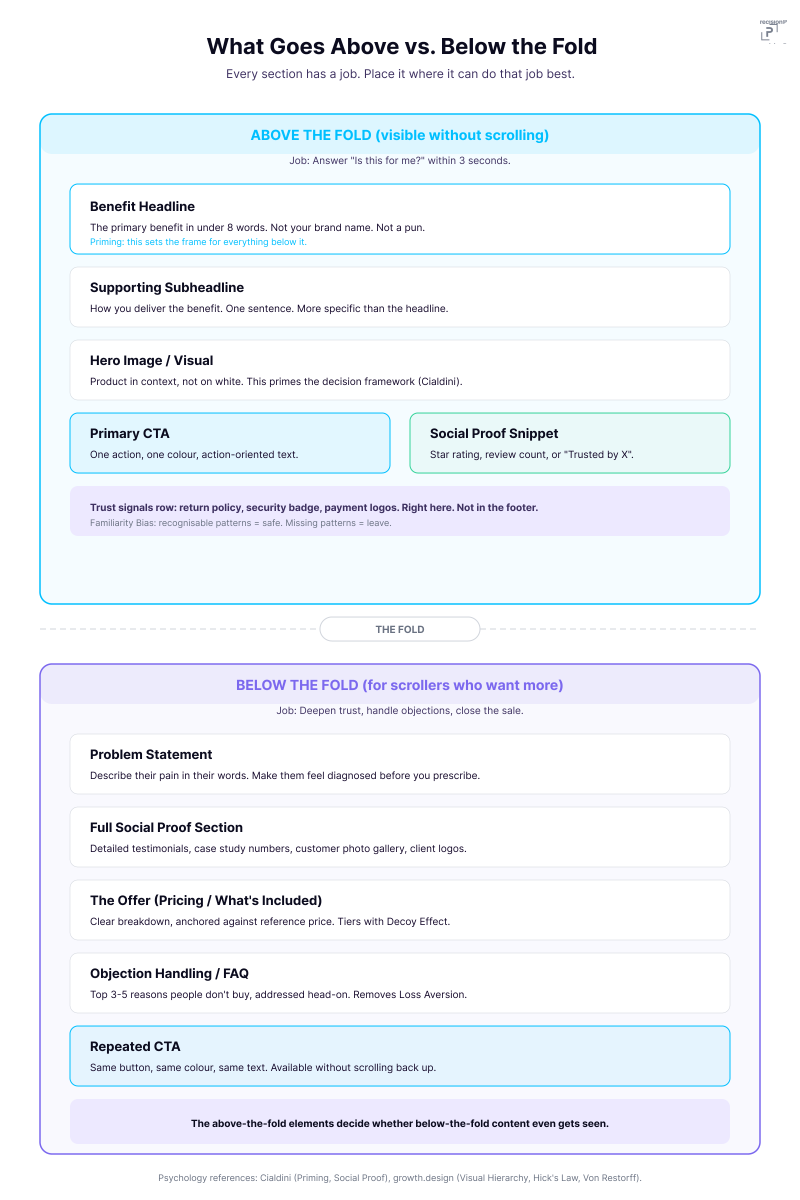
Above the fold vs. below the fold: what goes where, the job of each section, and the psychology principle driving it.
Step 4: How should you frame your offer to maximise perceived value?
Frame your offer as the outcome the customer is buying, not a list of features they are paying for. Show what changes for them after they buy. Stack the value visibly: bonuses, guarantees, what is included. Then anchor the price against what doing nothing costs them. This is where most e-commerce landing pages lose people. The customer understands the problem, believes you can solve it, and now wants to know: exactly what am I getting, and what does it cost?
Anchoring Bias: The first price the customer sees becomes their reference point. If you show a higher price first (original or competitor) and then your actual price, the actual price feels like a gain. If you show your price in isolation, it is just a number with no context.
If you offer tiers, the Decoy Effect applies: three options, with the middle one as your target. The low tier exists to make the middle feel like a smart choice. The high tier exists to make the middle feel reasonable.
Can someone who has never heard of your brand understand what they are buying within 10 seconds of reading the offer section? If not, simplify. Show what is included, what it costs, and why it is worth it.
Step 5: How do you handle customer objections before they are raised?
Handle customer objections before they are raised by anticipating the three or four biggest doubts and answering them directly on the page. Most landing pages avoid the hard questions. The pages that convert do the opposite. They name the doubt out loud and resolve it. By this point, interested visitors have one thing stopping them: doubt. "What if it does not work?" "What if it is not for me?" "What if I cannot return it?"
Loss Aversion: The fear of making a bad purchase outweighs the excitement of getting a good product. Your job is to neutralise that fear before the customer has to ask. An FAQ section that addresses the top 3-5 objections head-on. A visible return policy. A guarantee badge.
This connects to a concept in Made to Stick called the "Curse of Knowledge." Once you know your product well, it is hard to imagine not knowing it. The objections that seem obvious to your customers are invisible to you because you have lost the ability to see your product through a newcomer's eyes.
List the top 5 reasons people do not buy from you (ask your sales team or read negative reviews). Address each one explicitly on the page. "Free returns within 30 days" directly next to the CTA removes more doubt than a beautifully designed FAQ page.
Step 6: Why does your landing page need one CTA, one goal, and one action?
Your landing page needs one CTA, one goal, and one action because every additional choice slows the buyer's decision. Two CTAs cuts conversion. Four cuts it more. The fix is ruthless prioritisation: one primary action, one goal, one button.
Hick's Law: Every additional link, navigation option, or secondary action reduces the probability of the primary action you want. One page, one goal, one CTA.
The Von Restorff Effect determines whether your CTA gets noticed. It should be the most visually distinctive element on the page. Contrasting colour, larger size, clear action-oriented text. "Start My Free Trial" beats "Submit." "Add to Cart" beats "Continue." And crucially, it should look the same everywhere on your site, so the visitor's brain recognises it without a second thought.
Count every clickable element on your landing page. If there are more than 3 links (CTA, logo home, privacy policy), you are leaking attention. Remove anything that does not directly support the primary conversion goal.
Step 7: Why are page speed and mobile experience non-negotiable for conversions?
None of the above matters if the page takes 5 seconds to load or looks broken on a phone. Mobile drives 78% of retail traffic, according to Statista's retail traffic data. Every second of page load delay costs up to 7% of conversions, per Deloitte's "Milliseconds Make Millions" research. These are not design considerations. They are revenue requirements.
Test every landing page on mobile before desktop. If it does not load in under 3 seconds, compress images and defer non-critical scripts. If the CTA is not visible above the fold on mobile, redesign the hero for smaller screens.
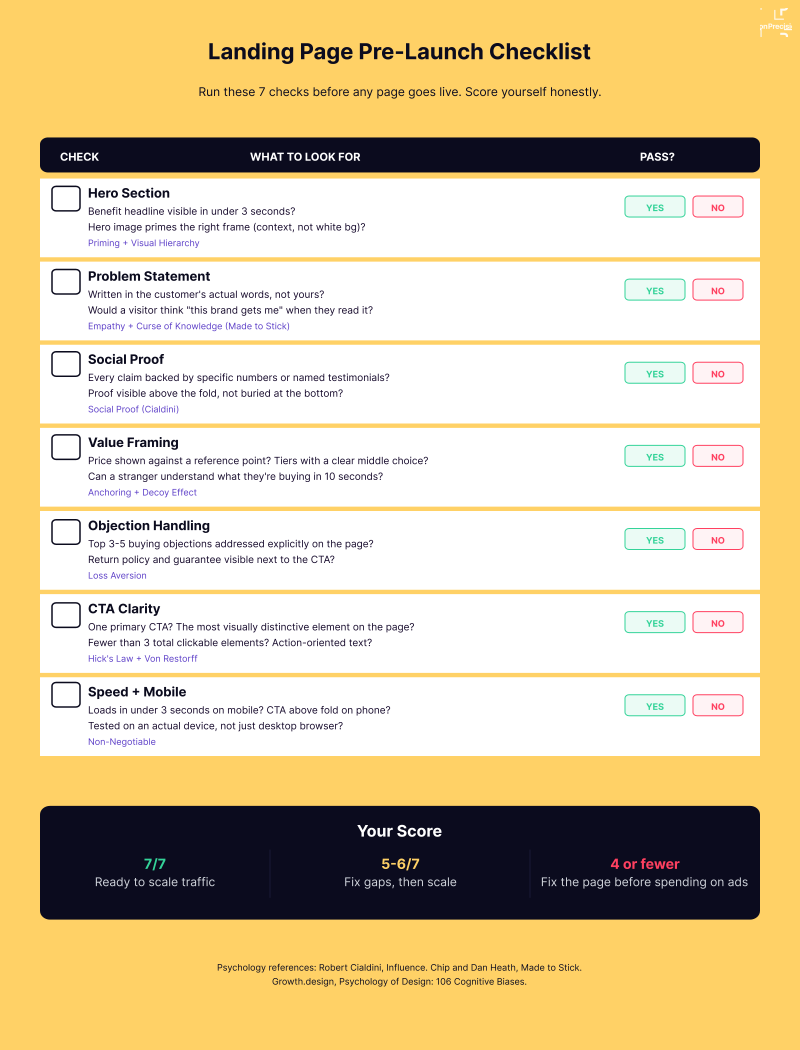
The landing page optimisation checklist: 7 steps, what to check for each, and the psychology principle behind it.
This is the kind of analysis we run in a Precision Deep Dive Audit. If you want to see exactly where your store is leaking revenue, request your free audit and we will walk through it together.
What are the most common landing page optimisation mistakes that kill conversions?
- Leading with your brand, not the customer's problem. Nobody cares who you are until they know you understand their problem. Diagnose first, prescribe second.
- Multiple CTAs fighting for attention. "Book a Call," "Download Guide," "Start Trial," "Learn More." That is four decisions. You want one obvious next step. Hick's Law applies to buttons just as much as product variants.
- Social proof buried at the bottom. If your best testimonial is below the 3rd scroll, most visitors will never see it. Place it near the hero or immediately after the solution section.
- No mobile-specific design. If you are shrinking your desktop page for mobile instead of designing mobile-first, you are losing the majority of your traffic. 78% of visits are on phones.
- Ignoring the priming effect of images. Your hero image is not decoration. As Cialdini's research shows, it actively shapes what visitors value next. A lifestyle image primes them for the experience. A product-on-white image primes them for specifications and price comparison.
Robert Cialdini's Influence covers the six principles of persuasion (including social proof and reciprocity) that underpin most high-converting pages. His follow-up, Pre-Suasion, goes deeper on the science of priming and attentional focus, explaining why what a visitor sees before your pitch matters as much as the pitch itself. Chip and Dan Heath's Made to Stick explains why some messages are remembered and acted on while others are instantly forgotten, with practical frameworks (the SUCCESs model) that apply directly to headline writing and value proposition design. All three are foundational readings for anyone designing pages meant to convert.
Once your landing page is built, test it systematically rather than making instinctive tweaks. The A/B testing guide for founders covers how to structure tests properly so you know what is actually working. For a broader site-wide audit beyond landing pages, the CRO audit checklist covers the ten highest-impact areas to diagnose first.
If your landing page is not converting the way it should, see how Precision works with e-commerce brands, or book a free strategy call to walk through your page together using this framework.
Key Takeaways
- Your landing page's first image and headline do not just capture attention. They prime the entire decision framework that follows.
- 7-step framework: hero, problem, solution with proof, offer, objection handling, CTA, speed and mobile.
- Every section is grounded in psychology: Priming, Empathy, Social Proof, Anchoring, Loss Aversion, Hick's Law, and Von Restorff.
- One page, one goal, one CTA. Every additional link dilutes conversion probability.
- Mobile-first, speed-first. If it does not work on a phone in under 3 seconds, nothing else matters.
Frequently Asked Questions
How long should a landing page be?
As long as it needs to be to address every objection, and no longer. For a simple product, that might be a single scrolling page. For a high-ticket service, it could be much longer. The test: if removing a section does not hurt conversions, it should not be there.
Should I remove navigation from landing pages?
For paid traffic, yes. Every navigation link is an exit opportunity. For SEO pages within your site, minimal navigation is acceptable. But the CTA should still dominate visually.
How do I know if my landing page is converting well?
Benchmarks vary by traffic source. Paid search landing pages typically convert at 3-5%. Paid social at 1-3%, according to Unbounce's conversion benchmark report. If you are below these, start with the 7-step framework and address the most obvious gap first.
What is the single most impactful change?
Usually, the headline. A clear benefit-first headline that answers "What is in it for me?" in under 8 words consistently outperforms clever, ambiguous, or brand-centric copy. Test 3 headline variations before anything else.
