Last updated:
A free shipping threshold is a behavioural mechanism, not a logistics policy. Set it correctly, and it reliably lifts average order value. Set it at the wrong level, and it costs you shipping on orders that would have happened anyway, while doing nothing for the buyers who would have spent more with the right nudge. If you want to understand the broader toolkit before reading further, the Precision services page covers how this kind of behavioural diagnosis fits into a full conversion programme.
Here is a pattern that comes up in almost every store audit. The founder offers free shipping above a certain amount. When asked what the number is based on, the answer is almost always one of two things: a round number that felt reasonable, or the current average order value. Both produce a threshold that is working against them.
What comes up most often in audits: stores where the threshold is set at or just below the current average order value. At that level, the threshold is invisible to most buyers. The mechanism is in place. It is just not doing anything.
Two books anchor the psychology in this article. Predictably Irrational by Dan Ariely explains why free operates differently from any other price point. Super Thinking by Gabriel Weinberg and Lauren McCann covers the goal-completion model that determines where to place the threshold.
Why buyers respond disproportionately to the word "free"
The mechanism behind free shipping is not about saving money. When the cost of something drops from any amount to zero, it shifts categories in the buyer's mind. A price, however small, triggers a cost-benefit calculation. Free removes that calculation entirely.
This is the Zero Price Effect. When the cost drops to zero, demand increases far more than the price reduction would predict. A buyer considering whether to spend four more pounds to qualify for free shipping is not doing maths. They are responding to the removal of a named cost.
This is why free shipping consistently outperforms an equivalent cash discount. A four-pound discount on a forty-pound order and free shipping on a forty-pound order represent the same savings. The second version converts at a higher rate because it removes a named cost rather than reducing an unnamed one. The buyer's brain treats them differently.
The Zero Price Effect: when a cost drops to zero, it changes category in the buyer's mind. It is no longer a price decision. It becomes a question of whether to spend more to remove a named cost entirely. That framing is more motivating for most buyers. A free shipping threshold activates this effect every time a buyer is close enough to see a small, achievable gap.
Check whether your store frames shipping as a cost or as a removal. "Free shipping over $60" removes a cost. "Save on shipping when you spend over $60" does not. The first framing activates the Zero Price Effect. If your messaging uses "save", change it to frame the shipping charge as something that disappears.
Why most thresholds are set at the wrong level
Set at current AOV: invisible to almost everyone
A threshold placed at or below the current average order value delivers free shipping to buyers who were going to spend that amount regardless. It does not change their behaviour. It reduces your shipping margin on orders that would have happened without it.
In a Precision audit on a homeware brand, the free shipping threshold was set at $50. Their average order value was $62. The result: 71% of orders already cleared the threshold before any shipping consideration entered the picture. Moving the threshold to $85 increased orders above $85 by 23% within six weeks. Not because of the product or the price. Because the threshold was now placed where the mechanism could activate.
Set too high: demotivating rather than activating
The opposite error is a threshold so far above the typical spend level that buyers mentally abandon the goal before engaging with it. Goal-completion research shows that people disengage from goals they perceive as too distant. The effort required has to feel proportionate to the reward available.
If a buyer has $32 in their cart and the threshold is $120, the gap is $88. No reasonable addition closes that gap without significantly changing the planned purchase. The threshold is not activating goal pursuit. It is confirming that free shipping is not available today.
The Goal Gradient Effect: motivation and effort increase as people approach a visible goal. The effect only activates when the goal feels reachable. A buyer who sees they are $8 away from free shipping will add an item. A buyer who sees they are $80 away will not. The threshold needs to sit where the majority of buyers can see a small, achievable gap.
Pull your last 90 days of orders and look at the distribution. If more than 60% of orders already clear your current threshold, it is set too low. Move it to your current AOV multiplied by 1.3. If fewer than 20% are reaching it, check whether the gap from the typical order is more than 40% of that order's value. If it is, the threshold is in the demotivation zone.
How to calculate the right threshold
The starting point is your current average order value. Pull the last 90 days of order data and calculate it precisely. Do not use a rough estimate. The threshold calculation is sensitive enough that being off by $10 produces a different result.
The 1.3x formula
Multiply your current AOV by 1.3. A current AOV of $45 produces a threshold of approximately $58. An AOV of $75 produces a threshold of approximately $98.
The 1.3 multiplier places the threshold in the goal gradient activation zone for most buyer distributions. Buyers in the top third of the spend range are at or above the threshold and receive free shipping as a benefit. Buyers in the middle third are close enough that the gap is motivating and achievable with one addition. Buyers in the bottom third are too far from the threshold for it to affect their behaviour, but this group was unlikely to increase their spend regardless.
The buyers whose behaviour changed after the homeware brand moved its threshold were not those who had previously spent $50. They were buyers spending $65 to $75, who saw a gap of $10 to $20 and added one complementary item to close it. That is the goal gradient at work.
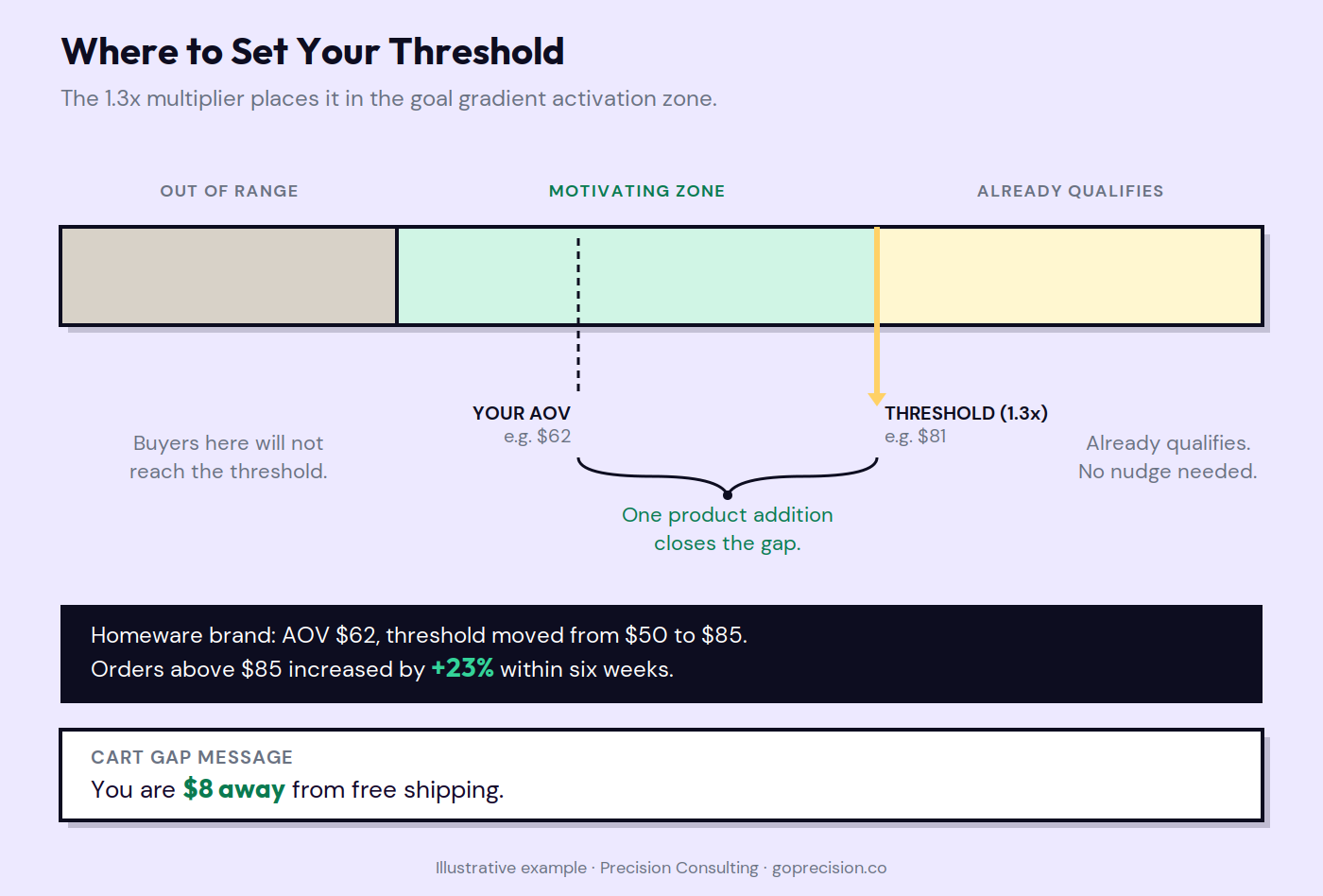
Free shipping threshold placement: where to position the threshold relative to your AOV distribution, with the goal gradient activation zone highlighted.
Why does the gap message convert better than the threshold message
The threshold message states a rule. The gap message activates a goal.
Most stores display free shipping as a policy: "Free shipping on orders over $60." That is a threshold message. It states the rule and asks the buyer to do the maths themselves. A buyer with $52 in their cart reads this and must calculate that they need $8 more, then evaluate whether that is worth the effort.
The gap message has already done the calculation: "You are $8 away from free shipping." The buyer only has to answer one question: do I want to spend $8 to remove the shipping charge? That is a different and easier question. The specificity of the gap message also activates goal pursuit more powerfully because the buyer can see exactly where the finish line is.
Show the gap message in three places: on the product page as a passive one-line reminder, in the cart as a dynamic message that updates as items are added, and in the checkout order summary as a final prompt. The cart gap message is the highest-converting placement because it appears at the moment of highest purchase intent.
A cart message that updates in real time as the buyer adds items shows them getting closer to the goal. A buyer watching their gap drop from $12 to $4 as they add an item is experiencing the goal gradient in real time. This is the same principle that makes progress indicators in checkout convert better than static field counts, a dynamic covered in the article on checkout optimisation.
If you would like to pressure-test whether your threshold and gap message are working together correctly for your specific buyer distribution, request a free audit and we will walk through the numbers with you.
How product recommendations close the gap
The most effective way to help a buyer reach the threshold is to recommend a specific product priced at or just above the remaining gap amount. Not a general "You might also like" carousel. A targeted recommendation that solves a specific problem: I need $8 more to get free shipping.
"Add a travel-size version ($9) to get free shipping" outperforms a generic carousel because it gives the buyer a concrete decision rather than a browsing invitation. Most buyers close to the threshold who see a relevant product at the right price point will add it.
What makes a gap-closing recommendation convert
Three conditions must be met. The price sits at or just above the remaining gap amount. The product is relevant to what is already in the cart. It is immediately available with no additional steps. All three must be true simultaneously. A relevant product that costs three times the gap amount will not close the gap. An irrelevant product at the right price will not close the gap. The broader psychology of complementary product placement is covered in our article on the psychology of product bundling.
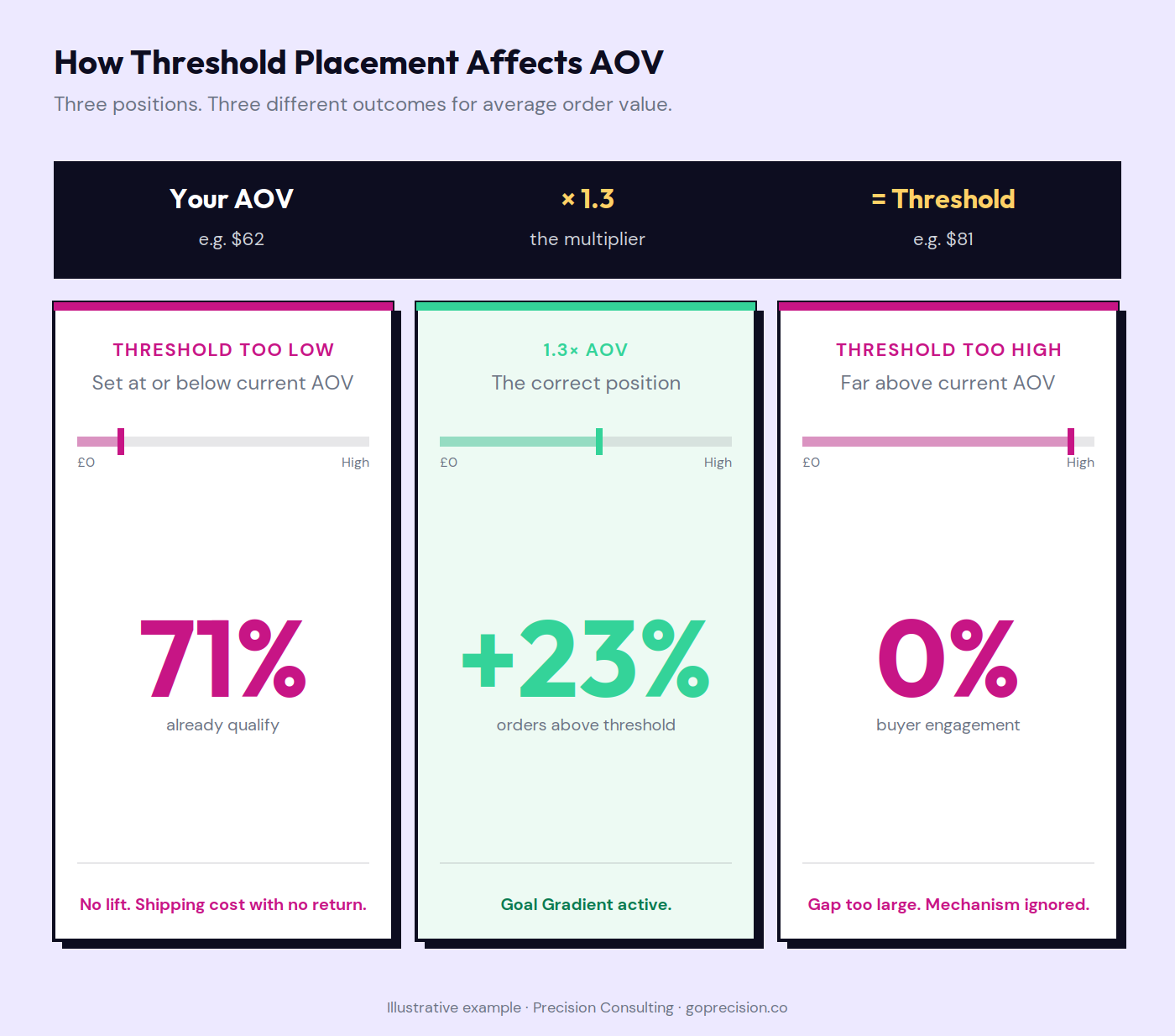
The 1.3x formula in context: buyer distribution zones, threshold placement, and how the gap narrows as buyers add qualifying items.
Why a free shipping threshold does not work for every business
When your margins cannot absorb the cost
Free shipping is not profitable at every AOV level. Run the maths before setting the threshold. The shipping cost on incremental orders must be less than the margin gained from the additional items. If the margin from the incremental spend does not exceed the shipping cost, the threshold is producing net negative economics. The broader framework for understanding how AOV and margin interact is covered in our article on how to increase average order value, which covers the full range of basket-building mechanisms and when each produces a net-positive margin outcome.
When the product category is naturally a single-item purchase
A buyer purchasing a high-value single item is not going to add a second item to reach a free shipping threshold. The natural basket is one. The mechanism does not work when there is no second item that the buyer logically wants. The threshold is in place. There is nothing for it to activate.
When delivery cost is part of the brand positioning
Some premium brands include delivery in the product price and market it as "free delivery, always." A conditional threshold creates inconsistency with that brand promise. A buyer who expects included delivery and encounters a threshold on a lower-value order has had their expectation violated. The trust cost of that violation exceeds any AOV lift the threshold might produce.
Removing or significantly raising a threshold after setting one is a trust event, not just a policy change. Buyers who previously qualified and no longer do will feel the loss more acutely than they felt the benefit when it was introduced. Loss aversion is asymmetric. If you need to change the threshold, move it incrementally over several weeks, not in a single step.
How to audit your threshold right now
Pull your last 90 days of orders. Calculate your average order value. Then look at the distribution: what percentage of orders fall below your current threshold, at the threshold, and above it?
- If more than 60% of orders are already above your threshold, it is set too low. You are buying shipping for buyers who would have spent that amount regardless. Move the threshold to your AOV multiplied by 1.3.
- If fewer than 20% of orders are reaching the threshold, it may be set too high. Look at where most orders cluster. If the majority sit at a level where the gap to the threshold is more than 40% of the typical order value, the threshold is in the demotivation zone.
- Check your gap message placements. Is it showing dynamically in the cart? Is it on the product page as a passive reminder? Is it in the checkout summary? If any of these are missing, address the messaging before adjusting the threshold level.
The order of operations matters. Threshold placement first, gap message second, product recommendations third. Changing all three simultaneously makes it impossible to isolate which change drove any improvement in AOV.
A free shipping threshold set at the right level is one of the most reliable AOV mechanisms in e-commerce. The formula is straightforward. The psychology behind it is specific. Most stores are leaving meaningful revenue on the table not because the mechanism does not work, but because the threshold is placed where it cannot. If you want to know whether your current threshold is working or costing you, the Precision services page explains how a diagnosis-led engagement identifies exactly that.
Predictably Irrational by Dan Ariely covers the Zero Price Effect in depth, including the research behind why free operates as a category change rather than a price reduction. Super Thinking by Gabriel Weinberg and Lauren McCann covers the Goal Gradient Effect and the broader class of goal-completion mental models that explain why threshold placement determines whether the mechanism activates.
- A free shipping threshold set at or below your current AOV buys shipping for buyers who would have spent that amount regardless. It delivers cost with no lift.
- The Zero Price Effect: free operates as a category change, not a price reduction. It removes a named cost rather than reducing an unnamed one. This is why free shipping consistently outperforms an equivalent cash discount.
- The Goal Gradient Effect: motivation increases as people approach a visible goal. The threshold only activates this effect when it sits roughly 20 to 40% above where the buyer currently lands.
- Starting formula: current AOV multiplied by 1.3. A homeware brand at $62 AOV, moving its threshold from $50 to $85, saw orders above $85 increase 23% within six weeks.
- The gap message ("You are $8 away from free shipping") converts better than the threshold message ("Free shipping over $60"). One activates a goal. The other states a rule.
- Show the gap message dynamically in the cart, passively on the product page, and as a final prompt in the checkout summary. The cart is the highest-converting placement.
- Gap-closing product recommendations need three conditions: priced at or just above the gap amount, relevant to the cart contents, and immediately available. All three must be met simultaneously.
- Removing a threshold after setting one is a trust event. Loss aversion is asymmetric. Move it incrementally if you need to change it.
Frequently asked questions
What is the best free shipping threshold for e-commerce?
The right threshold depends on your current average order value. The starting formula is current AOV multiplied by 1.3. This places the threshold in the goal gradient activation zone: close enough that buyers in the middle of your order value distribution see an achievable gap, far enough above the current average to produce meaningful AOV lift. Pull your last 90 days of order data, calculate your AOV precisely, and apply the formula. Then check your distribution to confirm the threshold is sitting where most buyers can see a small, closable gap.
Why does free shipping increase average order value?
The Goal Gradient Effect shows that people increase effort as they approach a visible goal. When a buyer can see they are a small amount away from free shipping, the probability of adding one more item increases significantly. The threshold only produces this effect when set above the buyer's natural spend level and close enough to be achievable with a single addition. Set it too low and it is invisible. Set it too high and buyers disengage before pursuing it.
What is the difference between a threshold message and a gap message?
A threshold message states the rule: "Free shipping on orders over $60." A gap message shows the specific remaining distance: "You are $8 away from free shipping." The gap message performs better because it activates goal pursuit by showing the buyer exactly how close they are. The threshold message requires the buyer to calculate the gap themselves, which reduces the probability that they act on it.
Where should the free shipping gap message appear on site?
Three placements produce meaningful impact: on the product page as a passive one-line reminder, in the cart as a dynamic message that updates as items are added or removed, and in the checkout order summary as a final prompt. The cart gap message is the highest-converting because it appears at peak purchase intent. Showing all three creates a coherent experience without being aggressive.
Can a free shipping threshold hurt conversion?
Yes, in specific cases. If the threshold is set so far above most buyers' natural spending level that the gap is demotivating, buyers in the mid-range stop engaging with the mechanism. If the margin on incremental orders does not exceed the shipping cost, the threshold produces net negative economics. For premium brands with an "always included delivery" positioning, a conditional threshold creates a brand inconsistency that costs more in trust than it gains in AOV.
How do I calculate the right free shipping threshold?
Pull your last 90 days of orders and calculate your average order value precisely. Multiply by 1.3 for the starting threshold. Then check your distribution: if more than 60% of orders already clear your current threshold, it is too low. If fewer than 20% are reaching it, it may be too high. The right threshold produces a meaningful concentration of orders just above it, indicating buyers are actively reaching for it.