Last updated:
Paid advertising and CRO should be prioritised in sequence rather than in competition: CRO first to make the funnel ready, paid advertising second to scale traffic through it. Most growth-stage businesses do it the other way around, and then spend more on paid advertising to compensate for the conversions they are losing. Our CRO engagements start with exactly this diagnostic before any recommendation on budget reallocation.
The two channels work on different parts of the same equation. Paid advertising puts more visitors in. CRO converts a higher percentage of the visitors already there. If your funnel is leaking, more traffic does not fix the leak. It just fills the bucket faster while the water is running out of the bottom.
This article covers when to prioritise each, how to think about budget allocation, and why the return on CRO investment compounds in a way that paid advertising spend never does. For a comparison of CRO against another organic channel, see our breakdown of CRO vs SEO and which pays back faster at each store stage.
Why does CRO compound while paid advertising spend does not?
The compounding asymmetry
Paid advertising scales linearly. Double the budget, roughly double the traffic, roughly double the orders. Pause the budget, the traffic stops. It is a tap: useful, necessary, and expensive to keep running.
CRO works differently. A checkout improvement that stops 15% of buyers from abandoning at the payment step does not expire. That improvement applies to every visitor who arrives next month, including every visitor you paid to acquire. The paid advertising benefits from the CRO work permanently, at no additional cost. It is not a tap. It is a higher pipe diameter. Every bit of traffic you push through afterwards flows faster.
This is why the timing of when you invest in each matters so much. CRO improvements made before scaling paid acquisition are worth more than the same improvements made after. The compounding base is larger, the paid traffic converts better from day one, and every pound of acquisition spend produces more return.
The numbers
The worked example below shows the same $2,000 monthly investment applied two different ways: more paid spend versus a CRO programme. The CRO option produces a larger revenue uplift from month one, costs nothing to maintain after the programme ends, and compounds further with each subsequent improvement. The paid option requires additional spending every month to maintain the gain.
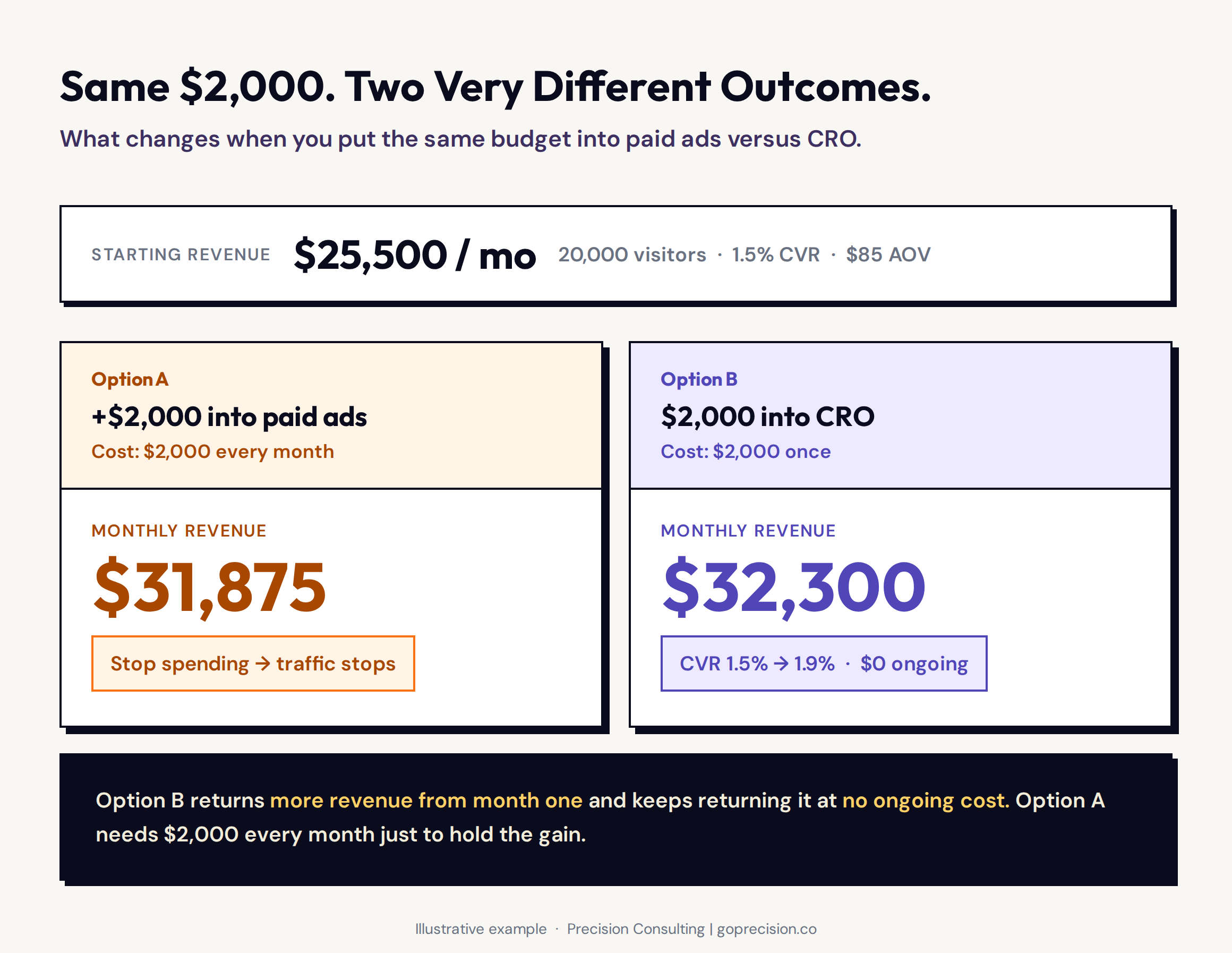
How the ROI profile differs: paid advertising is a linear tap that stops when you stop spending; CRO is a permanent improvement to how much of that traffic converts.
When should paid advertising come before CRO?
There are genuine cases where scaling paid acquisition before investing heavily in CRO is the right call. Getting this wrong in either direction costs real money, so it is worth being specific about when each applies.
Your traffic is too low to run meaningful tests
A/B testing requires statistical significance. Below roughly 5,000 to 10,000 monthly visitors, a test running on a key page may need three months to reach the confidence threshold needed to trust the result. Most businesses do not have the patience for that, and rightly so. At that traffic volume, controlled A/B testing is simply not a viable method.
That does not mean CRO is off the table entirely. Expert heuristic review, session recording analysis, and direct high-confidence fixes can still reduce friction and improve conversion without waiting for statistical significance. But the most powerful lever in the CRO toolkit, the systematic testing programme, cannot operate effectively at that scale. Below that threshold, growing traffic through paid acquisition is not just a valid priority. It may be a prerequisite for CRO to work at all.
Your funnel is already performing at benchmark
If your conversion rate is at or above your category benchmark, your session recordings show smooth navigation, and your funnel drop-off at each step looks healthy, the marginal return on CRO is lower than the marginal return on bringing more visitors in. You have already captured most of the available conversion improvement. The remaining opportunity is volume.
Most stores believe they are in this position before they have done a proper diagnosis. The audit changes the answer more often than not. But where the funnel genuinely is performing, more traffic is the right lever.
You have a time-sensitive opportunity
A product with a short relevance window, a promotional event with a hard close date, or a category moment that will not repeat itself may justify scaling traffic even into a suboptimal funnel. The key is to know the cost of that decision explicitly. If a funnel converting at 1.2% could convert at 1.7% after a week of CRO work, every thousand visitors you send in the meantime costs you five orders you could have had. Sometimes that trade-off is worth making. It should never be invisible.
When should CRO come before scaling paid advertising?
For most growth-stage businesses, CRO should be the priority before paid advertising scales. The three situations where that is most clearly true are a conversion rate below category benchmarks, rising customer acquisition cost, and diminishing returns on paid spend.
Conversion rate is below category benchmark
Below-benchmark conversion means every pound of acquisition spend is producing fewer orders than it should. You are filling a leaking bucket faster. The water is still running out of the bottom. Category benchmarks vary significantly: fashion and apparel typically sit in the 1% to 2% range, health and beauty between 2% and 4%. Before using a benchmark as a reference point, make sure you are comparing against your own category, not the market average.
Customer acquisition cost is rising
Most paid channels get more expensive over time. More advertisers, more competition for the same inventory, higher CPCs. A business whose CAC has increased 20% year over year is facing a structural economic problem that more spending does not solve.
The only lever that improves unit economics without requiring higher spend is conversion rate. A 20% improvement in conversion rate is the exact financial equivalent of a 20% reduction in CAC. It requires no ongoing cost to maintain.
Paid spend is showing diminishing returns
Every paid channel has a point of diminishing returns. The first tranche of the budget captures the most efficient inventory. Each subsequent tranche captures progressively worse inventory at a higher cost. When ROAS is flat or declining against increasing spend, continuing to push budget into the same channel produces less and less per pound.
This is the sunk cost problem applied to channel allocation. Having already invested in building paid infrastructure, attribution models, and creative libraries, most businesses continue increasing paid spend past the point of diminishing returns because stopping feels like waste. The alternative, redirecting that next marginal pound to CRO where the return is higher, requires acknowledging that the current allocation is suboptimal. That is a harder decision than it looks on a spreadsheet.
Not sure whether your funnel is ready to scale paid acquisition? Request a free audit and we will give you a direct read on where the conversion losses are and whether paid or CRO deserves the next pound.
How should you think about CRO vs paid advertising budget allocation?
Most growth-stage businesses spend less than 5% of their growth budget on conversion optimisation. The research and practitioner consensus suggests 15% to 25% is a more defensible allocation. The gap between those two numbers is where most of the revenue is being left.
The simplest way to sense-check your own allocation: calculate the monthly revenue impact of a 0.3 percentage point improvement in your conversion rate on your current traffic and AOV. Compare that to the monthly incremental revenue a 10% increase in your paid acquisition budget would produce at your current conversion rate. For most growth-stage businesses, the CRO number is larger, often significantly so. Our article on how to calculate CRO ROI walks through the formula in full.
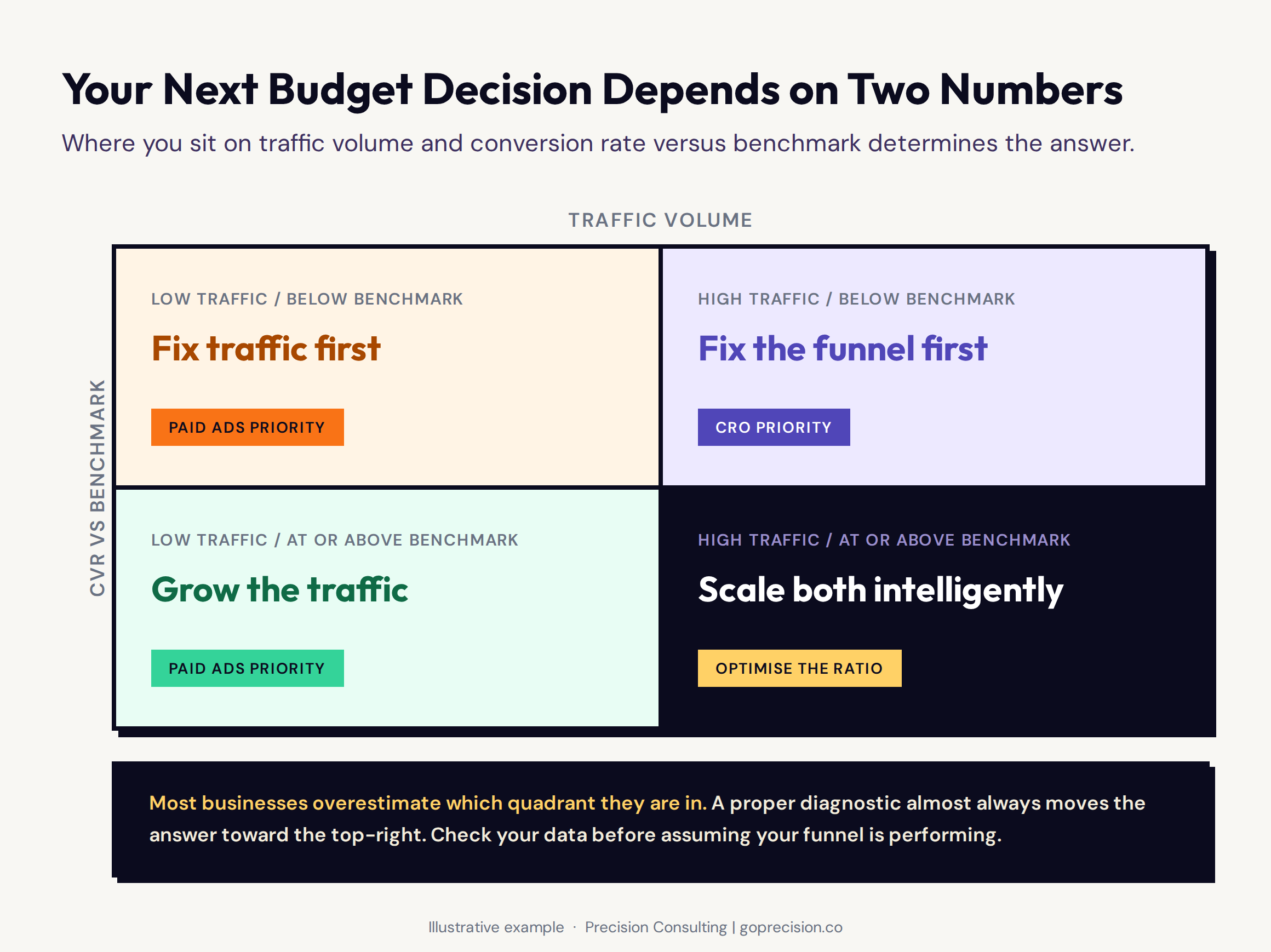
Where to direct the next pound of growth budget, based on traffic volume and current conversion rate relative to category benchmark.
A workable starting allocation for a business between 15,000 and 50,000 monthly visitors is roughly 70% to 75% on paid acquisition and 25% to 30% on conversion. As traffic scales and acquisition costs rise, the balance should shift further toward conversion. Above 100,000 monthly visitors, the economic case for spending less than 30% on CRO is hard to construct.
Think of the allocation as a sequence, not just a ratio. CRO diagnostic first, to build the friction hierarchy and validate analytics. Testing programme second, to address the highest-impact friction points. Paid acquisition scaling third, to drive more traffic through the improved funnel. Running both in parallel from the start is less efficient because it means paying for acquisition before the funnel is ready to convert it well.
What does CRO investment actually return over time?
CRO is not a one-time spend. Think of it like a renovation on a property you are planning to rent. You could advertise the property as-is and get tenants. Or you could spend six weeks improving it before listing, charge more per month, and recoup the renovation cost within a few months. The renovation is a one-time cost. The improved rental yield is permanent. For a precise look at what drives the timeline, how long CRO takes to show results breaks down the variables that determine when you see meaningful movement.
The diagnostic stage is the survey: finding out exactly what needs fixing before spending on materials. Done well, it prevents months of work on the wrong pages. The testing stage is the renovation itself: addressing the friction points in priority order, measuring the impact of each change. The compounding stage is the improved yield: each improvement raises the baseline for the next one.
Programmes that invest in structured CRO for twelve months typically see the overall conversion rate improve by 0.3 to 0.8 percentage points. On a business with 30,000 monthly visitors at $80 AOV, a 0.5-point improvement is $12,000 per month in additional revenue. Over twelve months, $144,000 in incremental revenue from the same traffic. The programmes that outperform that range are almost always the ones that started with the most rigorous diagnostic.
- Paid advertising and CRO work on different parts of the same equation. Paid brings visitors in. CRO converts a higher percentage of them. The question is not which to choose but which to prioritise first at your current stage.
- Paid advertising is a tap: useful, necessary, and expensive to keep running. CRO is a wider pipe. Every bit of traffic you push through it afterwards flows faster, including the traffic you pay for.
- CRO improvements compound. A conversion rate gain made today applies to every future visitor, including those acquired through paid channels, with no ongoing cost.
- Prioritise paid first when traffic is too low for meaningful testing (below 5,000 to 10,000 monthly visitors), when the funnel is genuinely performing at benchmark, or when a time-sensitive opportunity requires volume now.
- Prioritise CRO first when conversion rate is below category benchmarks, when CAC is rising quarter over quarter, or when paid spend is showing diminishing returns on ROAS.
- Most growth-stage businesses spend less than 5% of their growth budget on CRO. The practitioner consensus suggests 15% to 25% is a more defensible number. The gap between those two figures is where the revenue is being left.
- The right sequence: CRO diagnostic first, testing programme second, paid acquisition scaling third. Scaling acquisition before the funnel is ready means paying for traffic the funnel is not yet ready to convert.
Frequently asked questions
What is the difference between CRO and paid advertising?
Paid advertising increases the volume of visitors arriving at your store. CRO increases the percentage of those visitors who complete a purchase. Paid advertising costs money continuously: stop spending, and the traffic stops. CRO improvements are permanent: a funnel improvement that raises conversion rate from 1.5% to 2.0% applies to every future visitor, including those acquired through paid channels.
Should I do CRO before or after scaling paid ads?
If your conversion rate is below category benchmarks, do CRO first. Every pound you spend on acquisition is currently producing fewer orders than it should. If your funnel is genuinely performing well and you have a time-sensitive growth opportunity, scale paid first. For most growth-stage businesses, CRO before or alongside paid scaling produces more efficient returns because conversion improvements compound in a way that traffic volume alone does not.
How much of my marketing budget should go to CRO?
The practitioner consensus is 15% to 25% of your total growth budget. The majority of businesses allocate less than 5%. The simplest way to sense-check your own number: calculate the monthly revenue impact of a 0.3 percentage point improvement in your conversion rate and compare it to what a 10% increase in your paid acquisition budget would produce. The one that produces more is the one that deserves more.
Can CRO replace paid advertising?
No. CRO maximises the return on visitors you already have and those you acquire. Paid advertising generates new visitors. A business that invests in CRO without acquiring new visitors improves the efficiency of a flat traffic base. Both are needed. The question is the sequencing and the allocation between them.
What is a realistic CRO return on investment?
A well-structured twelve-month CRO programme typically produces 0.3 to 0.8 percentage points of conversion rate improvement. On a business with 30,000 monthly visitors at $80 AOV, a 0.5-point improvement represents $12,000 per month in additional revenue with no increase in acquisition spend. That is $144,000 over twelve months from a programme that typically costs significantly less than that to deliver.
The CRO vs paid advertising question is not really a channel preference debate. It is a sequencing and ROI question, and the maths usually point in the same direction: make the funnel ready before scaling the traffic through it. If you want to run those numbers on your own store before deciding where the next pound goes, our audit engagement starts with exactly that calculation.
Predictably Irrational by Dan Ariely covers the psychological mechanisms behind why small conversion improvements compound in ways that feel disproportionate. Hooked by Nir Eyal covers the mechanics of habitual product use.
