Last updated:
An exit intent popup recovers a sale when it removes an obstacle between the visitor and a goal they already had. It backfires when it asks for something new at the moment they decided to leave.
Imagine you are halfway out of a shop and an assistant steps into your path. If she says, "You left your umbrella," you thank her. If she says, "Before you go, can I take your email address?", you sidestep her and quietly decide not to come back.
That is every exit intent popup on the internet. Same trigger. Same split second. Opposite outcome. And the difference is never the design. It is what the popup asks for.
Most of what is written about exit popups misses this. One camp quotes the best-case numbers. Wisepops' analysis of a billion popup displays found exit-intent campaigns converting at 2.81% on average, with the top 10% reaching around 19%. The other camp hands you a listicle. Add urgency. Add a discount. Make the close button obvious.
Neither tells you why the same tactic wins 19% on one store and gets the tab closed in disgust on the next. Not a design problem. A demand problem.
In the work we do at Precision, this is the first question we ask before touching a client's popup copy or offer. Most popup tools never ask it for you.
Why does interrupting someone on their way out ever work?
Think about what a visitor is doing when their cursor swings towards the tab bar. They have already made a decision. They are leaving. That decision has direction and momentum, like someone already walking towards the door.
An exit intent popup fires right as that decision is about to complete. Which makes it either the best moment to interrupt someone or the worst. What decides it is what you say.
The research here is older than most of the tools selling exit intent as a feature. In 2002, Edwards, Li, and Lee published a study in the Journal of Advertising on pop-up ads and perceived intrusiveness. They tied the feeling of intrusion to psychological reactance. That is the reflex you get when someone tells you what to do, and you do the opposite on principle. Teenagers do it to their parents. Adults do it to pop-ups.
Here is the detail that matters. Interruption alone was not the problem. What made a pop-up feel intrusive was how badly it fitted the task the person was already doing, and how absorbed they were when it appeared. A popup that lands while someone is idly browsing feels very different from one that lands while they are trying to finish something and leave.
An exit intent popup hits the most goal-directed moment on your whole page, because the goal (leaving) is one the visitor set for themselves a few seconds earlier. Whatever the popup does next either helps that goal or fights it.
Psychological reactance is the discomfort people feel when something threatens their freedom to choose. The usual response is to reassert that choice harder than before. Edwards, Li, and Lee tied perceived intrusiveness to exactly this response, with irritation and ad avoidance following. A popup does not have to be ugly or badly written to annoy someone. It just has to show up mid-goal and ask for something else.
What makes an exit intent popup win back the sale instead of losing it twice?
The popups that work answer a question the visitor is already asking themselves. They do not start a new conversation.
Take someone with three items in their cart, about to close the tab. They are not wondering whether they want your newsletter. They are wondering whether the thing they half-committed to is still worth buying. A popup that meets them there, with a discount code, free shipping, or a note that their cart is saved, is answering the question already in their head. It is the same moment behind most cart abandonment, and the same reason a well-matched message can reverse it.
There is a reason that lands so hard. Once a shopper has built a cart, they have started to own what is in it, at least in their head. Walking away feels like losing something, not just declining to buy. That is loss aversion. Kahneman and Tversky's 1979 research found people feel a loss roughly twice as strongly as they feel an equal gain.
Think of a supermarket trolley you have already half-filled. Abandoning it in the aisle feels like waste, not a neutral act. A well-timed popup makes that loss concrete at the exact moment the visitor is weighing it. "Your cart is saved." "Here's 10% to finish this order."
The numbers back this up. OptiMonk's 2025 data put cart-abandonment exit popups at a 17.12% conversion rate. Omnisend's figure for generic exit-triggered email capture popups is 1.8%. That is roughly nine times higher on the same trigger.
Same detection. Wildly different result. One popup closes a loop the visitor had already opened. The other tries to open a new one.
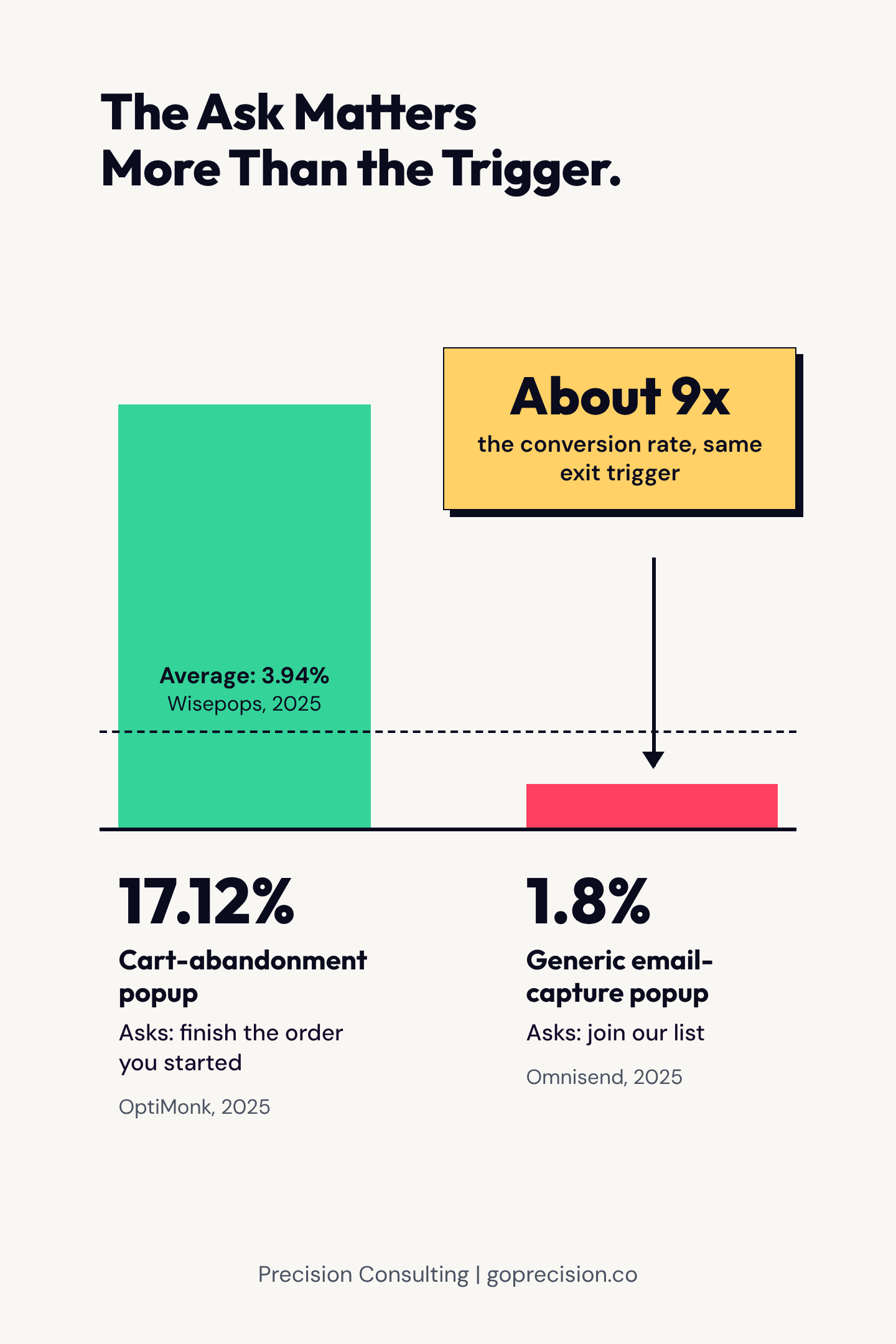
Same exit trigger, very different results: offers matched to the visitor's obstacle against generic offers.
Before you write any exit popup copy, finish this sentence from the visitor's side: "I was about to leave because ___." If your offer answers that blank, it will recover sales. If the honest answer is "I don't need a newsletter" and your popup offers a newsletter, rewrite the offer before you touch the design.
Matching an offer to an obstacle starts with knowing where your own buyers get stuck. The Cart and Checkout checklist in the CRO Leak Finder kit is a fillable PDF you work through step by step. Tick what applies, fix what is flagged, and you will know which obstacle your exit popup should be answering. Get the kit.
Why do the same tactics put visitors off on other sites?
Flip it, and you get the backfire. Someone came to read a blog post, or was never close to buying. They get the same popup: an email form gating a discount they never wanted, triggered by the same mouse movement. That is the assistant with the clipboard.
Nothing about their situation matches the offer. You are not removing friction from their exit. You are putting a new decision in front of them at the moment they had decided not to make one.
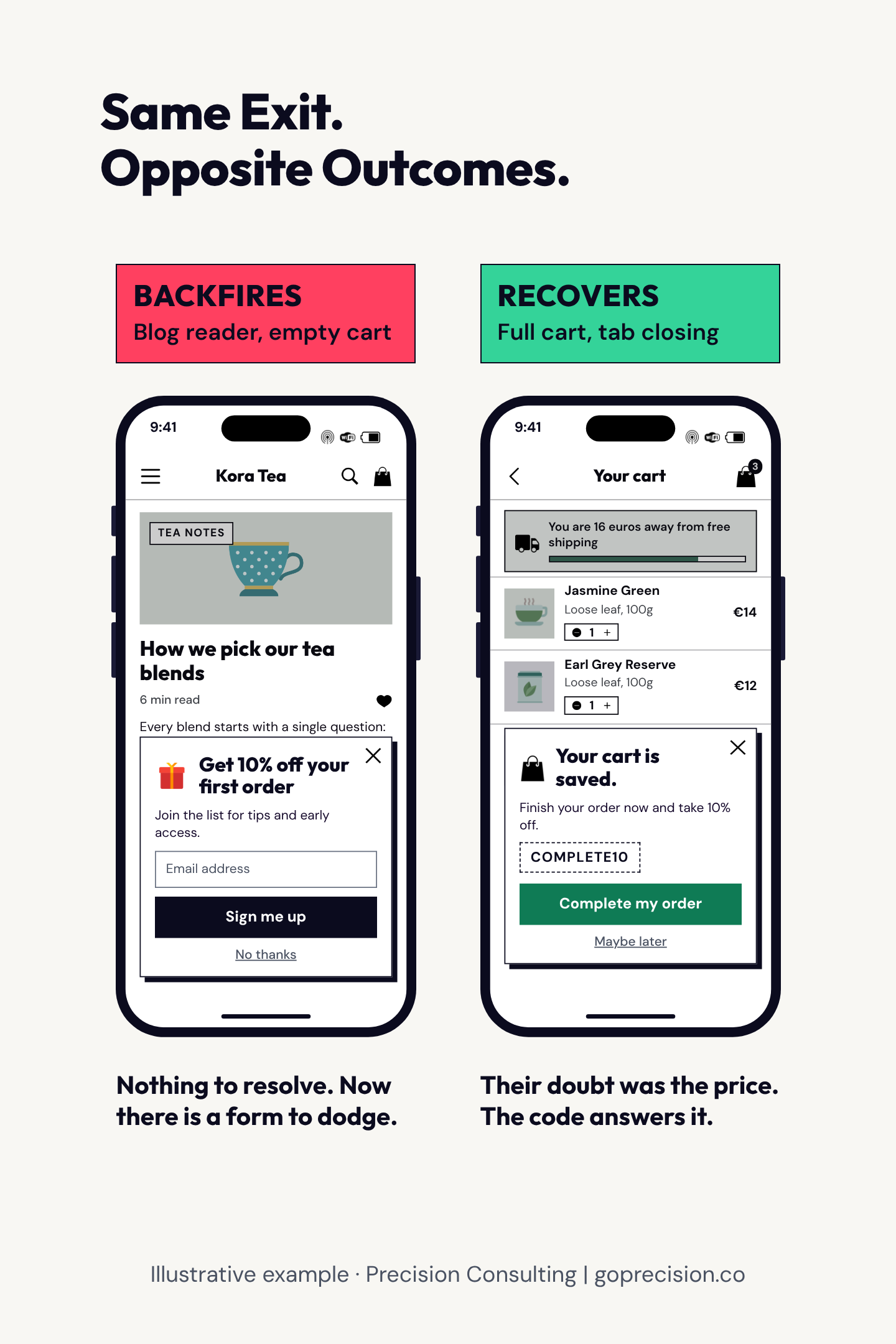
The same exit trigger with two different offers: one backfires, one recovers an abandoned cart.
OptiMonk's survey on how people view popups shows the split clearly. 54.2% consider popups effective for list building. But 23.5% called them annoying despite that, and 22.3% said they actively dislike the experience.
Read those together, and you get the split reactance theory predicts. The tactic works on the people whose goal it happens to serve. For everyone else, the same popup costs you goodwill.
This is not really a targeting failure. It is a category error. Most stores treat "someone is about to leave" as one audience with one motive. It is actually two audiences wearing the same exit signal. One group is leaving because something is unresolved. The other is leaving because they are done.
You can recover the first group. Asking the second group for their email in exchange for staying does not recover them. It confirms they were right to go.
Read the OptiMonk numbers as segments, not one average. Just over a fifth (22.3%) actively dislike popups. Another 23.5% find them annoying even while admitting they work. The rest are closer to the people the popup was built for. One popup with one offer cannot suit all of them, because the offer that clears one person's obstacle is the exact interruption another person is reacting against.
When we review a client's store, a mismatch between offer and obstacle is one of the most common reasons an exit popup falls short of its own benchmark. A quick popup audit usually turns up the same offer going to visitors in completely different states.
What is the one variable that decides which outcome you get?
Strip away the copywriting, the colours, and the countdown timers, and every exit popup comes down to one question. Does it remove an obstacle between the visitor and the goal they already had? Or does it add a new one?
That is the whole mechanism. The discount amount, the headline, and the button colour only matter once that question is answered correctly.
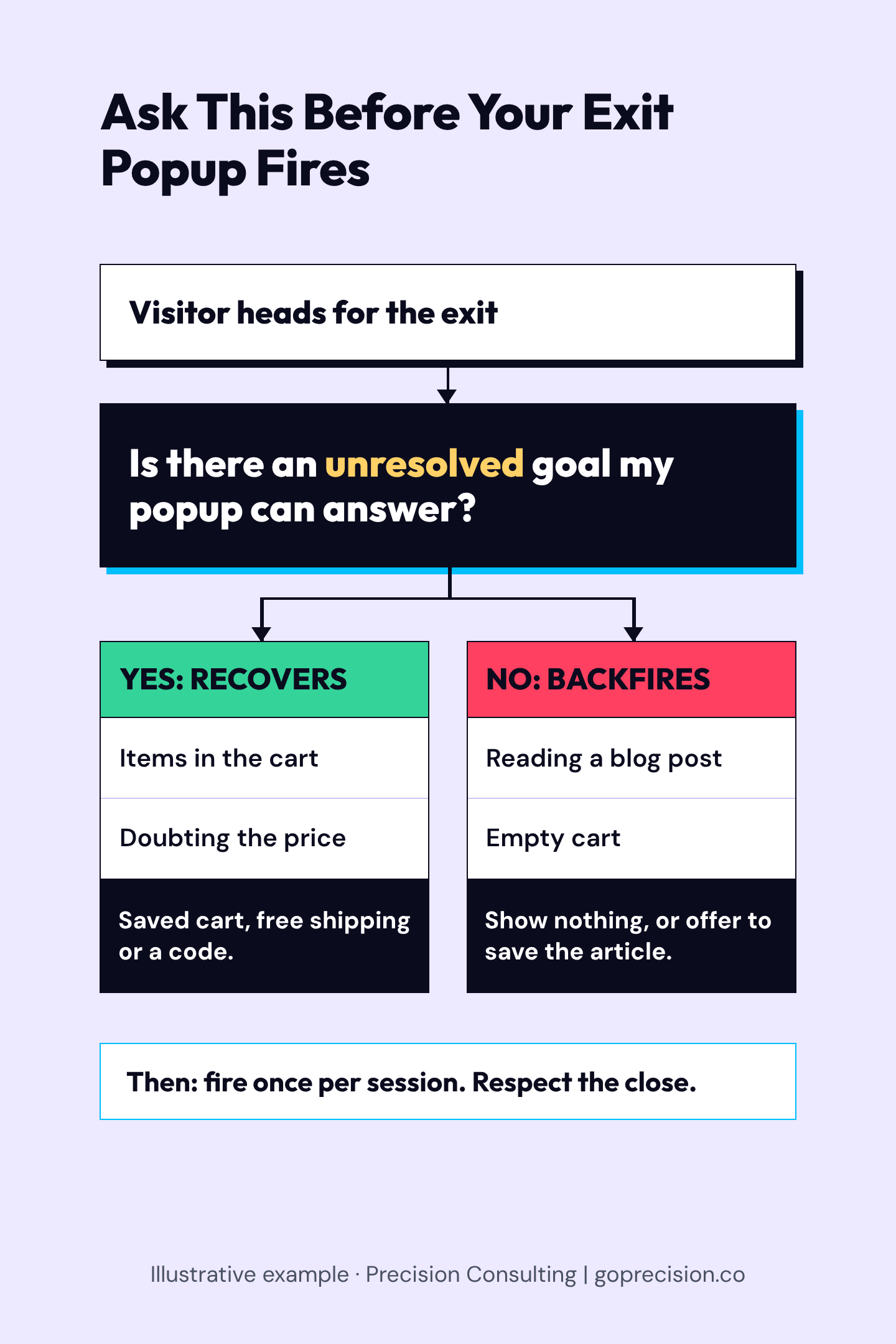
One branch decides the outcome: does the popup remove an obstacle to the visitor's own goal, or add a new one?
Picture two stores with identical setups. Same trigger. Same detection tool. Store A shows a visitor with a full cart this message: "Your cart is saved. Here's 10% off to complete it." Store B shows a visitor who is just browsing the same message.
Store A is answering a real question. The visitor was weighing whether the price was worth it, and the discount speaks to that directly. Store B has no cart to save and no obstacle to remove, so the popup invents one ("you'll lose this discount") that did not exist a second ago.
Store A recovers a sale it was about to lose. Store B irritates someone who was never going to buy today, and teaches them to link the brand with a cheap trick.
So the trigger condition is not "exit intent." It is "exit intent plus an unresolved goal." Leave out the second half, and the mechanism that makes the popup work becomes the one that makes it backfire.
How do you build an exit intent popup that recovers instead of repels?
You do not need a smarter algorithm to detect intent. You do not need five popup variants running at once. You need to match the offer to the state the visitor is actually in when they try to leave.
- Segment by what is unresolved, not by page. Someone with items in the cart gets a cart-recovery message. Someone reading a blog post with an empty cart gets nothing, or something genuinely low-commitment, like saving the article. Never a hard sell dressed up as a favour.
- State the loss in their terms, not yours. "Complete your order before this reserved price expires" speaks to what the visitor stands to lose (only say it if it is true, as covered in the psychology of scarcity and urgency). "Sign up for 10% off" speaks to what you want. The first uses loss aversion properly. The second just uses a popup.
- Fire once per session, and mean it. A popup that returns after being dismissed is not persistence. It is the site refusing to accept the visitor's answer, which is exactly the free-choice threat that triggers reactance.
- Make the exit as easy to find as the offer. A hidden close button, or a fake one that opens another offer, turns goodwill into the exact complaint Edwards, Li, and Lee studied: perceived intrusiveness, which they linked to irritation and ad avoidance.
- Test for false positives before you test the copy. Mobile scroll-up and tab-switching often get misread as exit intent. A popup that fires on someone who was never leaving has already failed. They were not leaving. They were reading, or checking something else.
- Do not disguise the popup as something it is not. A close button styled to look broken, or a modal dressed as a system alert, buys a click today and confirms what the visitor already suspected. You then spend the rest of the visit overcoming that, not just the next ten seconds.
When is an exit intent popup the wrong tool entirely?
Some sites should not run one at all. Think high-consideration B2B and service pages. When someone leaves those, the goal is usually "I need to think about this" or "I'm comparing you with someone else." There is no cart to save, and no price objection a 10% code can answer.
A popup there does not recover anything. It adds the one thing the research on intrusiveness keeps flagging: a forced interruption with nothing to offer the goal already in motion.
If you cannot finish the sentence "the visitor was about to leave because ___" with something a popup can genuinely solve, the answer is not a better popup. It is no popup, and a better answer to the real objection further up the page. A generous returns policy, for example, uses the same loss aversion mechanism and is worth checking before you touch the popup.
- Exit intent popups recover sales when they remove an obstacle to a goal the visitor already had. They backfire when they add a new one.
- Edwards, Li, and Lee's 2002 Journal of Advertising research tied perceived intrusiveness to psychological reactance. Pop-ups feel intrusive when they interrupt a task and have nothing to do with it, which drives irritation and ad avoidance.
- Cart-stage exit popups convert at 17.12% (OptiMonk 2025). Generic email capture exit popups convert at 1.8% (Omnisend). Same trigger. One closes a loop the visitor opened. The other opens a new one.
- OptiMonk's popup survey found 22.3% of people actively dislike popups and 23.5% find them annoying even while admitting they work.
- Do not design for "exit intent." Design for exit intent plus an unresolved goal the visitor still holds.
- A popup that returns after being dismissed, or hides its close button, triggers the exact reactance the research warns about.
- Some pages, especially high-consideration B2B and service pages, have no obstacle a popup can remove in the moment. On those, the honest fix is no popup at all.
Influence by Robert Cialdini is the foundational text on reciprocity and commitment, both of which shape why a discount offered at the exit moment lands differently depending on what has already been given or promised earlier in the visit.
Predictably Irrational by Dan Ariely expands on the loss aversion mechanics behind cart abandonment and why a saved cart feels like something already owned, not something still being considered.
Frequently asked questions
Do exit-intent popups actually work, or is that just marketing-tool copy?
Yes, but only for visitors whose exit the popup can actually explain. Wisepops' analysis of a billion popup displays found exit-intent campaigns averaging 2.81% conversion, with the top 10% reaching around 19%. That average hides a big split between offers matched to an unresolved goal and offers that are not.
What is the single biggest reason exit popups get closed immediately?
The offer does not match what the visitor was already trying to resolve. A generic email capture popup shown to someone with an empty cart asks them to start a new decision just after they finished making one: to leave. That is the goal interruption Edwards, Li, and Lee tied to reactance, irritation, and ad avoidance.
Should every e-commerce site run an exit-intent popup?
No. It only makes sense when there is a real obstacle a popup can resolve, such as an abandoned cart, a price objection, or a shipping-cost surprise. On content pages, browse pages, or high-consideration service pages with no cart and no clear objection, a popup has nothing to offer. It just adds the intrusiveness the research warns about.
Does showing the same popup twice to someone who already dismissed it help recovery rates?
No, and it usually does the opposite. The visitor made their choice when they closed it. Showing it again overrides that choice, which is what reactance theory says provokes the strongest pushback. One firing per session, respected, protects the recovery rate the first popup was trying to earn.
If your exit popups convert well below the 2 to 3% benchmark, the popup itself is rarely the problem. It is what it asks for at a moment the visitor has already answered. Our CRO services include a conversion audit that shows you exactly where that mismatch is happening on your site.