Last updated:
Scarcity and urgency work because the fear of missing out is a more powerful motivator than the prospect of gaining something equivalent. This is not an opinion. It is one of the most reliably replicated findings in behavioural economics, described by researchers as loss aversion, and it has a direct and measurable effect on purchasing behaviour. The challenge is not whether to use scarcity and urgency in your product. The challenge is how to use them without crossing the line into manipulation that destroys the trust you have worked to build.
Scarcity and urgency are not the same thing, though they are often used together. Scarcity is about limited availability: only three seats left, this pricing tier closes Friday, just two units in stock. Urgency is about limited time: the offer ends tonight, the trial expires in 48 hours, your cart expires in 20 minutes. Both create the same psychological effect. They shift the buyer's frame from a comfortable, open-ended decision to a choice that has a cost attached to delay. That shift is the mechanism. Everything else follows from it.
What goes wrong is not the mechanism. What goes wrong is fabrication. Countdown timers that reset. Stock indicators that never change. Flash sales run every week. When buyers notice that the scarcity was not real, the damage is not just to that transaction. It is to every future transaction with that store.
Most urgency tactics backfire not because the psychology is wrong, but because the signal is fake. This is the guide to using scarcity and FOMO in ways that lift conversion without costing you trust.
Why scarcity and urgency work: the psychological mechanism
Loss aversion is the tendency to feel the pain of a loss more acutely than the pleasure of an equivalent gain. Losing $20 feels worse than finding $20 feels good. In the context of any product decision, the possibility of losing access to something at its current price, or losing it entirely, activates the same response. The buyer is no longer evaluating whether to buy. They are evaluating whether they can afford not to.
People want things more when they might not be able to have them
There is a familiar version of this outside of product decisions. A restaurant with a queue outside always looks more worth entering than one with empty tables, even if you know nothing else about either. The scarcity itself signals value. The same mechanism runs in any buying context: a product, a plan, a seat in a cohort becomes more desirable simply because it is harder to get.
Identical products are rated as more valuable when described as rare than when described as widely available. This is the scarcity heuristic, documented in detail in Dan Ariely's Predictably Irrational: the perceived value of an item is not fixed. It is contextual, and availability is one of the strongest contextual signals. What it means in practice is that an e-commerce product sitting in a cart for days will often get purchased the moment a genuine low-stock notification appears, and a SaaS prospect on the fence will often convert when the early-access pricing tier is about to close. The product has not changed. The buyer's perception of what they stand to lose has changed.
A deadline turns 'I will come back to this' into a decision now
Without a deadline, there is no cost to delay. The brain's default is to defer: it conserves effort by treating open-ended decisions as things that can be resolved later. A countdown timer or expiring offer changes that calculation. Now waiting has a cost. The decision can no longer be deferred without consequence.
Research by Ran Kivetz and colleagues at Columbia shows that people accelerate effort toward a goal as the visible finish line gets closer. The same principle runs in reverse with time limits: as a deadline approaches, the motivation to act before it passes increases. A runner in the final hundred metres of a race does not slow down. A buyer seeing a timer with twelve hours remaining responds differently from one seeing four days, even if the actual gap between decision and deadline is identical.
Urgency works through loss aversion, one of six mental shortcuts explained in the Buyer Psychology Playbook. It is one of nine PDFs in the CRO Leak Finder kit, and it explains each shortcut by mechanism so you can apply it to your own pages. Get the kit.
What is the difference between real scarcity and manufactured scarcity?
Real scarcity is when a product genuinely has limited availability. A handmade item with a three-day production time per unit is scarce. A seasonal product available only until a specific date is scarce. A limited-run colourway with a fixed production count is scarce. Communicating this honestly is not manipulation. It is giving the buyer information that is relevant to their decision.
Manufactured scarcity is when you create the appearance of limitation where none exists. A stock counter that shows "only 2 left" regardless of actual inventory levels. A flash sale countdown that resets every 24 hours. A "limited time" banner that has been there for six months. These tactics work in the very short term, in the same way that a one-time lie works. The problem is that buyers notice, and the consequence of being caught is disproportionate to the short-term gain.
Your buyers notice faster than you expect
Buyers are more sophisticated than most stores give them credit for. They shop at multiple stores. They screenshot prices. They compare notes. A countdown that resets, a flash sale that runs every weekend, a stock counter that never changes: these are noticed. Review sites, Reddit threads, and social media are full of examples of buyers calling out specific brands for fake urgency tactics.
The commercial damage is not limited to the buyer who notices. It extends to every potential buyer who reads that review or sees that post. Trust, once damaged, is difficult to rebuild. The conversion lift from a fake countdown timer is measurable over days. The trust damage is measurable over years.
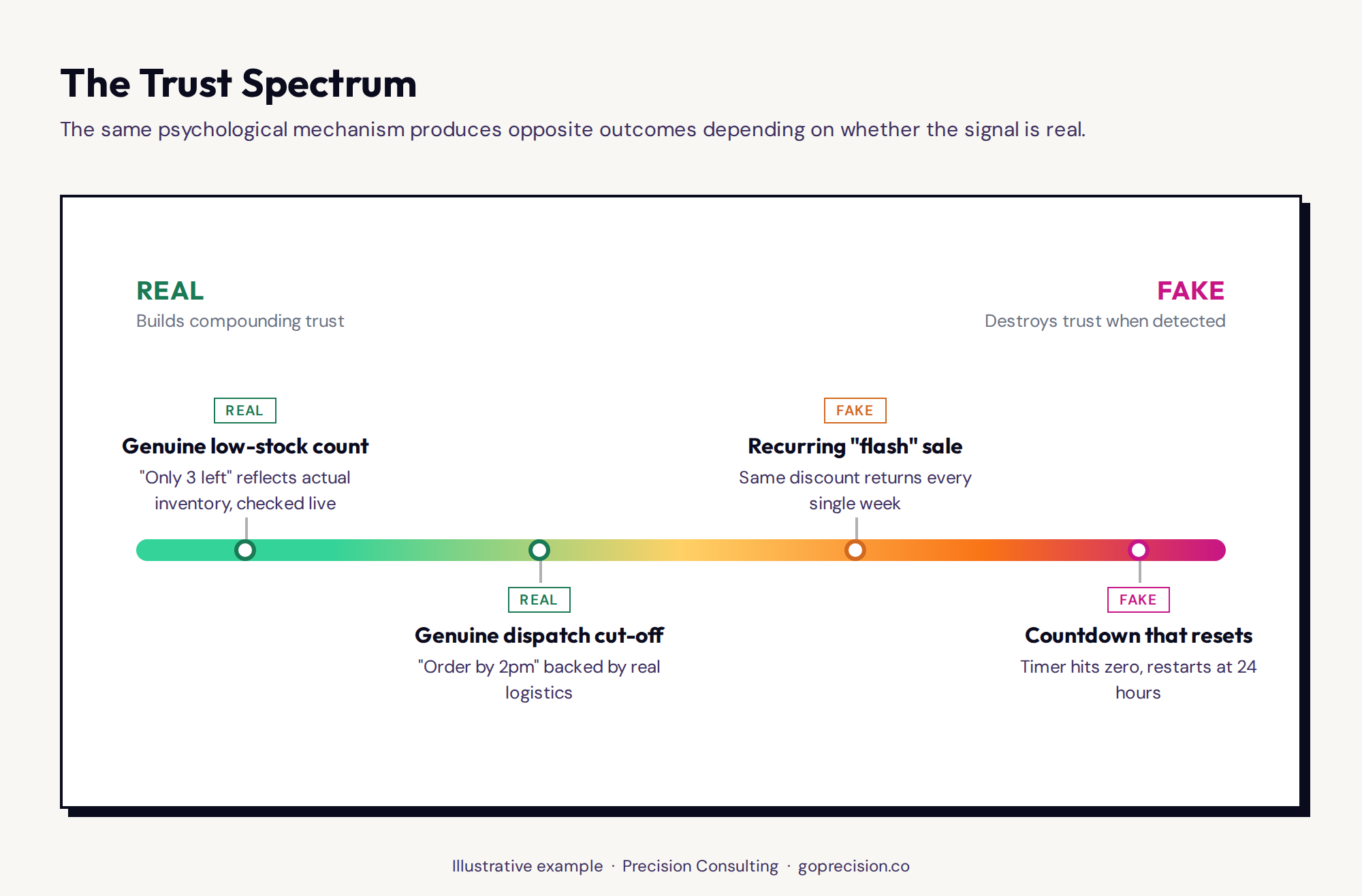
The trust spectrum of urgency: genuine signals compound trust, fabricated ones compound scepticism.
Which genuine scarcity and urgency signals can you use?
There are more genuine sources of scarcity and urgency available to most product businesses than founders often realise. The challenge is identifying them and communicating them clearly, rather than inventing constraints that do not exist.
Your availability is limited, and your buyer does not know it
Physical inventory with fewer than five units remaining is the most obvious form of genuine scarcity, but it is not the only one. A SaaS product onboarding in cohorts has limited seats per cohort. A consultancy running a six-week programme has a cap on how many clients it can take. A subscription with early-access pricing has a genuine deadline before the price rises. In each case, the constraint is real. Most businesses do not surface it.
That silence is a missed conversion. From the buyer's perspective, knowing about a real constraint is relevant to their decision. Without it, they may assume the offer is always available and defer the purchase to a moment that never comes. Specificity signals reality: "Only 3 spots left in the October cohort" is more credible than "Limited availability."
Time-based constraints you already have are worth communicating
Same-day dispatch cut-offs are among the most credible urgency signals available to physical product businesses because they are operational truths, not marketing inventions. A buyer who needs a product by the weekend benefits from knowing that ordering before 2 pm guarantees next-day delivery. The urgency is real. The deadline is external. Nothing has been manufactured.
The SaaS equivalent is the trial expiry. If a prospect is seven days into a 14-day trial and has not yet experienced the core value, a clear "Your trial ends in 7 days" is both useful and urgent. The same applies to pricing tier closures, annual plan discount windows, or onboarding cohort start dates. This form of urgency is self-validating: if the deadline is real and the consequence follows, the trust signal reinforces itself next time.
A real end date is all the urgency you need
A genuine promotional period with a real end date creates legitimate urgency across any product category. A price reduction running until the end of a specific event, a bundle offer available for a defined number of days, a seasonal line clearing before a new collection, an annual plan discount closing at the end of the month: all of these give the buyer real information about when the conditions they are seeing will change.
The discipline is consistent regardless of product type: when the deadline passes, the conditions must actually change. A SaaS product that offers "launch pricing" for eighteen months is not offering launch pricing. It has trained its buyers not to believe the next urgency signal either. Consistency is what makes promotional urgency credible over time.
Other people deciding is its own urgency signal
"12 people are viewing this right now" and "Sold 43 times today" are e-commerce versions of a signal that works just as well in other contexts. "847 companies signed up last month" on a SaaS pricing page, or "14 people joined this cohort" on a course enrolment page creates the same effect: other people are making this decision, which means there may not be room for everyone.
When the figures are accurate, these signals are highly effective because they combine scarcity with social proof. The same caveat applies regardless of product type: when the figures are fabricated or inflated, experienced buyers notice, and the consequences for trust are significant.
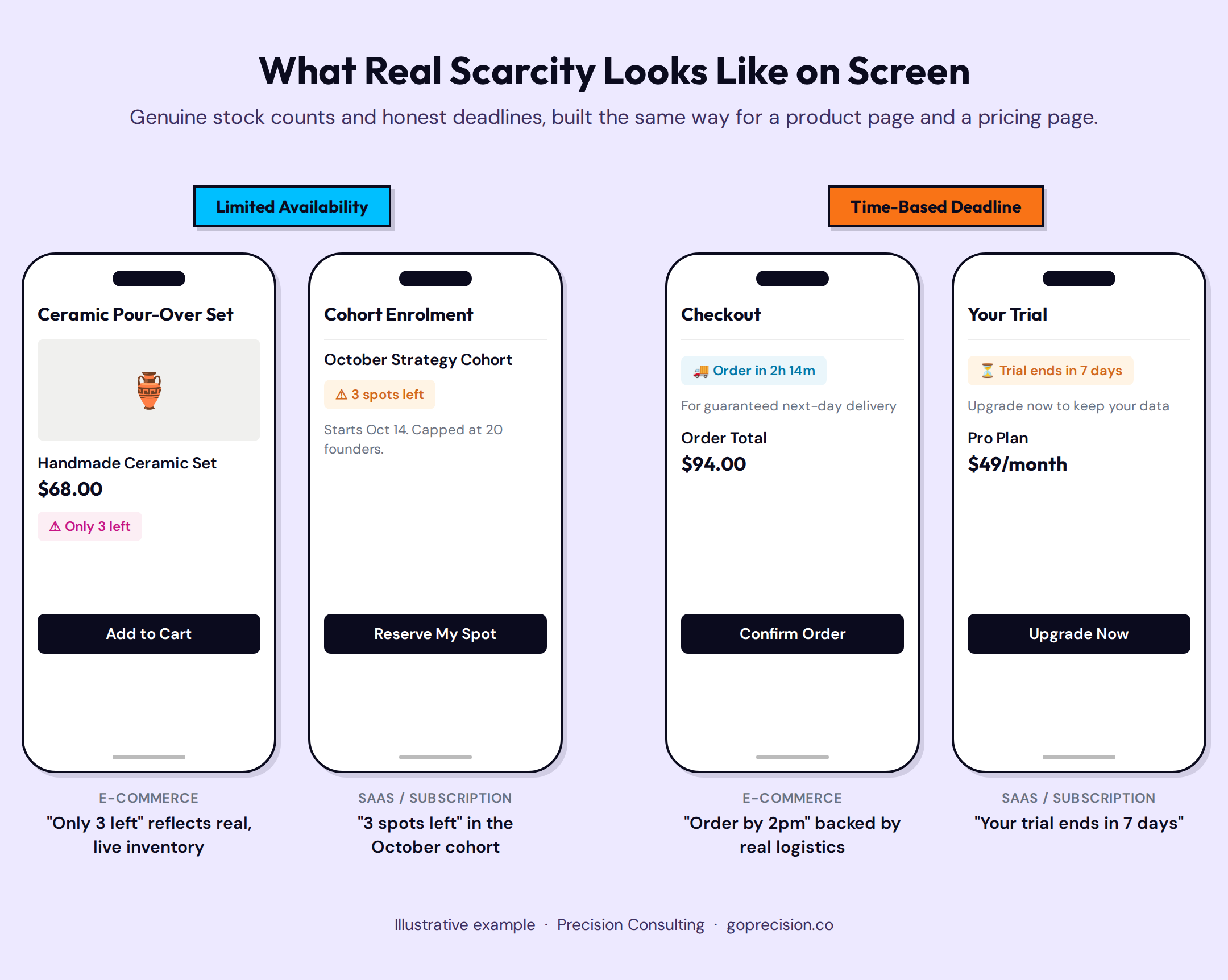
What real scarcity looks like on screen: the signals that are credible because they reflect an actual condition.
How to implement scarcity and urgency without crossing the line
The line between ethical urgency and manipulation is not whether the psychological mechanism activates. It is whether the underlying condition is real. Loss aversion is a normal human response. Activating it with false information is manipulation. Activating it with true information is good communication.
Most products are running urgency signals that have never been checked
Start by auditing every urgency or scarcity signal currently on your site or product. For each one, ask: is the underlying condition real and verifiable right now? A stock counter should reflect actual inventory. A cohort badge should reflect the actual available places. A countdown should reflect an actual deadline. A "limited time" label should correspond to a date when the offer actually ends. If any of these signals are disconnected from reality, remove or fix them before doing anything else.
This audit matters not just ethically but commercially. Fake urgency works until it does not, and the point at which it stops working is usually also the point at which it starts actively damaging your brand. Cleaning up manufactured signals before they are noticed is the better outcome. The most common CRO mistakes include running signals that were never grounded in data in the first place — urgency is one of the most frequent offenders.
Applying urgency to everything makes it credible for nothing
Evergreen offers with no genuine constraint do not benefit from urgency framing and look suspicious when it is applied. What you see on most sites is urgency signals used indiscriminately: every product has a "low stock" badge, every SaaS plan has a "limited time" offer, every course has a countdown. When everything is urgent, nothing is.
Reserve low-stock warnings for products that actually run out. Use countdown timers for offers that actually end. Apply demand signals to products or plans that actually attract significant interest. The selectivity itself creates credibility. When buyers see your urgency signals in some places and not others, they are more likely to believe the ones they do see.
Your buyers may react very differently from the case studies
Urgency signals affect different audiences differently. If your buyers research carefully before purchasing, aggressive countdown timers may create friction rather than conversion. If your buyers are impulse-driven, the same signals may be highly effective. You cannot assume the mechanism operates identically across all audiences.
Run A/B tests on the presence and placement of your urgency signals before scaling them. Psychology is universal, but the response varies by context. Your data will tell you what works for your specific audience and your specific products.
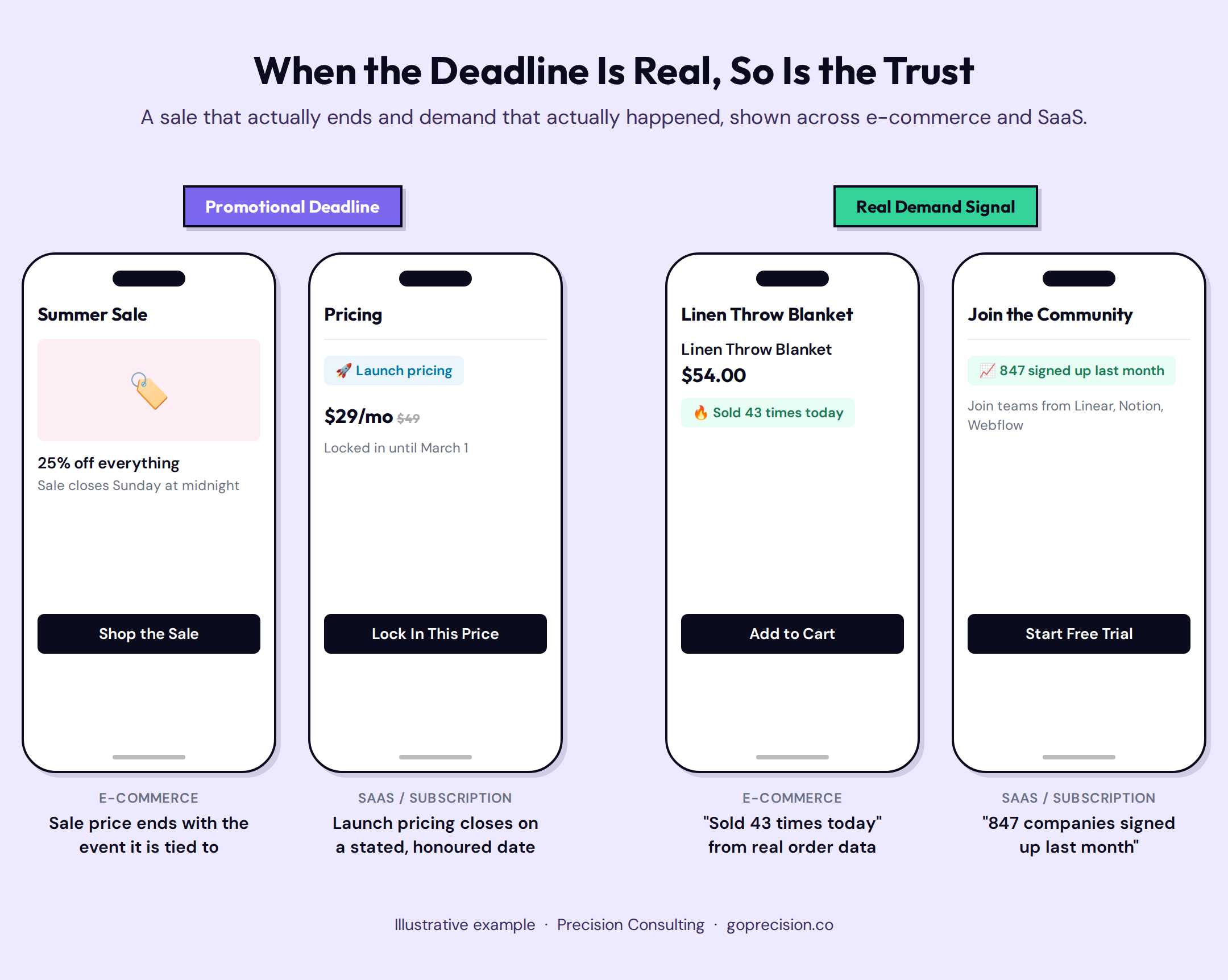
How to make urgency trustworthy: the conditions each signal must meet before it earns the buyer's belief.
Why does genuine urgency build long-term conversion?
There is a commercial argument for honesty in scarcity and urgency that goes beyond ethics. Stores that use genuine signals build a different kind of relationship with their buyers. When a buyer has trusted your signal once and been proven right, they trust it more next time. That compounding trust has measurable value in repeat purchase rate, word-of-mouth referral, and lifetime customer value.
There is a newer dimension to this that most businesses have not yet fully accounted for. An increasing share of new customer discovery now happens through AI chat tools: Claude, ChatGPT, Gemini, and others. When someone asks an AI assistant which tool to use, which brand to buy from, or whether a business is trustworthy, those systems draw heavily on publicly available user feedback: reviews, Reddit threads, forum posts, and social commentary. A brand with a visible pattern of fake urgency complaints on Reddit or Trustpilot is not just losing the buyers who wrote those posts. It is training the next wave of AI-mediated discovery to recommend competitors instead. This is why how AI cites your brand is increasingly shaped by the trust signals you leave in public.
Stores that use fake signals achieve a short-term conversion lift and a long-term credibility debt. As the signals are detected and called out, each new buyer arrives with scepticism rather than openness. The conversion rate on a site with a reputation for fake urgency is structurally lower than it would otherwise be.
The psychology of FOMO is genuinely powerful. You do not need to fake it. Most businesses have real scarcity and urgency conditions available to them that never surface to the buyer. The opportunity is not to manufacture pressure. It is to communicate the real pressure that already exists. For more on the trust signals that belong on every product page, the placement guide covers where each type earns the most credibility.
If you want to audit your current urgency signals and identify which are earning trust and which are costing it, see how Precision approaches conversion audits.
Predictably Irrational by Dan Ariely covers the scarcity heuristic and dozens of related mechanisms in detail, with real experiments rather than assertions. Influence by Robert Cialdini dedicates a full chapter to scarcity as a principle of persuasion, including the psychological research on why limited availability increases perceived value. Both are practitioner reading and directly applicable to the decisions covered in this article.
Key Takeaways
- Scarcity and urgency work because loss aversion is a more powerful motivator than equivalent gain. The psychological mechanism is real and does not require fabrication to be effective.
- Manufactured scarcity, including countdown timers that reset and stock counters that never change, is detectable by buyers and causes trust damage that outweighs any short-term conversion lift.
- Real scarcity includes genuine low stock levels, limited cohort places, same-day dispatch cut-offs, trial expiry dates, pricing tier closures, and social proof signals derived from real demand data.
- Applying urgency signals to every product makes all of them less credible. Reserve them for situations where the underlying condition is genuinely present.
- A/B test your urgency signals before assuming they will improve conversion. Psychology is universal, but the response varies by audience and product category.
- Stores that use genuine urgency signals build compounding trust. Buyers who have been proven right once by a signal are more responsive to the next one.
- The opportunity is not to manufacture pressure. Most stores have real scarcity and urgency conditions that they never communicate. Surface those first.
Frequently Asked Questions
What is scarcity in marketing?
Scarcity in marketing is the communication of limited availability to a potential buyer. This applies equally to physical inventory, SaaS plan seats, cohort places, and pricing tiers. When a genuine constraint exists and is surfaced clearly, it creates a psychological response that makes buyers more likely to act now rather than defer the decision.
What is the difference between scarcity and urgency?
Scarcity refers to the limited availability of a product or condition. Urgency refers to the limited time before a condition changes. Both activate loss aversion in the buyer, but they operate on different dimensions. Scarcity says the product may not be there. Urgency says the current price or offer may not be there. Both can be genuine, and both can be fabricated.
Do urgency tactics damage brand trust?
Fake urgency tactics damage brand trust when buyers detect them. Countdown timers that reset, stock counters that never change, and flash sales that run every week are all eventually noticed. The trust damage from being caught is disproportionate to the short-term conversion lift. Genuine urgency signals, clearly communicated, do not damage trust. They build it.
How do I use scarcity ethically?
Display real stock levels for products with genuine limited inventory. Use countdown timers only for promotions with real end dates. Surface same-day dispatch cut-offs based on your actual logistics. Apply social proof signals only when the data behind them is accurate. Every urgency signal should reflect a real condition you could explain honestly to the buyer.
What is loss aversion in e-commerce?
Loss aversion is the tendency to feel the pain of losing something more acutely than the pleasure of gaining something equivalent. In e-commerce, it means buyers are more strongly motivated by the possibility of missing out on a product or price than by the prospect of gaining that product or price. Scarcity and urgency signals work by activating this response.
What is FOMO marketing?
FOMO marketing uses the fear of missing out to motivate purchasing decisions. It encompasses scarcity signals, urgency timers, social proof of demand, and any other tactic that makes the buyer aware that other people want this product and that availability may be limited. When the underlying conditions are real, it is an effective and ethical use of behavioural psychology.
