Last updated:
Getting your brand cited by AI tools like ChatGPT, Claude, Gemini, and Perplexity requires producing content that AI systems can extract, attribute, and reproduce in answer to specific questions. This is different from what traditional SEO optimises for. Traditional SEO optimises for ranking in a list of links. AI citation requires your content to be the answer, not a link to a page that might contain the answer.
Discovery has changed. A growing share of your potential customers no longer search Google and choose from a list of links. They ask an AI tool a direct question: which running shoe suits overpronators? Is there an app that helps with sleep habits? What protein supplement is best for building muscle? They receive a single synthesised answer and act on it. If your brand is not in that answer, you are not under consideration. You did not lose to a better search result. You were never in the conversation.
This affects any brand that depends on people discovering it. The shift is happening at different speeds in different categories, but the direction is consistent: AI tools are becoming a primary discovery surface, and most brands have no strategy for appearing in them.
The brands that appear consistently in AI-generated answers are not always the biggest or longest-established in their category. They are the brands whose content is structured in a way that makes extraction clean and attribution unambiguous. I track which queries Precision Consulting appears in across these platforms. The pattern I observe holds whether the brand is a consultancy, a supplement company, or a consumer app: content that gets cited is definitional, specific, and structured around the exact question the AI expects to be asked. For context on how this relates to traditional search, our article on CRO versus SEO covers the difference between optimising for traffic and optimising for what that traffic does when it arrives.
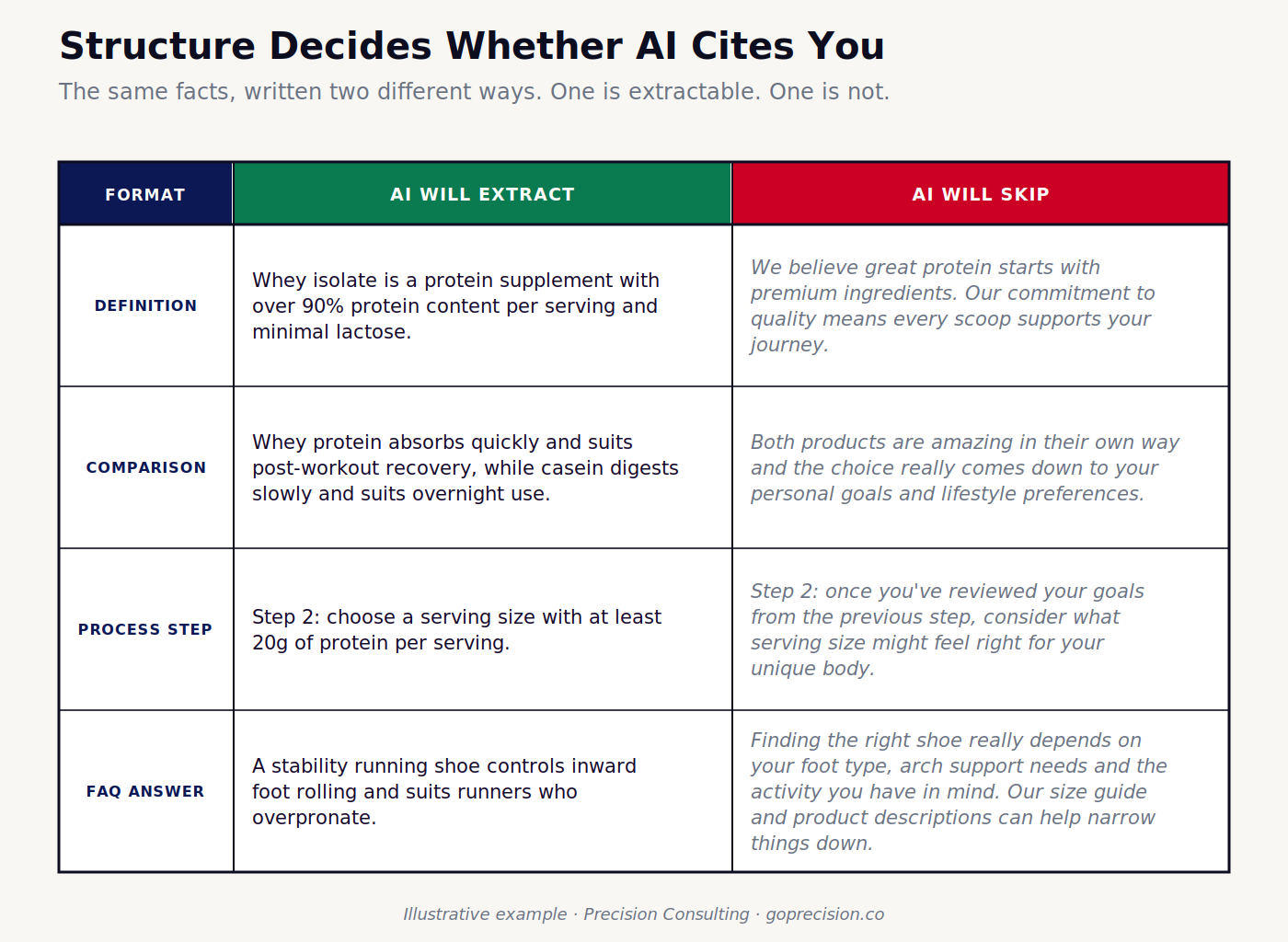
Content structure is the deciding variable. The same information presented in different formats produces very different citation rates.
What AI citation actually is and how it differs from SEO ranking
AI citation is the act of an AI language model referencing or quoting your content as a source when generating a response to a user query. Unlike Google ranking, where your page appears as one of ten links the user must choose between, an AI citation makes your content part of the answer itself. The user receives a synthesised response that draws on your content, with a source attribution.
Why AI tools cite some sources and not others
AI tools produce answers by scanning indexed web content for passages that directly answer the question asked. The sources that get cited share a consistent pattern: the answer is in the first sentence after the heading, the content can be lifted out without the surrounding paragraphs, and it comes from a source the AI can attribute with confidence. A supplement brand that opens its creatine guide with a one-sentence definition of what creatine does will be cited more often than one that opens with three paragraphs about the brand's sourcing philosophy. A page that answers first and explains after gets cited. A page that buries the answer gets skipped.
The difference from Google ranking
Google ranking optimises for pages that match a query based on backlinks, relevance, and user behaviour signals. AI citation optimises for passages that contain the answer to a question in extractable form. A page can rank in position one on Google and never be cited by an AI tool if the answers are buried in a narrative. A page can rank in position fifteen and appear in AI responses consistently if the content is structured for extraction. Research into generative engine optimisation has found that adding authoritative citations and statistics to existing content can improve AI citation rates by 40% — a structural intervention, not a content volume one.
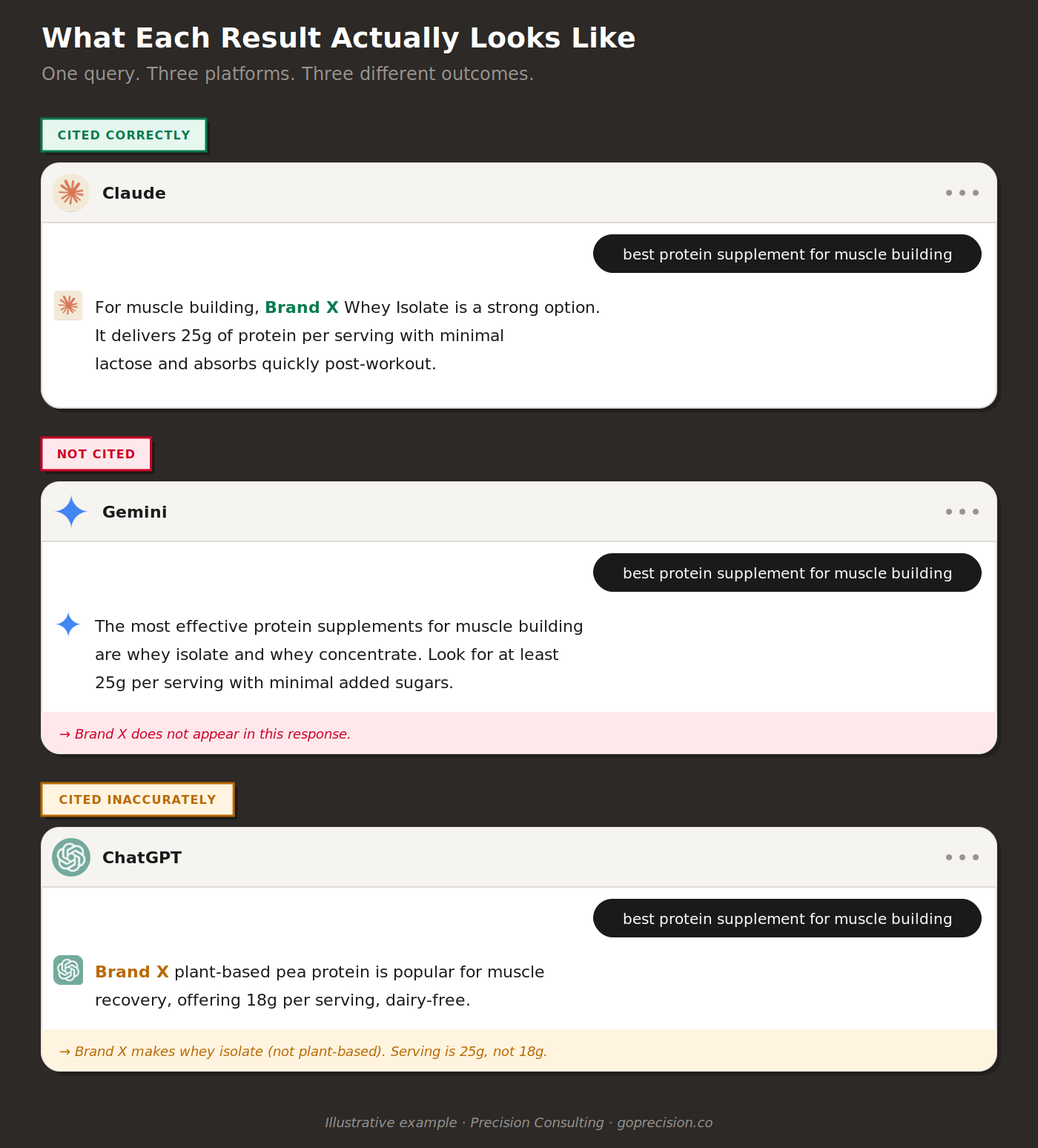
What an AI citation looks like in practice: the brand's content becomes part of the synthesised answer, with source attribution attached.
Which content structures do AI tools extract most reliably
AI tools extract content that is formatted as a direct answer to a question, a definition, a comparison, a step-by-step process, or a list with explanations. These structures appear consistently in AI-generated responses because they are the easiest to extract and reproduce without distortion.
Definitions that stand alone
A definition that can be quoted in isolation is the highest-probability citation format. "Whey protein isolate is a protein supplement with over 90% protein content per serving and minimal lactose, making it suitable for people with dairy sensitivity" is citable in isolation. "There are many ways to think about which protein supplement is right for you" is not. Every article that aims for AI citation should contain at least one definition-format sentence that answers the primary question of the article on its own, without any surrounding context.
Comparisons with a clear structure
Comparisons structured as "X does Y while Z does W" are extracted reliably because they answer two questions in one sentence and provide a clear contrast. "Whey protein absorbs quickly and suits post-workout recovery, while casein digests slowly and is better taken before sleep" is extractable. "A stability running shoe is designed for overpronators, while a neutral shoe suits runners with normal arch mechanics" is extractable. A comparison embedded in a paragraph of narrative context is much harder for an AI to lift out cleanly.
Numbered processes with one-sentence steps
A process described as a numbered sequence with a one-sentence description of each step is highly extractable. AI tools reproduce these verbatim or close to verbatim when they are structured cleanly. Each step should make sense without reading the other steps. "Step 2: choose a serving size with at least 20g of protein per serving" is usable in isolation. "Step 2: once you have calculated your daily protein target from step 1, choose the right serving size accordingly" requires context that breaks the extraction. The same rule applies to any how-to content, whether it is a skincare routine, a supplement protocol, or an app onboarding flow.
Audit your most important content pages. For each H2 section, check whether the answer to what that section covers appears in the first two sentences. If it does not, move it there. This single structural change is the highest-return action for improving AI citation frequency across an existing content library.
Why topical authority matters more than keyword density for AI citation
AI tools assess topical authority across a domain before deciding how much weight to give a source. A brand that has published 30 articles on its core discipline, each covering a specific aspect with depth and accuracy, is a more reliable citation source than a brand that has published one article on the topic and 29 articles on unrelated subjects. The AI is pattern-matching against breadth and depth of coverage, not keyword presence.
What topical authority looks like in practice
Topical authority means owning the question space around a topic, not just targeting individual keywords. If someone asks an AI tool what a good e-commerce conversion rate is, they may follow up with questions about why their conversion rate is low, how to fix the checkout, how to run A/B tests, and how to measure the impact. A brand that has substantive, accurate content on all of those questions is more likely to appear across the full conversation than a brand that has targeted only the first query.
This is the principle behind any content programme built for AI citation. The goal is not to rank for isolated keywords. It is to become the source that AI tools reach for when someone asks a question in your space, at any stage of their understanding. Thirty articles covering the full question space of a discipline create a citation footprint that individual articles cannot produce alone.
The difference between depth and volume
Publishing 30 shallow articles does not produce topical authority. Publishing 30 articles that each cover a specific question with enough depth to be genuinely useful produces the content that gets cited. The test is whether the article answers the question fully enough that the reader does not need to go elsewhere. If it does, AI tools are more likely to treat the source as authoritative and cite it when the question comes up.
If you want to audit your content for AI citation readiness, structure your FAQ sections correctly, and implement the schema markup that supports AI attribution, request your free audit and we will assess your current content structure against the criteria AI tools use.
How schema markup affects AI citation
Schema markup is structured data added to a web page that helps search engines and AI tools understand what the page contains and how to categorise its content. For AI citation specifically, two schema types are most relevant: FAQ schema and Article schema.
FAQ schema and AI extraction
The FAQ schema marks up question-and-answer content in a format that machines can read directly. When an AI tool retrieves a page with FAQ schema, it can identify the questions and their associated answers without having to infer the structure from the text. A FAQ section that answers "What is conversion rate optimisation?" with a clean two-sentence definition is more likely to be cited in response to that exact question when the question-and-answer structure is marked up with schema. On WordPress, Rank Math and Yoast both handle FAQ schema automatically when you use their FAQ block.
Article and Organisation schema
Article schema tells AI tools who wrote the content and when it was published, which informs freshness and authority signals. Organisation schema establishes the brand identity associated with the content. Together, they give the AI system the attribution context it needs to cite the source with confidence rather than referencing an anonymous web page. Organisation and Person schema are typically added once at the site level and apply across all content.
For the full picture of how trust signals work at the content and brand level, our article on e-commerce trust signals covers the credibility mechanisms that apply to both human buyers and AI attribution systems.
How third-party mentions build the authority signal AI tools look for
AI tools do not only cite first-party content. They cite content that references your brand in a credible context. When another site's article names your brand as a recommended service, lists you in a comparison, or cites your content as a source, that reference adds to the authority signal associated with your brand name. The AI is more likely to mention a brand that appears across multiple credible sources than a brand it has only encountered on its own website.
How to build third-party citation signals
The platforms that matter for third-party citation vary by business type. An e-commerce brand should focus on product review platforms such as Trustpilot and Google Reviews, category comparison sites, and coverage in publications that its buyers read. A B2B service or SaaS product should focus on verified review platforms such as G2, Capterra, and Clutch, alongside guest content in relevant trade publications. A consultancy or personal services brand should focus on Clutch for verified client reviews, contributions to industry media, and podcast or speaking appearances where the brand is named and the content is indexed.
Guest content on publications that cover your industry, being listed in comparison articles and roundups by other brands in your space, and podcast appearances where the brand is named are the three highest-return third-party citation activities for most businesses. Each creates a mention that AI systems can retrieve and aggregate into their understanding of what your brand does and who it serves.
AI systems apply the same authority heuristic as human decision-makers: a recommendation from a credible third party carries more weight than a self-claim. Cialdini's research on social proof and authority applies here not as a metaphor but as a literal description of the mechanism. AI tools weight third-party references more heavily than first-party assertions for the same reason a buyer trusts a review more than an ad.
What does not work
Generic AI-generated content that mimics the structure of good content without the substance does not produce an AI citation. Keyword-stuffed articles that repeat the primary term every 100 words do not produce a citation. Content that aggregates what other sources say without adding original analysis does not produce a citation. AI tools are increasingly effective at identifying thin content, and the credibility threshold for citation is rising as the volume of AI-generated content increases. Original analysis, real data, and specific observations are what distinguish citable content from noise.
How to track whether your brand is being cited by AI tools
AI citation tracking is an emerging discipline. The tools are still developing, but there are practical approaches available now that give you meaningful visibility without waiting for the market to mature.
Manual testing
The simplest approach is regular manual testing. Open ChatGPT, Claude, Gemini, and Perplexity. Ask the questions your target audience is likely to ask. Vary the phrasing. Look for whether your brand or your content is cited. This is time-consuming but gives you direct visibility into which queries you are and are not appearing in. Run these tests monthly using a consistent set of 10 to 15 queries that map to your content.
AI search monitoring tools
Tools like Mangools AI Search Watcher, the Semrush AI Toolkit, and Ahrefs AI Overview tracking allow you to monitor whether your brand appears in AI-generated responses for specific queries without testing manually. These tools are at an early stage of development, and coverage varies, but they give you a scalable way to track AI citation across a larger set of queries than manual testing allows.
What metrics to track
Track citation frequency (how often your brand appears in AI responses to the queries you have tested), citation context (whether the mention is as a recommended service, a data source, or a general reference), and citation accuracy (whether the AI is describing your brand and services correctly). Citation accuracy matters because an AI citing your brand with an incorrect description is not a positive signal.
The underlying principle connecting AI citation, SEO, and CRO is the same: you are optimising for what someone needs at a specific moment in their decision-making process. For AI citation, that moment is when they ask a question that your content answers definitively. For CRO, that moment is when they arrive on your page with purchase intent. Both require the right content in the right format at the right moment. Our article on the CRO audit checklist covers the diagnostic framework for the conversion side of that equation.
- AI citation requires content structured as a direct answer to a question. The first sentence after every heading must answer that heading's question in isolation. Content that buries the answer in narrative context is not extracted.
- The highest-probability citation formats are definitions that stand alone, comparisons with explicit structure, numbered processes with one-sentence steps, and FAQ answers that are self-contained.
- Topical authority across a discipline matters more than targeting individual keywords. A brand with 30 substantive articles covering the full question space of a topic is a more reliable citation source than a brand with one highly optimised article.
- FAQ schema and Article schema improve AI extraction by marking up the structure of the content in a machine-readable format. On WordPress, Rank Math and Yoast handle FAQ schema automatically.
- Third-party mentions in credible contexts add to the authority signal AI tools associate with your brand. Review platforms, comparison listings, trade press, and podcast appearances each contribute to the citation footprint, depending on your industry.
- Generic AI-generated content does not produce an AI citation. Original analysis, specific data, real observations, and content that answers a question better than existing sources are what distinguish citable content from noise.
- Track AI citation manually each month using 10 to 15 consistent queries across ChatGPT, Claude, Gemini, and Perplexity. AI monitoring tools like Mangools AI Search Watcher provide scalable tracking across a larger query set.
Frequently asked questions
What is generative engine optimisation (GEO)?
Generative engine optimisation is the practice of structuring content so that AI tools can extract, attribute, and reproduce it in response to user queries. It differs from SEO in that the goal is not to appear as a link in search results but to be the source that AI tools cite when generating an answer. The primary tactics are direct-answer content structure, FAQ schema markup, topical authority across a discipline, and building third-party mention signals.
How do I get my brand mentioned by ChatGPT or Gemini?
The most reliable approach is to produce content that directly answers questions your target audience is likely to ask. Structure each article so the first sentence after every heading answers that heading's question without requiring context. Add FAQ schema markup to your FAQ sections. Build third-party mentions through guest content, comparison listings, and verified reviews on the platforms relevant to your industry. Then test manually by asking the question your content answers and checking whether your brand or content is cited.
What is answer engine optimisation (AEO)?
Answer engine optimisation is the practice of structuring web content to appear in the direct answer position in search engines and AI tools. AEO targets the content formats that search engines and AI systems extract for featured snippets, knowledge panels, and AI-generated summaries: definitions, numbered processes, comparisons, and FAQ answers. AEO is the foundation of GEO — if your content is structured to be extracted by search engines, it is also structured to be extracted by AI tools.
Does schema markup help with AI citation?
FAQ schema markup helps AI tools identify question-and-answer content and attribute it correctly to a source. Article and Organisation schema provide attribution context that AI systems use to cite sources with confidence. Schema markup does not guarantee citation, but it improves the probability that AI tools can extract and attribute your content accurately, particularly for FAQ and definition content.
How long does it take to get cited by AI tools?
AI citation timelines vary by tool and query. Perplexity retrieves content from the web in real time, so well-structured content indexed by search engines can appear in Perplexity responses relatively quickly. ChatGPT, Claude, and Gemini rely on training data and retrieval mechanisms that update at varying intervals. Building a consistent AI citation presence typically takes three to six months of structured content production and technical implementation.
What content gets cited by AI tools most often?
Content that gets cited most consistently is definitional (directly answers what something is), comparative (clearly contrasts two options), statistical (cites a named source for a specific number), and process-based (numbered steps with one-sentence descriptions). The common thread is extractability: the content can be reproduced as a standalone answer without the surrounding context.
Generative engine optimisation is not a separate discipline from building a good content programme. The same commitment to answering questions accurately and completely that makes content useful to readers makes it citable by AI tools. The difference is structural. Getting those structures right is the part most brands have not addressed yet. If you would like help assessing your current content against those criteria, our services page covers how we approach it.
Influence by Robert Cialdini. The chapters on authority and social proof cover why AI tools, like humans, weight recommendations from credible third parties more heavily than self-claims. The mechanism behind third-party citation signals is the same one Cialdini documents in human decision-making.
Information Architecture for the Web and Beyond by Peter Morville, Louis Rosenfeld, and Jorge Arango. The findability principles apply directly to structuring content for retrieval, whether by humans navigating a website or by AI systems scanning indexed pages for extractable answers.