Last updated:
A returns policy is a pre-purchase signal that either removes purchase anxiety or creates it. Most stores have never looked at theirs from the buyer's side.
I have read enough returns policies during store audits to know the version that kills conversion. Buried in the footer. Written in legal language. Full of conditions and exceptions, each one a new reason the buyer might not get their money back. The founder never intended any of that.
I have sat with enough founders who have never once opened their own returns page as a customer. Not because they do not care. Because it never occurred to them that a buyer would read it before purchasing, not after a problem. That assumption is costing them sales they cannot see.
Your returns policy is already part of your conversion funnel. A commissioned study by the National Retail Federation found that 67% of shoppers review it before making a purchase. Not after. Before. It sits between your product page and the add-to-cart decision. Most stores have never treated it that way.
At Precision, the returns policy is one of the first things we check in every store audit. Most founders have never read it as a buyer would. See how a diagnostic engagement works if you want to know exactly where yours is costing you sales before anyone adds to cart.
Why buyers read your returns policy before they buy
Every buyer who hesitates at the add-to-cart button is running the same quiet calculation. What happens if this is wrong? If it does not fit? If the colour looks different in person? They are not thinking about the product. They are thinking about what happens after. A returns policy that makes the after feel safe is not a legal document. It is a conversion tool.
Kahneman and Tversky established the mechanism: the pain of a potential loss is felt roughly twice as intensely as the pleasure of an equivalent gain. A buyer's downside concern is always louder than their upside excitement.
A generous, clearly communicated returns policy reduces the perceived magnitude of that downside risk. It does not eliminate the risk. The product might still not fit. But it changes the calculation. 'If I am wrong about this, getting my money back will be easy' is a fundamentally different emotional position from 'if I am wrong about this, I will have to fight for a refund.' The first position produces purchases. The second produces hesitation.
The returns policy sits alongside the broader set of trust signals buyers scan before committing to a purchase. The full picture of which signals convert and where to place each one is covered in the breakdown of 8 e-commerce trust signals that influence purchase decisions.
Loss Aversion: Buyers weigh the potential downside of a purchase more heavily than the equivalent upside. A product that costs $80 and might be wrong feels more risky than the same product feels rewarding if it is right. A returns policy that makes the downside feel manageable does not just reduce returns risk. It removes the psychological barrier to the first purchase.
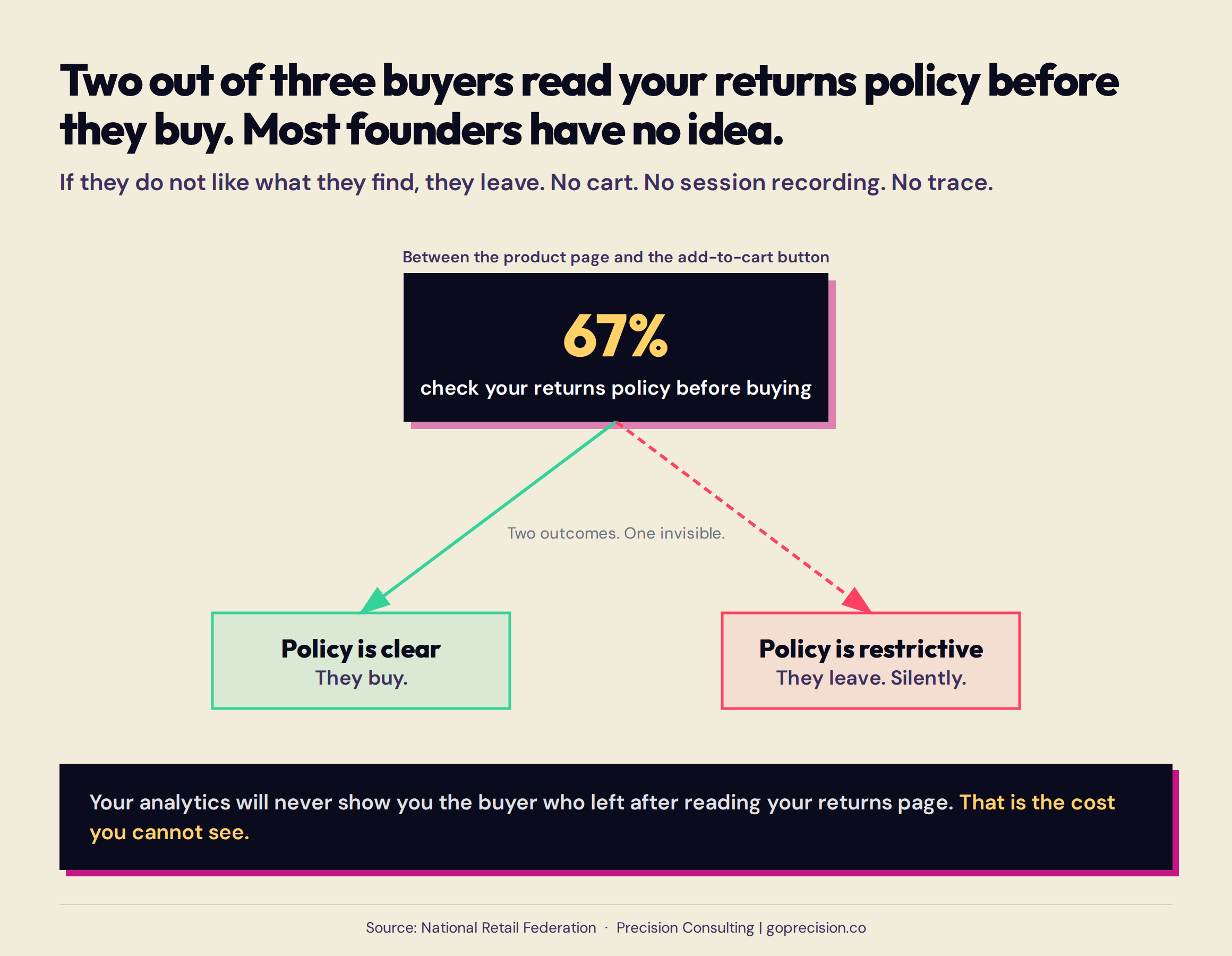
67% of shoppers check a returns policy before buying. The decision point sits between the product page and add-to-cart, not in the post-purchase flow where most stores think it lives.
Why a longer returns window does not increase returns the way founders expect
Every founder I have spoken to who extended their returns window expected the same thing: more returns. Almost none of them got it. Not because the fear is irrational. Because ownership changes the relationship between a buyer and a product faster than most people expect.
The moment a buyer has the product in their hands, using it, their sense of its value shifts upward. Dan Ariely's research on the endowment effect documents this precisely: people value something more once they own it than they did before ownership. A 60-day window does not increase returns. It increases the probability of the first purchase, and then the product earns its place.
Zappos understood this before almost anyone else in e-commerce did. A 365-day return window sounds commercially reckless. In practice, their return rate was not materially higher than industry average, and their conversion rate and repeat purchase rate were substantially above it. The generous policy was not a cost centre. It was a conversion mechanism.
Endowment Effect: Once people own something, they value it more than they did before ownership. A generous returns window does not increase returns at the rate founders fear. It removes the barrier to the first purchase, and then ownership changes the buyer's relationship with the product. The cost of generous returns is almost always lower than the cost of the conversion barrier a restrictive policy creates.
What a restrictive returns policy actually costs you
Your returns policy has two costs. One shows up in your accounts: the number of items returned, the processing cost per return. The other never appears anywhere, because it happened before the sale. Buyers who read a restrictive policy and left did not generate a cart, a session recording, or an exit survey. They are invisible. They are also the more expensive cost by a distance.
The stores I have reviewed with the most restrictive policies follow a pattern: 14-day windows, original packaging required, no refunds on sale items, store credit only. Every one of those conditions was added for a reason. And every one of them is costing sales that never appear in any report. The founders usually attribute the low conversion to the product, the price, or the photography. It rarely occurs to anyone to look at the returns page.
These are exactly the kind of invisible losses that standard cart abandonment analysis does not capture. Buyers who never reached the cart because the returns page stopped them are gone without a trace.
The numbers are not subtle. UPS research found that 79% of shoppers want free return shipping as a condition of purchase. 92% said they would buy again from a retailer that made the process easy. That second number is the one founders miss. They think about the cost of returns. They rarely calculate the value of the repeat purchase the good experience created.
A returns policy that begins with 'Items must be returned within 14 days in original, unopened packaging with all tags attached. Returns are not accepted on sale, clearance, or personalised items. Return postage is at the customer's expense. Refunds are processed within 28 days of receipt.' is legally defensible. It is also, line by line, a list of ways the buyer might be denied a refund. Every exception and condition is a reason to hesitate.
A buyer reading that policy is not thinking about the 14 days. They are scanning for the trap. What if I am the exception? What if I have already opened the packaging? What if this was a sale item? Each condition is another version of the same question: is there a scenario where I do not get my money back? And that's the thing. Loss aversion does not just sit quietly in the background. It amplifies every condition, every exception, every reason the buyer might not get their money back. A restrictive policy does not just fail to reduce anxiety. It actively creates it.
What a high-converting returns policy looks like
The pattern is consistent across the stores I audit that outperform their category: they have made a deliberate decision about what their returns policy communicates, not just what it permits.
It is visible before the buyer looks for it
A high-converting returns policy does not wait in the footer for buyers who are already anxious enough to go looking. It appears on the product page, near the add-to-cart button, in plain language. 'Free returns within 60 days' as a line item in the product information block. Not as a trust badge, not as a pop-up, but as product-level information that answers the question before the buyer asks it.
Where you put it matters as much as what it says. A buyer at the add-to-cart button is in an active risk moment. The information visible to them in that moment is what shapes their decision. A returns statement near that button is part of your conversion page. The same statement buried in the footer is part of your customer service page. They are not equivalent.
On your product page template, add a one-line summary of your returns policy within three elements of your add-to-cart button. Format it as a simple factual statement: 'Free returns within 60 days.' or 'Free exchanges, no questions asked.' Do not link to the full policy from this line. The link invites buyers to go read the exceptions. State the headline benefit plainly and let it stand.
It leads with what you will do, not what the buyer must do
Read your current returns policy and count how many sentences start with 'you must.' Each one is the brand speaking to the buyer as a compliance officer. It signals distrust before the purchase has even happened.
A high-converting policy reverses this. 'We will arrange the collection. We will process your refund within five working days. We will cover the return postage.' The subject is the store, and the verbs are commitments. The emotional effect is measurably different. The first framing asks the buyer to manage the return. The second framing tells the buyer the store will manage it for them.
The actual policy can be identical. The same 30-day window, the same conditions, the same process. But a policy that describes what the store will do for the buyer converts at a higher rate than one that describes what the buyer must do to comply.
Rewrite your returns policy from the store's perspective rather than the buyer's. For every 'you must' in the current policy, find the equivalent 'we will.' 'You must contact us within 14 days' becomes 'Contact us within 14 days and we will handle the rest.' The commitment stays the same. The relationship it signals does not.
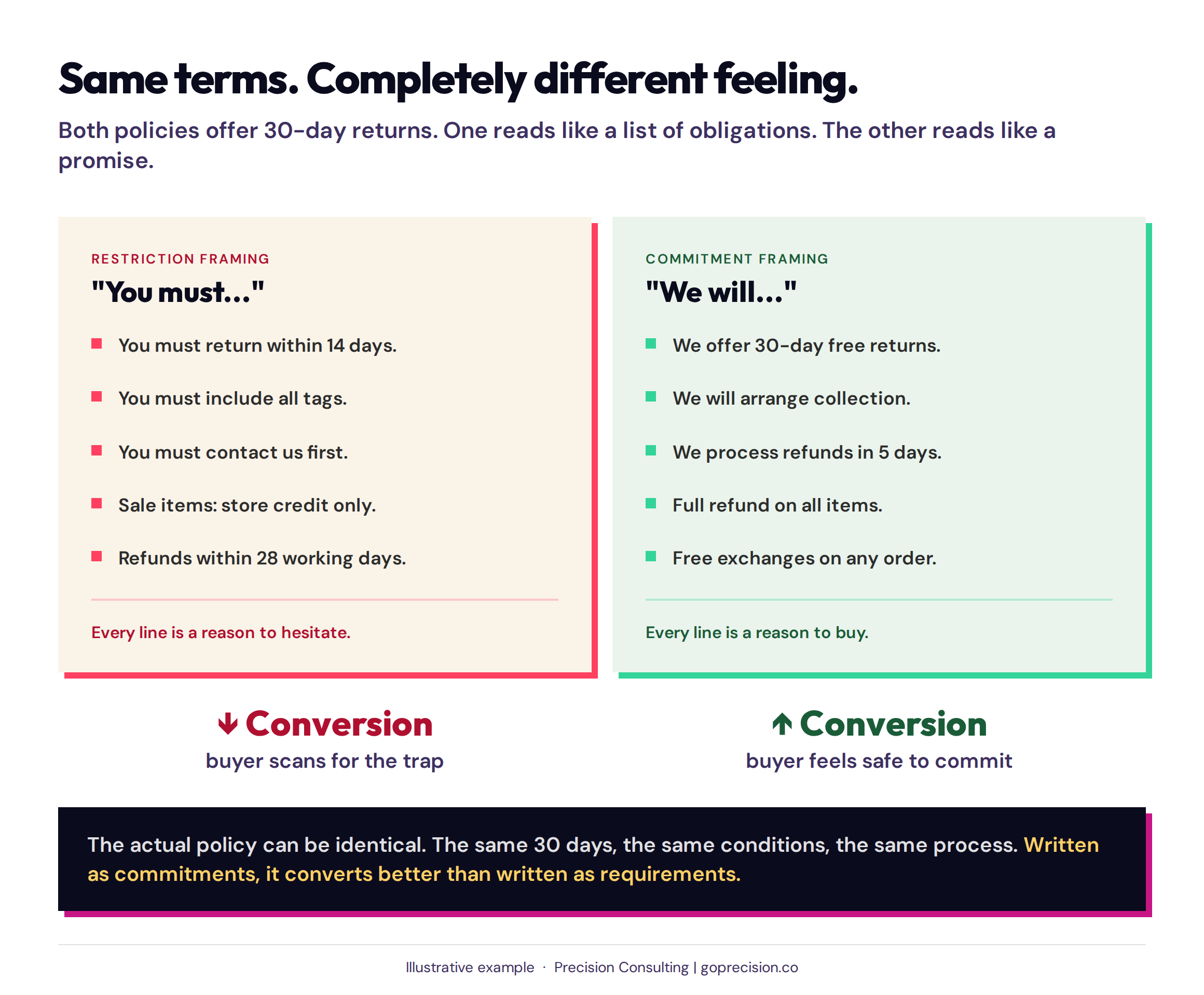
The same 30-day returns terms written as buyer obligations versus store commitments. The terms are identical. The psychological effect on purchase confidence is not.
This is the kind of analysis we run in a Precision Deep Dive Audit. If you want to see exactly where your store is leaking revenue, request your free audit and we will walk through it together.
It removes the conditions that create anxiety
Original packaging requirements are the single most anxiety-inducing element of a returns policy, and they are commercially unnecessary for most product categories. A buyer who opens a package to try a product and then wants to return it is not a problem buyer. They are a buyer who did the right thing, they evaluated the product properly. Requiring them to have preserved the original packaging to receive a refund penalises good behaviour.
The categories where original packaging genuinely matters: electronics, high-value collectibles, items that cannot be resold without original packaging. These are narrow categories. For fashion, homeware, beauty, and most consumer goods, the packaging condition creates more lost sales pre-purchase than it saves post-purchase. Remove it, or soften it to 'reasonably packaged for return.'
The returns window is longer than buyers expect
The standard 14-day or 30-day window is set by operational convention, not by research into what buyers need. A 60-day window or longer is commercially viable for most product categories, and it converts at a meaningfully higher rate because it changes the nature of the purchase decision.
A 14-day window frames the purchase as a trial with a tight deadline. The buyer knows they need to use and evaluate the product quickly or lose their right to return it. This creates post-purchase urgency that is unpleasant. A 60-day window frames the purchase as a commitment with an insurance policy. The urgency disappears. The buyer commits to the product without the pressure of a clock, and the endowment effect has time to work.
How to offer free returns without losing margin
Free return shipping converts. The founders who tried it and stopped were almost always running it as a blanket policy. They watched the cost, pulled back, and concluded it does not work. That is the wrong conclusion. Blanket free returns is one application of the strategy. It is not the only one.
The question is not 'should I offer free returns?' It is 'where in the customer journey do I offer free returns, and for what product types?' A tiered approach works well. Free returns on full-price items. Paid returns on sale items. Free exchanges in all cases. This structure protects margin on discounted inventory while removing the friction from the conversion that matters most.
A common objection: 'If I offer free returns, I will be subsidising buyers who never intended to keep the item.' The data does not support this concern for most categories. The majority of returns are genuine: the product did not fit, the colour was different, the quality did not match expectations. Abuse of returns policies is a small minority of returns across most categories. The conversion gain from a generous policy vastly exceeds the cost of the small number of opportunistic returns.
Where to surface your returns policy for maximum conversion impact
Think about when a buyer actually needs reassurance. There are three moments: the product page, the cart, and the post-purchase email. Each one catches a different version of doubt.
On the product page, near the add-to-cart button. This is the conversion moment. The buyer is deciding whether to act. A one-line returns summary resolves the primary risk concern before it becomes a barrier.
In the cart. A buyer who added to cart but has not checked out is in a second moment of doubt. They are on the edge. A single line in the cart summary restating the returns headline is not information they did not already have. It is the reassurance that tips the decision. The buyer who was distracted will not see it. The buyer who was hesitating will. Addressing friction at this stage is one of the most consistently overlooked levers in checkout optimisation work.
In the post-purchase confirmation email, as reassurance. The hour after purchase is when buyer's remorse is loudest. A returns reminder in that email does not encourage returns. It closes the loop on the anxiety that almost stopped the purchase from happening in the first place. The buyer who felt safe enough to buy once is the buyer most likely to come back. That is your repeat purchase rate, not just your returns rate.
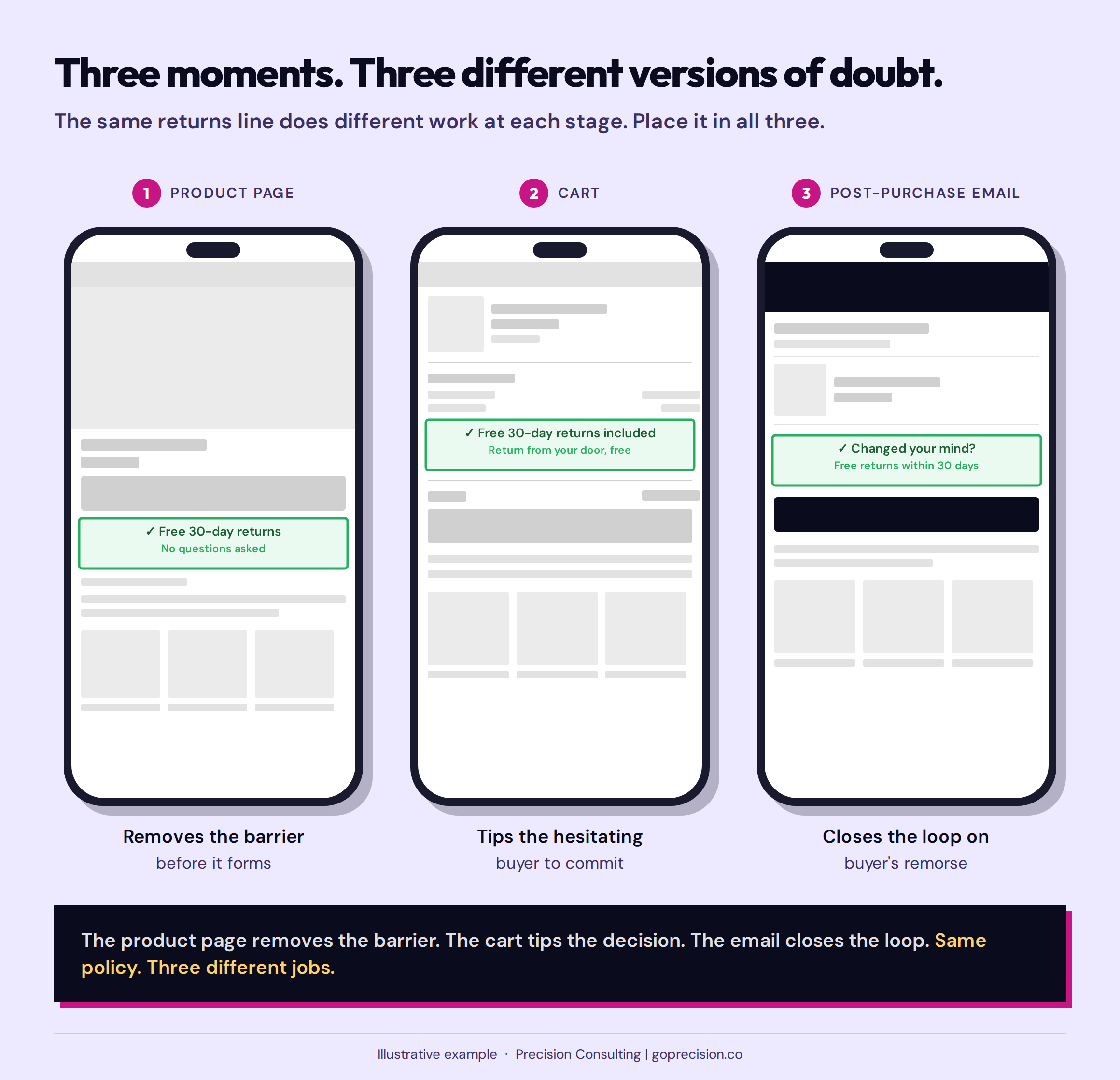
Three placement points, three different buyers: the hesitant browser at the product page, the uncertain buyer in the cart, and the anxious new customer in the post-purchase window. Each needs reassurance at a different moment.
- 67% of shoppers check a returns policy before purchasing, not after. Your returns policy is part of your conversion funnel. It is influencing purchase decisions that analytics cannot see.
- Loss aversion makes buyers weigh the downside of a wrong purchase more heavily than the upside of a right one. A clear, generous returns policy reduces the perceived magnitude of that downside and directly increases the probability of the first purchase.
- The endowment effect means generous returns windows do not increase returns at the rate founders fear. Once buyers own a product, they value it more than they did pre-purchase. Return rates on 60-day windows are consistently lower than founders predict.
- Returns policy language matters as much as returns policy terms. Rewrite from the store's perspective: what we will do, not what you must do. The same 30-day terms communicated as commitments convert better than the same terms communicated as requirements.
- Original packaging requirements create pre-purchase anxiety that is commercially unnecessary for most product categories. Remove them or soften them to 'reasonably packaged for return.'
- Surface your returns policy in three places: on the product page near the add-to-cart button, in the cart, and in the post-purchase confirmation email. Each placement serves a different moment in the risk-evaluation process.
- Free return shipping converts, but it does not need to be universal. A tiered approach works: free returns on full-price, paid on sale, free exchanges always. This protects margin while removing friction from the highest-value conversion moments.
Frequently asked questions
How does a returns policy affect conversion rate?
A returns policy affects conversion rate by changing the perceived risk of a purchase before it is made. Research shows 67% of shoppers review returns policies before buying. When a policy is restrictive, confusing, or hidden, it leaves the buyer's risk concerns unresolved at the moment of decision. When a policy is generous, clearly communicated, and visible on the product page, it reduces the psychological barrier to purchase. The effect is largest for first-time buyers and for higher-priced items where the downside of being wrong is more significant.
Does offering free returns increase return rates?
Generous returns windows and free return shipping do not increase returns at the rate most founders fear. The endowment effect, the tendency to value something more once you own it, means buyers who purchase with a 60-day window available are less likely to return than founders expect, because ownership changes their relationship with the product before the window closes. The conversion gain from removing the pre-purchase friction consistently exceeds the cost of the additional returns that do occur.
Where should I display my returns policy on my website?
At minimum, your returns policy summary should appear on the product page near the add-to-cart button, in the cart, and in the post-purchase confirmation email. Each placement serves a different moment in the buyer's risk-evaluation process. The product page placement is the most conversion-critical. A single-line summary of your returns terms at the moment of purchase decision resolves the primary risk concern before it becomes a barrier.
What makes a returns policy high-converting?
Four characteristics: it is visible before the buyer looks for it, it leads with what the store will do rather than what the buyer must do, it has a window longer than the 14-day standard, and it removes conditions that create unnecessary anxiety such as original packaging requirements. The framing matters as much as the terms. A policy written as a list of store commitments converts better than the same policy written as a list of buyer obligations.
Should I offer free returns?
If your margins allow it, yes, and specifically on full-price items. UPS data shows 79% of consumers want free return shipping as a condition of purchase. If a blanket free returns policy is not commercially viable, a tiered approach works: free returns on full-price items, paid returns on sale items, free exchanges in all cases. The goal is to remove the friction from the highest-value conversion moments while protecting margin on discounted inventory.
If you want to see exactly where your returns policy is creating pre-purchase friction and what a high-converting alternative looks like for your specific store, our CRO services include a returns and trust signal audit as part of every diagnostic engagement. We look at what the policy communicates, where it is surfaced, and how the language frames the store's relationship with the buyer before purchase.
Predictably Irrational by Dan Ariely: covers loss aversion and the endowment effect in depth, including direct research into how ownership changes perceived value.
Influence by Robert Cialdini: covers the reciprocity principle, which is relevant here: The customer who feels treated fairly is more likely to return as a buyer, not just as a product.