

Last updated:
Google Optimize was sunset on September 30, 2023, and the alternatives in 2026 fall into three honest categories. Paid platforms (VWO, AB Tasty, Convert.com, Optimizely) that replicated and extended the testing functionality. Open-source and free-tier options (GrowthBook, Statsig) that work for technically capable teams. And a single ongoing gap: no free alternative has matched Optimize's native integration with Google Analytics, which is the feature most stores actually miss.
When Google shut Optimize down, it was like the free public WiFi everyone had been using suddenly disappearing. Some operators installed their own routers (open-source). Some bought enterprise data plans (paid). Many just stopped using the internet (stopped testing entirely). Almost three years later, the market has consolidated around that split, and there is no sign of anyone rebuilding the free WiFi.
In my work at Precision, the question still comes up regularly, and the mistake I see most often is not picking the wrong alternative. It is panic-buying the right one too early. At a major delivery platform I worked with, the Optimize sunset triggered a rushed VWO purchase three months before the team had built the operational rhythm to use it. The platform sat at the top of the stack for nine months, producing nothing. By the time the testing cadence caught up, the company had paid for a year of a tool that had delivered no winning tests. Not because VWO was wrong. Because the team was not ready.
Gabriel Weinberg and Lauren McCann's Super Thinking covers the statistical significance discipline that determines whether any of these tools will actually move your conversion rate. The platform decision matters less than the operational discipline behind how you use it. A perfectly chosen tool runs into the same wall as a poorly chosen one if the team calls winners on day three.
This article covers what changed, the alternatives worth considering, and which one to pick based on the realistic state of your store.
What happened to Google Optimize?
Google announced the shutdown in January 2023. Optimize and Optimize 360 stopped running experiments on September 30, 2023, after nine months of notice, and the dashboard was removed shortly after. Google's stated reason was that the product "did not have the features and services that our enterprise customers required". Most operators read that as a polite way of saying Google was deprioritising the standalone tool in favour of integrations between GA4 and third-party platforms.
The shutdown removed a category, not just a product. Optimize was the most-used A/B testing tool in the market for stores under enterprise scale, primarily because it was free and integrated cleanly with Google Analytics. The free tier covered most use cases for small-to-mid-sized e-commerce, and the GA4 integration meant you could segment test results by any audience dimension you had set up in Analytics. No other tool replicated that combination, then or now.
The market split cleanly afterwards. Paid testing platforms picked up the bulk of Optimize's user base. The engineering-heavy teams that wanted to keep testing without committing to enterprise pricing moved to GrowthBook or Statsig. The stores that did not want to pay mostly stopped testing. The drop in active testing programmes among sub-50,000-monthly-visitor stores has been visible across the industry ever since. For a meaningful share of operators, Optimize was the only thing keeping testing on the roadmap.
Why has no free alternative fully replaced it?
No free alternative has fully replaced Optimize because the combination it offered (free pricing, native GA4 integration, a visual editor, no engineering required) is commercially difficult to sustain. Every alternative has had to give up at least one of those: free but technical (GrowthBook), free with event limits and no GA4 integration (Statsig), or visually editable and integrated but paid (VWO, AB Tasty, Convert.com). Google was willing to subsidise Optimize for years because it deepened lock-in with the wider Google Analytics and Google Ads ecosystem. No independent vendor has that incentive, and the economics that justified Optimize do not exist anywhere else in the market.
The GA4 integration is the part most stores actually miss. Optimize could segment test results by any GA4 audience without additional configuration: new vs returning visitors, traffic source, device, geography, all from inside Google's own ecosystem. No external tool can replicate that depth, because no external tool has the same access to Google's audience system. The visual editor matters too, but the missing GA4 integration is the bigger ongoing complaint, and the reason a meaningful slice of former Optimize users have not fully settled into any replacement.
Which paid alternatives are worth your money in 2026?
The best paid alternatives are VWO, AB Tasty, Convert.com, Crazy Egg, and Optimizely. All five include the core capability Optimize had (visual A/B testing without heavy engineering) and most extend it with multivariate testing, personalisation, and deeper analytics. The right one depends on your team and how much else you want the platform to do.
VWO is the strongest all-in-one for stores that want testing, personalisation, heatmaps, and session recordings in a single platform. The visual editor is one of the cleanest in the market, and the platform scales from growth-stage to enterprise, but it earns its cost at 50,000+ monthly visitors with a real testing programme planned. AB Tasty sits in the mid-market with stronger AI-driven personalisation at the entry tier, which makes it the right pick for stores with growing personalisation ambition. Convert.com is the cleanest choice for stores where privacy compliance is a hard requirement (GDPR and CCPA are built in) and where the focus is on conversion testing rather than personalisation. Crazy Egg is the lightest paid option, bundling A/B testing with heatmaps at the most accessible price point, best for stores running occasional tests rather than a continuous programme. Optimizely is the enterprise leader with server-side testing, full personalisation, and feature flags, but the pricing is enterprise-only, and the implementation requires real engineering. It is the wrong call for a small-to-mid-sized store migrating from Optimize for simple visual tests.
Which free and open-source alternatives are worth running?
The free and open-source alternatives are GrowthBook, Statsig, and Microsoft Clarity. None replicates the full Optimize experience, but in combination, they cover most of what a technically capable team needs.
Statsig is the clearest example of how the post-Optimize market reshaped itself. The company was founded in 2021 by Vijaye Raji and a team of engineers who had built and run experimentation infrastructure at Facebook. They started Statsig because the experimentation rigour available inside large tech companies was effectively unavailable to smaller teams. The Optimize sunset accelerated their growth, because the cohort of operators who could no longer get a free GA-integrated tool from Google needed somewhere to land. Today, the platform powers testing at OpenAI, Notion, and Atlassian, and offers a free tier covering up to 1 million events per month.
GrowthBook is the open-source pick. The cloud version has a free tier for small teams, and the self-hosted version is fully free if you can run the infrastructure. It is built around feature flagging, server-side testing, and statistical rigour, which makes it the right call for engineering-led teams. Microsoft Clarity is not an A/B testing tool, but it is the best free diagnostic replacement for the heatmap and session recording side of what Optimize did indirectly. The combination of Statsig (for testing) plus Clarity (for diagnostics) is the closest thing to a free Optimize replacement that exists in 2026, with the gap being the GA4 audience integration that Statsig does not replicate.
For the methodology side of running A/B tests on any of these tools, the A/B testing for founders guide covers how to design tests so the platform choice matters less than the discipline.
This is the kind of analysis we run in a Precision Deep Dive Audit. If you want to see whether your store is ready for the testing tool you are about to buy, request your free audit and we will walk through it together.
Why does the GA4 integration gap matter?
The GA4 integration gap is the single most common reason former Optimize users have not fully settled into a replacement. Every paid platform integrates with GA4 at some level, but none of them deliver the audience-segmented test results that Optimize made trivial. VWO, AB Tasty, Convert.com, and Optimizely all push test data into Analytics through Google's Measurement Protocol, which lets you segment by GA4 audiences after the test, but the setup requires custom configuration and the data flows in one direction (testing platform into GA4) rather than the bidirectional integration Optimize had. GrowthBook and Statsig integrate via custom event configuration, which is more flexible but requires engineering to set up.
The honest answer is that the perfect replacement does not exist. Most stores that have moved on use the testing platform's own analytics as the primary view and accept GA4 integration as a secondary capability. The audience segmentation that Optimize made effortless is now an integration project, not a feature.
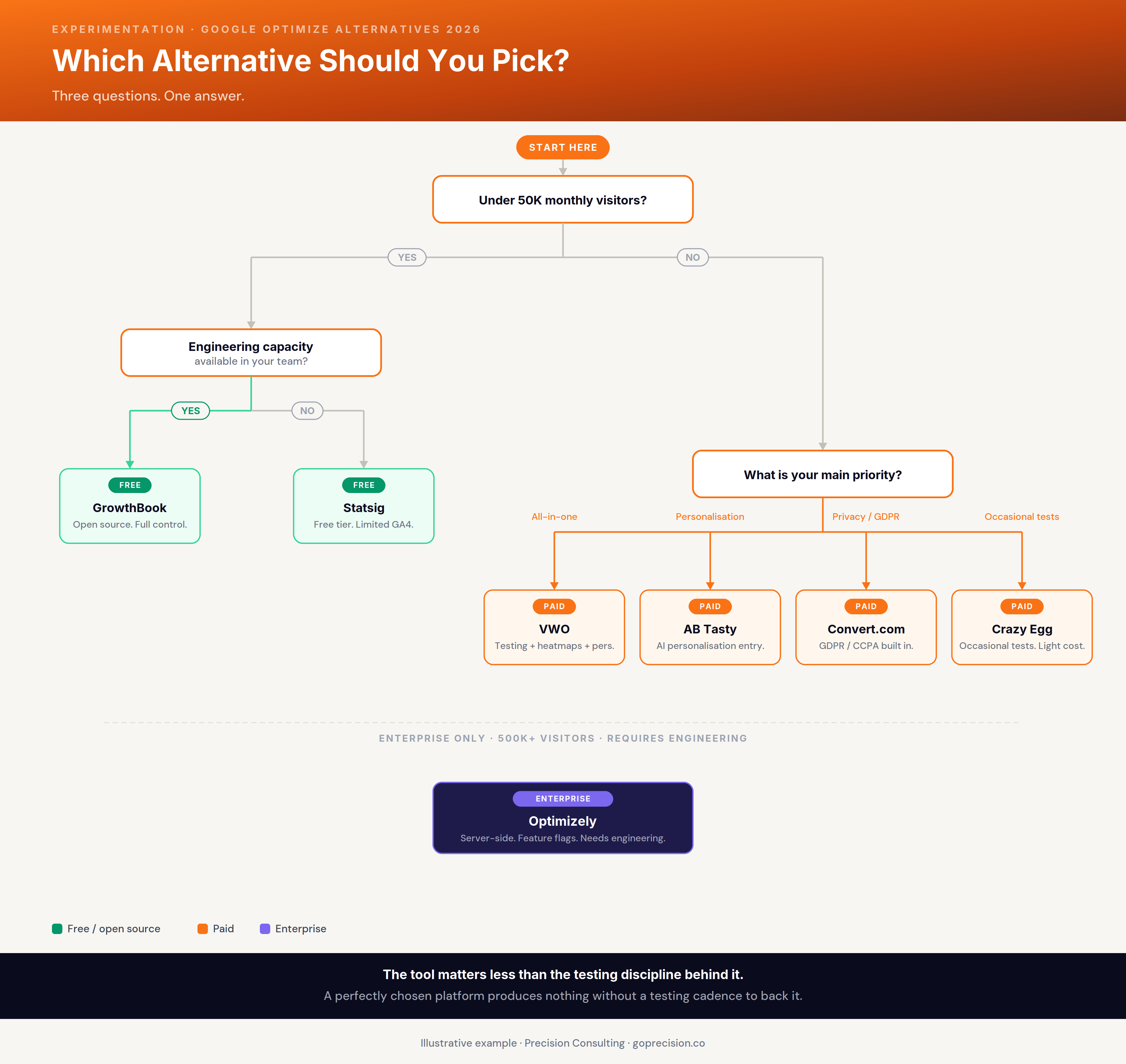
The post-Optimize market split into three lanes: paid platforms with the visual editor, free and open-source for engineering-led teams, and one ongoing GA4 integration gap that nobody has filled.
How do you choose the right alternative for your stage?
The right alternative depends on your traffic, your team's technical capacity, and how often you will actually run tests. There is no universal answer, because the value of any platform is determined by how often it gets used. A tool that runs zero tests is the most expensive in your stack, regardless of price.
For most growth-stage e-commerce stores doing 50,000 to 500,000 monthly visitors with a non-technical operator running CRO, VWO is the strongest all-in-one choice because the visual editor and integrations reduce the operational overhead enough that the testing programme actually happens. AB Tasty fits mid-market stores with growing personalisation ambition. Convert.com fits privacy-focused stores where compliance is a hard requirement. Crazy Egg fits stores running occasional tests rather than a continuous programme. GrowthBook (self-hosted) or Statsig (free tier) fit engineering-led teams on Shopify Plus or custom platforms with real developer capacity. Optimizely fits enterprise stores with dedicated experimentation teams and the engineering capacity to run server-side tests. The best CRO tools for Shopify guide covers how the testing tool sits alongside the rest of the stack.
How do you move off Optimize cleanly?
For the rare store still running on Optimize-like setups (Google Tag Manager hacks, custom JavaScript variants, or just unpurchased subscriptions to alternatives), the migration in 2026 is straightforward. Pick the alternative that fits the stage. Set up the new platform in parallel for two weeks. Validate the data flow against your existing analytics. Then cut over.
Three things to avoid. Do not try to replicate Optimize's exact setup in the new tool. Every platform has its own structural decisions about how experiments, audiences, and goals are configured, and trying to map Optimize's logic one-for-one usually produces a worse result than rebuilding around the new tool's strengths. Do not migrate without revisiting the test backlog. Six months of Optimize tests that never ran or ran inconclusively do not need to be ported. Rebuild the backlog around the highest-leverage hypotheses for your store right now, which the CRO audit checklist walks through. And plan for a slowed testing cadence in the first quarter. Operators who knew Optimize's interface deeply tend to slow down when moving to a new tool, and the testing volume usually takes three to four months to return to pre-migration cadence. Treat the dip as an investment, not a regression.
The migration is not the hard part. The delay is. Every quarter without a working testing programme is a quarter of conversion gains you did not capture.
Want help picking the right alternative for your store and avoiding the panic-buy trap? See how Precision works with e-commerce brands, or book a free strategy call and we will run through the options against your stage.
Gabriel Weinberg and Lauren McCann's Super Thinking is the clearest non-statistician's guide to the significance and sample-size discipline that decides whether any testing platform actually produces wins. Whichever tool you pick after the Optimize sunset, the operational rhythm matters more than the platform brand, and Super Thinking is where that rhythm starts.
Key Takeaways
- Google Optimize was sunset on September 30, 2023. The market in 2026 has consolidated around paid platforms (VWO, AB Tasty, Convert.com, Optimizely, Crazy Egg) and free or open-source options (GrowthBook, Statsig, Microsoft Clarity for diagnostics).
- In Precision audits, the most common Optimize-replacement mistake is panic-buying VWO or AB Tasty before the testing programme is operationally ready. The tool waits. The cost does not.
- No free alternative has fully replaced Optimize. The combination of free pricing, native GA4 integration, and a no-engineering visual editor does not exist in any single 2026 product.
- For most growth-stage e-commerce stores, VWO is the strongest all-in-one paid replacement. For the mid-market with personalisation ambition, AB Tasty. For privacy-focused, Convert.com. For light use, Crazy Egg.
- For engineering-led teams, GrowthBook (self-hosted, free) or Statsig (cloud, generous free tier) are the strongest free or cheap options. Statsig was founded in 2021 by ex-Facebook experimentation engineers and now powers testing at OpenAI, Notion, and Atlassian.
- Microsoft Clarity is not an A/B testing tool, but it is the best free diagnostic replacement for the heatmap and session recording side of what Optimize did indirectly.
- The GA4 integration that Optimize made effortless is now an integration project. Every alternative integrates with GA4 at some level, but none replicate the audience segmentation Optimize offered natively.
- The migration is not the hard part. The delay is. Every quarter without a working testing programme is a quarter of conversion gains you did not capture.
Frequently Asked Questions
What is the best free alternative to Google Optimize in 2026?
The closest free alternatives in 2026 are Statsig (cloud, free tier covers up to a million events per month) and GrowthBook (self-hosted, fully free if you have the infrastructure to run it). Neither replicates Optimize's GA4 integration nor visual-editor simplicity, but both produce statistically rigorous A/B test results for technically capable teams.
Why was Google Optimize discontinued?
Google announced the discontinuation in January 2023, citing the product's lack of features that enterprise customers required. The wider read in the industry is that Google chose to deprioritise the standalone testing tool in favour of integrations between GA4 and third-party experimentation platforms like AB Tasty, Optimizely, and Convert.
Does GA4 have a built-in A/B testing tool?
GA4 does not have a built-in A/B testing tool that replaces Optimize. Google's recommended path is to use third-party experimentation platforms that integrate with GA4 through native or custom integrations, which puts the testing functionality into a paid tool while keeping GA4 as the analytics layer.
Which paid Google Optimize alternative is the most affordable?
Crazy Egg is generally the most affordable paid alternative for stores running occasional A/B tests, because it bundles testing with heatmaps and recordings in a single tool at a lower price point than dedicated experimentation platforms. Convert.com is the most affordable serious experimentation platform at the entry tier.
Can I keep using Google Optimize in any form?
No. Google Optimize and Optimize 360 stopped running experiments on September 30, 2023, and the platform was fully removed shortly after. Any active tests at the time of shutdown ended with the platform. There is no way to continue using Optimize.
What should I look for when choosing a Google Optimize alternative?
Native integration with your analytics stack, a visual editor if your operator is non-technical, statistical rigour around test stopping (95% confidence as the floor, full business cycles for test duration), and pricing that matches your traffic. The most expensive mistake is paying for an enterprise tool you do not have the operational capacity to use.
