Social proof increases conversion when it appears at the moment of decision. The type of proof matters far less than the timing and the placement. This applies whether you run an e-commerce store, a SaaS product, a consultancy, or a B2B operation. Most businesses already have reviews, testimonials, or case studies. The problem is not the volume. It is that those assets sit where no buyer reads them when the decision is actually being made.
A store with 400 five-star reviews buried below the fold. An agency with excellent client work three clicks from the homepage. A SaaS product whose G2 rating lives on a page nobody visits before they decide whether to sign up for a trial. The proof exists. The buyer never sees it when they need it. Showing your strongest testimonial at the bottom of a page the visitor never reaches is like a job candidate sending their best reference letter after the hiring panel has already decided to pass. The timing is everything.
Why Social Proof Works
When buyers are uncertain, they look for evidence of what people like them have already decided to do. The less familiar the brand, the higher the uncertainty, and the stronger the pull toward external validation. This is not irrationality. It is a reasonable shortcut when information is incomplete.
The mechanism is that we weigh the choices of others as information about quality. A restaurant with a queue outside is assumed to be worth the wait. A SaaS tool with 2,400 G2 reviews is assumed to be worth evaluating. A consultancy whose client list includes names you recognise is assumed to be credible. The choices of others substitute for the personal experience the buyer has not yet had.
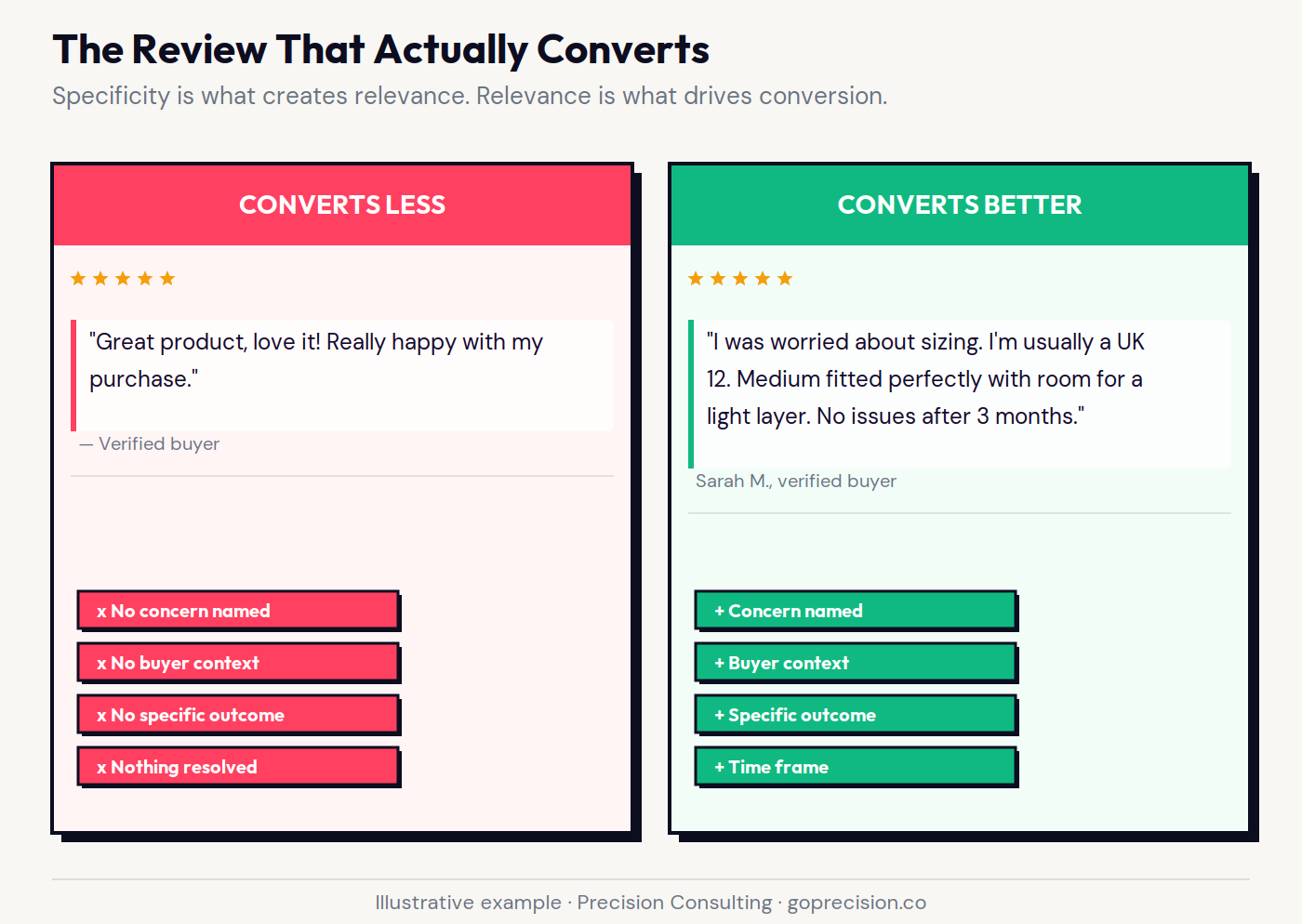
Informational Social Influence. Robert Cialdini named the mechanism social proof in Influence, but the underlying principle is older: when information is incomplete, humans treat the choices of others as data about quality. What determines how effective that data is has nothing to do with volume. It is relevance. A review from "a founder of a 15-person agency" is more persuasive to a similar buyer than one from "a verified user." A case study from a company in your sector outperforms a shinier result from a different industry. Specificity is what creates relevance. Relevance is what drives conversion.
For deeper reading on how psychology shapes buyer decisions at every stage of the funnel, our piece on the ten cognitive biases that drive e-commerce revenue covers each mechanism with examples.
The Placement Principle: Same Logic, Different Surfaces
Regardless of business model, social proof follows the same rule: it works at the moment of decision and loses most of its effect anywhere else. The moment of decision is different for each business type. For an e-commerce store, it is the product page, the cart, and the checkout. For a SaaS product, it is the pricing page and the free trial sign-up form. For an agency or consultancy, it is the services page, the proposal, and the follow-up after the first meeting. For a B2B vendor, it is the vendor shortlist stage, the RFP response, and the final presentation.
Most businesses place their social proof where it is convenient to display, not where it is effective. The homepage logo bar is the most common example. Client logos on a homepage look impressive. They are not at the decision moment for most visitors. The visitor who reads a case study, navigates to the pricing page, and then sees the logo bar for a company they recognise is experiencing social proof at the decision moment. The visitor who sees the logo bar first, before they have any context, is experiencing decoration.
Social Proof for E-Commerce
On the product page
The star rating and review count need to be visible above the fold. A visitor who sees "4.3 stars (847 reviews)" directly beneath the product title before they read anything else starts from a position of reduced uncertainty.
Research from the Spiegel Research Center at Northwestern University found that displaying five or more reviews increases purchase likelihood by 270% compared to a product with no reviews.
On a skincare brand, moving the star rating and review count from below the product description to directly beneath the product title increased product page conversion by 14% in four weeks. The reviews did not change. The placement did.
Review count matters alongside the rating. Products rated 4.0 to 4.5 often outperform products at 5.0 because a perfect score reads as curated. Do not chase a 5-star average. Chase a credible one. For more on the full anatomy of a converting product page, our article on the behavioural science behind product pages that convert covers each element in order of impact.
Image reviews outperform text reviews
A review with a photo drives significantly more conversions than the same review without one. Professional product photography shows the product in ideal conditions. A customer photo shows it in real ones. For apparel, homeware, beauty, and any product where appearance or fit matters in context, a customer photo resolves uncertainty that no description can address.
Yotpo research found that image reviews generate up to 180% more conversions than text-only reviews on the same product.
Add one line to your review request email: "Got a photo of it in use? Add it to your review." Collection rates on image reviews rise sharply when you ask explicitly.
At cart and checkout
The cart is the moment of maximum doubt. Brief, specific social proof works here: purchase volume signals ("4,200 orders this month") and a visible returns guarantee. At checkout, the buyer's question is not whether to buy the product. It is whether to trust this site with their card details. Payment provider logos (Stripe, PayPal, Apple Pay) function as institutional trust signals. A one-line returns summary in the order panel does more than a link to the full returns policy page.
For a complete breakdown of signals that reduce checkout hesitation, our article on 8 e-commerce trust signals and where to place each one covers each with specific placement guidance.
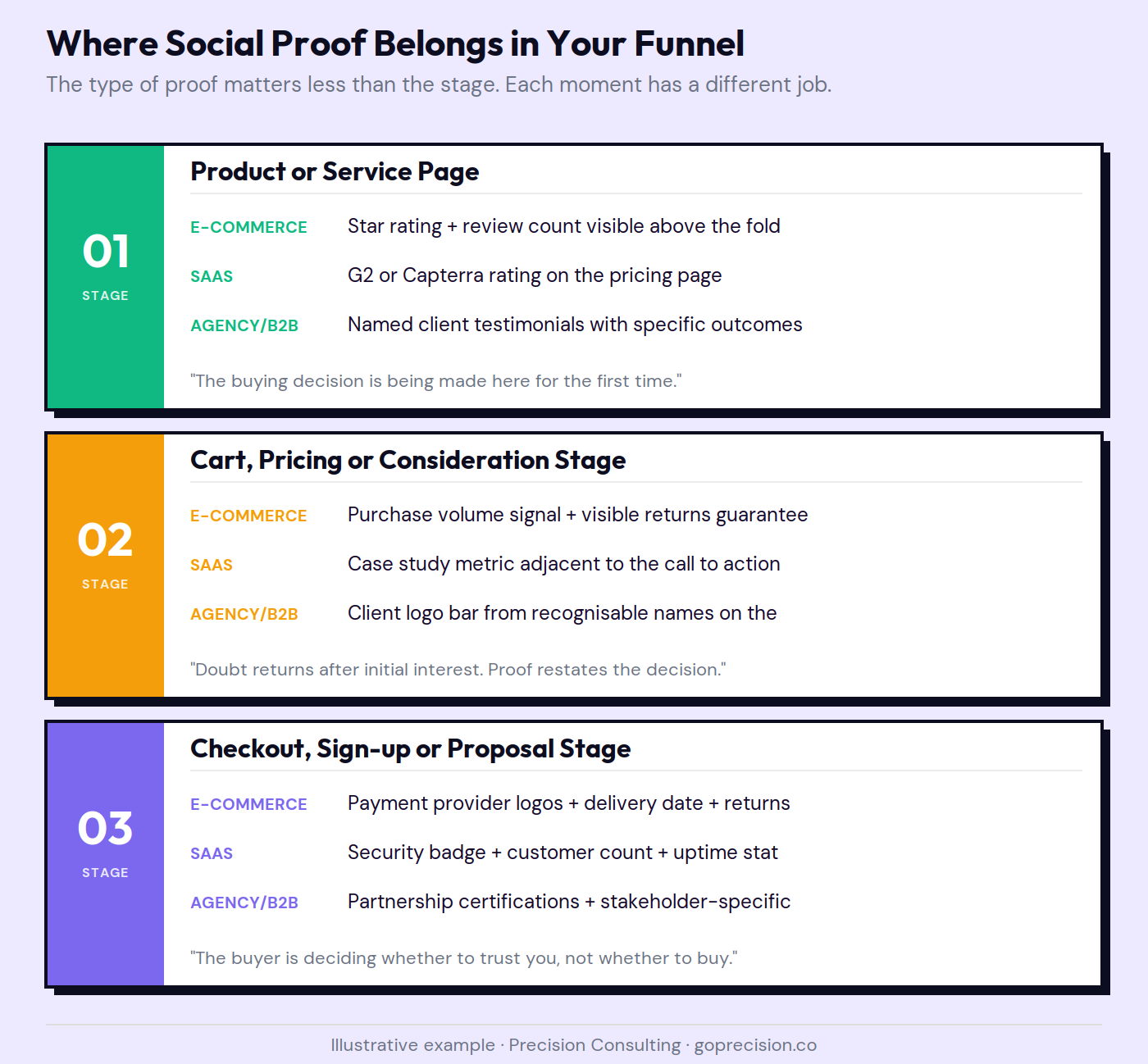
Social proof placement by funnel stage and business model
Social proof only works where the buyer needs it. The Trust checklist in our kit of 9 fillable PDFs has three sections: proof from buyers, safe to pay, and backed if it goes wrong. Tick what applies, fix what is flagged. Get the kit on Etsy.
Social Proof for SaaS
The decision moment in SaaS is the pricing page and the free trial sign-up. Almost every SaaS company puts its testimonials on the homepage. The homepage is not where most buyers decide. It is where they begin. The decision happens on the pricing page, when the buyer is looking at the cost, comparing tiers, and asking whether the tool will actually produce the outcome it claims.
Ratings platforms as third-party validation
G2, Capterra, and Trustpilot serve the same function as Amazon reviews for e-commerce: independent validation that the product does what it says. A SaaS product with 2,400 G2 reviews at 4.4 stars is easier to buy than one with 12 reviews, regardless of what either homepage says about the product.
Move your G2 or Capterra badge from the footer to the pricing page, directly above or adjacent to your call to action. The buyer who is about to click "Start free trial" is the buyer who benefits most from seeing "4.4 stars across 2,400 reviews" at that exact moment.
Case studies with metrics on pricing pages
A case study headline on a SaaS pricing page does real work. "Rocketbook reduced their support volume by 40% in 90 days" is more persuasive adjacent to a pricing decision than it is in a "Customers" section the buyer may never visit. The metric gives the buyer a reason to believe the cost is worth it at the exact moment they are evaluating the cost.
The specificity principle applies to SaaS testimonials exactly as it does to e-commerce reviews. "Great tool, would recommend!" does nothing on a pricing page. "We cut our sales cycle from 28 days to 11 using this" addresses the outcome the buyer is hoping for, and the cost of the subscription becomes a different calculation.
Customer logos on the right page
A logo bar showing recognisable company names on the pricing page transfers institutional credibility at the decision moment. If a prospect sees that a company they know and respect is a paying customer, the implicit message is that the tool passed that company's procurement process. The same logo bar on the homepage, before the visitor has any context, is considerably less effective.
Social Proof for Agencies and Service Businesses
For agencies, consultancies, and any service business, the decision moment is rarely a single page. It happens across several touchpoints: the services page, the first conversation, the proposal, and the follow-up. Social proof needs to be present at each stage, and the type that works shifts at each one.
Named testimonials over anonymous ones
An anonymous testimonial is close to worthless. A named testimonial from a recognisable person and company ("Working with this team reduced our cost per acquisition by 34% in Q3") is a different thing entirely. The name and company make the claim verifiable in principle, which makes it believable in practice, even for prospects who never verify it.
Think about it from the prospect's position. They are evaluating two agencies. One has testimonials attributed to "Marketing Director, retail brand." The other has testimonials from named people at named companies they can look up on LinkedIn. The second agency has social proof. The first has decoration.
Client logos as legitimacy signals
A client logo bar serves a screening function. If a prospect recognises three of the eight logos, they infer that an agency capable of working with those companies is capable of working with theirs. If they see a direct competitor's logo, they assume the agency understands their sector. Placement matters here too: logos on the specific service page most relevant to the prospect's need do more work than the same logos on the homepage.
Case studies at the proposal stage
The social proof that moves most agency conversations forward is not the homepage testimonial. It is the case study included in a proposal that directly parallels the prospect's situation. A prospect running a food delivery platform who receives a proposal that includes a case study from a similar platform, with specific numbers, is in a fundamentally different position than one who receives a generic proposal with a generic testimonial. The specificity signals that you have solved this problem before.
Most agencies keep case studies in a separate section of the website that prospects rarely navigate to. Surface them at the proposal stage, in the first follow-up email, and on the service page most relevant to the enquiry. Not a case study shortage problem. A surfacing problem.
Social Proof for B2B
In B2B, the buying decision is rarely made by one person and rarely made quickly. Social proof needs to function across a longer consideration period and for multiple stakeholders, each of whom has a different concern.
Partnership and certification logos
A "Certified Partner" badge for Salesforce, HubSpot, Google, or any other platform the buyer already uses is institutional social proof. It means the vendor has passed an external organisation's requirements for that certification. The trust transfers from the institution to the vendor. This is particularly effective on vendor shortlists, where the buyer is comparing multiple options and looking for signals that reduce the risk of a poor choice.
ROI-specific testimonials for different stakeholders
A procurement manager, a technical lead, and a CEO have different concerns when evaluating the same B2B product. The testimonial that works for the CEO does not work for the technical lead, who wants to know whether the integration caused problems. B2B social proof that converts is stakeholder-specific, not just outcome-specific. One testimonial addressing implementation smoothness, one addressing ROI, and one addressing support quality covers more of the decision committee's concerns than three testimonials all making the same outcome claim.
Social proof types mapped to business model and funnel stage
The Reviews and Testimonials That Actually Convert
A pattern that comes up in almost every audit across all business types: businesses focus on volume and star rating while underinvesting in specificity. A SaaS product with 800 generic positive reviews is not better served than one with 80 reviews, of which 20 directly address specific objections. An agency with 15 vague testimonials is not better served than one with 4 case studies that name the client, the problem, the approach, and the result.
The specificity principle
Representativeness and persuasion. Buyers evaluate social proof by asking, implicitly: "Is this person like me?" The more closely a reviewer's context matches the reader's own situation (role, industry, concern, outcome), the more persuasive the review becomes. This is why one specific testimonial that names a concern, describes a context, and reports an outcome outperforms ten generic five-star reviews. Volume signals credibility. Specificity drives the conversion.
The most useful social proof does four things: it names a specific concern the buyer is likely to have, it describes the context of the reviewer, it reports a specific outcome, and it resolves an objection for a similar buyer. For e-commerce, this is a sizing review that says, "I was worried about fit; medium worked perfectly." For SaaS, it is a testimonial that says, "We had tried two other tools; this one took one afternoon to set up." For an agency, it is a case study that says, "We came in thinking our problem was traffic. The audit revealed it was product page trust. Revenue increased 28% in twelve weeks from the same traffic." The specificity makes it credible. The relevance makes it persuasive.
What to Do When You Have No Social Proof Yet
The launch problem is real across every business model. You need buyers to get reviews. You need reviews to attract buyers. A newly launched e-commerce store, a just-released SaaS product, or a consultancy in its first year all face the same paradox: the absence of social proof is most damaging at exactly the moment when it is hardest to acquire.
Friends, family, and genuine early users
The fastest route to the first five to ten reviews or testimonials is to work with people you know who fit the target customer profile and ask for honest feedback, not favourable feedback. The distinction matters. A generic five-star review from a friend reads as inauthentic. A specific, honest account of their experience, including what they were unsure about and how it turned out, is worth having regardless of the relationship. Ask the specificity question: "What were you unsure about before using this, and how did that turn out?" This prompt generates the objection-resolving responses that convert the next buyer in the same position.
Product and service seeding
Send your product to people in your target community. Offer your service at a reduced rate to early clients in exchange for a detailed case study. For SaaS, offer extended free trials to users who agree to provide structured feedback after 30 days of real use. Be transparent about the arrangement. Most professional communities respect founders who are open about building something and asking for honest input.
The Reddit and community launch
When founders post about a new product or service on communities like r/entrepreneur, r/smallbusiness, or sector-specific subreddits, the most common mistake is asking for validation instead of feedback. A post that says "Just launched, would love your thoughts" gets polite engagement at best. A post that says "Just launched this, here is the problem I was trying to solve, here is what I built, here is what I am still unsure about, genuinely open to critique" gets specific and useful responses.
The engagement from a transparent community launch does not sit in a review widget on your homepage. But it serves the same function: third-party validation from people with no stake in your success. Screenshot the useful responses. Use them in early outreach and proposals. They are early social proof, even if they do not look like it yet. To understand whether your conversion problems go beyond social proof, our piece on the ten things to fix before spending more on ads is a useful starting point for identifying the full picture.
Reviews Stopped Being a Differentiator
Every business has reviews. Every agency has testimonials. Every SaaS product has a G2 rating. The businesses that convert better show the right proof to the right person at the right moment in the funnel. That is a placement and specificity problem, not a volume problem.
Start by mapping your decision moments, not your content inventory. For each stage where a prospect or buyer makes a go or stop decision, ask: what social proof is visible here, and does it address the specific concern this person has at this stage? The gap between where your proof lives and where it needs to be is the answer to most social proof underperformance. Not a proof problem. A placement problem. Heatmaps and session recordings are the tools that make that gap visible. Our guide to the best CRO tools for e-commerce covers which behaviour analytics platforms are worth installing first.
Precision works with e-commerce brands, SaaS products, and agencies on the placement and context decisions that make social proof drive conversions rather than decorate pages. To understand what a structured conversion review covers, take a look at the full audit process.
Influence by Robert Cialdini: the foundational text on social proof, reciprocity, authority, and the six principles of persuasion. The social proof chapter alone explains why specificity and source similarity matter more than volume.
Contagious by Jonah Berger: how social observation drives behaviour and why visible usage signals spread adoption differently from explicit testimonials. Useful for understanding why some proof types create momentum while others just fill a page.
- Social proof works at the moment of decision. Placement matters more than type or volume. This applies equally across e-commerce, SaaS, agencies, and B2B. Most businesses have enough proof. Most have it in the wrong place.
- The decision moment differs by model. E-commerce: product page, cart, checkout. SaaS: pricing page, free trial sign-up. Agency: services page and proposal. B2B: vendor shortlist and proposal stage. Social proof before the decision moment is decoration.
- For e-commerce: star rating and review count above the fold. Image reviews generate up to 180% more conversions than text-only (Yotpo). Five or more reviews increase purchase likelihood by 270% (Spiegel Research Center).
- For SaaS: G2 or Capterra badge belongs on the pricing page, not the footer. Case study metrics adjacent to the CTA. Recognisable customer logos at the decision moment, not just the homepage.
- For agencies: named testimonials only. Anonymous quotes are decoration. Case studies surfaced at the proposal stage, matched to the prospect's specific situation, move more conversations forward than homepage testimonials.
- For B2B: partnership and certification logos signal institutional validation. ROI testimonials must speak to different stakeholders: procurement, technical lead, and executive concerns are not the same objection.
- Specificity converts. One review that names a concern, describes a context, and reports a specific outcome is worth ten generic five-star reviews, regardless of business model.
- New businesses: ask the specificity question in early feedback requests: "What were you unsure about before using this, and how did that turn out?" Not a proof shortage. A surfacing and sequencing problem.
Frequently asked questions
Does social proof increase conversion rates?
Yes, when placed at the moment of decision. Research from the Spiegel Research Center found that displaying reviews can increase purchase likelihood by 270%. The effect holds across business models: e-commerce product pages, SaaS pricing pages, and agency proposals all benefit from well-placed, specific social proof. Social proof that appears before the decision moment or in locations most visitors do not reach at the relevant stage has limited measurable impact.
What is the most effective type of social proof?
The most effective type is the one that addresses the specific concern of the buyer at the specific stage they are at. For e-commerce, this is often an image review that shows a product in real use. For SaaS, it is a case study with a metric that matches the buyer's goal. For agencies, it is a named testimonial from a recognisable client in a similar situation. The type matters less than the relevance and the placement.
What is the difference between social proof for e-commerce and B2B?
E-commerce social proof focuses on product-level proof (reviews, ratings, purchase volume) at high-speed decision moments. B2B social proof operates over longer consideration periods with multiple stakeholders, each with different concerns. E-commerce buyers often decide in minutes. B2B buyers evaluate over weeks or months, and the social proof needs to function across multiple touchpoints and speak to procurement, technical, and executive concerns simultaneously.
How do you get social proof for a new business?
Start with friends, colleagues, and early users who fit the target customer profile. Ask the specificity question: "What were you unsure about before using this, and how did that turn out?" Offer early access or reduced pricing to buyers who commit to structured feedback. For service businesses, offer the first one or two engagements at a reduced rate in exchange for a case study. Be transparent about the arrangement. Honest early feedback is more valuable than enthusiastic but vague endorsements.
Should social proof appear on the homepage?
Yes, but it should not be the primary placement. The homepage is where visitors begin, not where they decide. A logo bar and a single testimonial establish baseline credibility. The conversion-critical placements are the pricing page, the services page, the cart, the checkout, and the proposal. Moving social proof from the homepage to these decision-moment pages typically produces a measurable conversion improvement.
Do client logos count as social proof?
Yes, when placed correctly. A logo from a company the prospect recognises transfers institutional credibility: the logo implies the vendor passed that company's procurement process, which is itself a form of endorsement. Logos are most effective on service pages and pricing pages adjacent to the call to action. Logos in a footer or on a homepage before the visitor has any context provide limited conversion value.