Post-purchase experience is every touchpoint a customer has with your brand after completing a purchase: the order confirmation, shipping notifications, delivery, packaging, the returns process if needed, and any follow-up communications. It determines whether a first-time buyer becomes a repeat customer, whether they leave a review, and whether they tell anyone else about your brand. Our e-commerce CRO services address the full funnel, post-purchase included, because it is the phase where most of the retention opportunity sits.
Most e-commerce CRO stops at the checkout. The post-purchase phase gets handed to whoever manages fulfilment and is never reviewed for its effect on repeat purchase rate or lifetime value. The result is stores that spend their entire optimisation budget on the front of the experience and then actively erode the customer relationship they just paid to build. ASOS is the clearest public example of how badly this compounds: the brand has a recognisable product and a genuine customer reach, yet its Trustpilot score sits at 1.8 out of 5. Reviews document refunds promised within 14 days and still being chased after 145. Fake complaint reference numbers issued by support agents. Customers told to re-order an item that was not delivered because the technical issue could not be resolved from the chat window. The product is not the problem. The post-purchase experience is.
Why post-purchase experience drives conversion
Acquiring a new customer costs five to seven times more than retaining an existing one. Research published in Harvard Business Review found that increasing customer retention by 5% can increase profitability by 25 to 95%. The second purchase is the most important conversion in e-commerce. A customer who buys twice is significantly more likely to buy a third time. A customer who buys once and has a poor post-purchase experience is unlikely to return.
Not a product problem. Not a marketing problem. A sequencing problem. The post-purchase phase is the sequence that either builds the customer relationship or ends it. Every store that treats fulfilment as a separate function from conversion has a sequencing problem, not a product problem.
How to use the order confirmation email as a conversion touchpoint
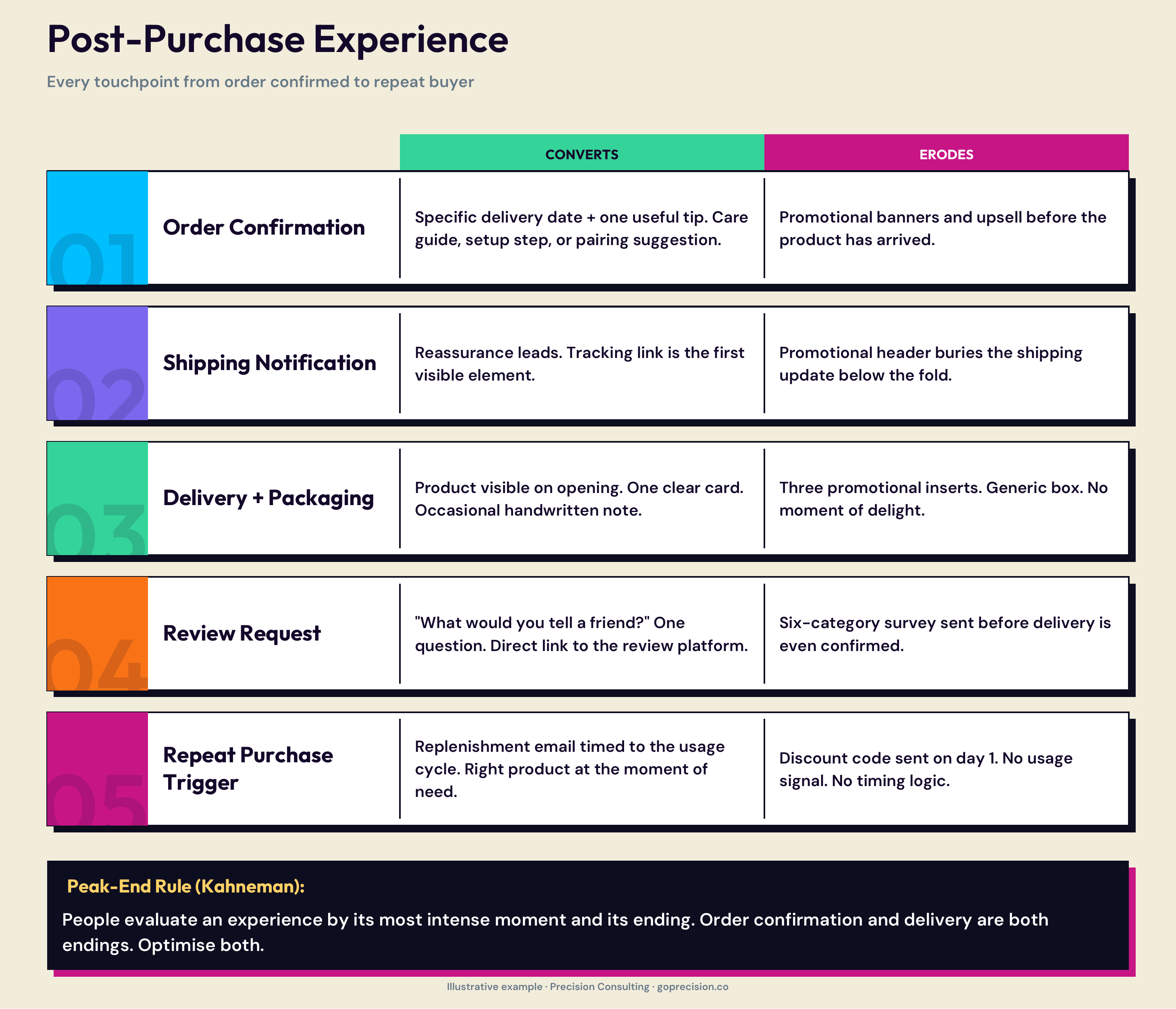
Order confirmation emails achieve open rates between 60 and 70%, compared to approximately 21% for standard marketing emails. This is the highest-engagement email you will ever send to a customer. Most stores use it only to confirm the order.
The order confirmation email should do four things. Confirm the order clearly, with the product name and order number visible in the first paragraph. State a specific delivery date, not a range. Give the customer one piece of immediately useful information: a care guide, a setup tip, a pairing suggestion. And make it obvious how to reach support if something goes wrong.
From the buyer's position, they have just handed over money and are now waiting. The psychological state at order confirmation is one of peak engagement and mild anxiety. The job of this email is reassurance and value, not a promotional banner for products they have not yet decided they want. The upsell belongs in email three, after the product has arrived and they have formed a positive impression.
The product page is where the expectations are set that the post-purchase experience must meet. Our article on the behavioural science behind product pages that convert covers how those expectations form and which signals set them correctly.
Gymshark illustrates the cost of skipping the basics here. Reviewers on Trustpilot document receiving zero shipping communication after placing an order, then discovering the parcel had been sent to the wrong address when it simply did not arrive. The first proactive communication the customer received was an apology after they raised a complaint. That sequence is the inverse of what a post-purchase flow should do.
A post-purchase email sequence mapped by timing and job: each message has one specific role in the conversion flow
Why setting delivery expectations below your capability drives repeat purchase
Delivery time accuracy is a more powerful repeat-purchase driver than delivery speed. A vendor showing a 40-minute delivery window who consistently delivers in 38 minutes generates a better repeat experience than a vendor showing 25 minutes who consistently delivers in 35. The gap between expectation and reality is the variable, not the absolute time.
The fix is simple in principle and consistently ignored in practice: set the delivery window below what you can reliably achieve, then beat it. A customer who expected delivery by Thursday and receives it on Wednesday has had a positive experience. A customer who expected Tuesday and receives it on Thursday has had a negative one, even if the total delivery time was identical.
Shipping notification emails follow the same logic. The job of a shipping notification is reassurance. Every version that buries that reassurance under a promotional header is prioritising the wrong outcome.
How the delivery and packaging experience affects repeat purchase rate
The delivery experience is where the brand promise meets physical reality for the first time. Most stores have limited control over the final mile. What they do control is everything the customer encounters when the parcel arrives.
Chip and Dan Heath's research in Made to Stick identifies 'unexpected' as one of the core properties of ideas that create lasting impressions. In the post-purchase context, this is precisely why Chewy's approach produces the results it does. When customers cancel subscriptions, Chewy agents proactively call to ask why. When a customer mentioned in a support conversation that their pet had died, Chewy sent flowers and a handwritten condolence card. Chewy's repeat customer rate is reported at 75%. These are not random acts of generosity. They are a systematic approach to creating unexpected moments that make the brand impossible to replace in the customer's mind.
Zappos operates on a similar principle. A 365-day return window. No call scripts. No time limits on support conversations. The longest recorded Zappos support call lasted 10 hours and 43 minutes. Zappos does not measure customer service by efficiency. It measures it by the impression left. The result: 75% of Zappos revenue comes from repeat customers.
Most stores do not have Chewy or Zappos budgets. The principle is still replicable. A box that opens with the product visible rather than buried in paper. A single card with one clear message rather than three promotional inserts. A handwritten note on a small percentage of orders. These are design decisions that cost very little and produce disproportionate social sharing, reviews, and referrals. The mechanism is the same: the unexpected moment is the memorable one.
Is your post-purchase sequence converting repeat buyers?
A CRO audit reviews every touchpoint from order confirmation to follow-up, identifying exactly where the customer relationship is being lost after checkout. Request your free audit and get a prioritised list of what to fix first.
Why a good returns process increases repeat purchase rate
NRF research found that 67% of shoppers check the returns policy before they buy. The returns experience does not start at the return. It starts at the product page. For the specific trust signals that build confidence before the purchase is even made, our article on 8 e-commerce trust signals and where to place each one covers the pre-purchase side of that same credibility gap.
ASOS and Gymshark both illustrate what the wrong returns experience costs. On Trustpilot, ASOS reviewers document return labels that do not work for multi-vendor orders, refunds promised within 14 days and not received after 145, and support agents issuing reference numbers for complaint processes that do not exist. Gymshark reviewers document receiving partial refunds with no explanation, exchange requests met with complete communication silence for weeks, and chatbot responses that directly contradict what human support agents subsequently say. Neither brand has a product problem. Both have a post-purchase sequencing problem. The customer who initiated a return was recoverable. The customer who chased a non-existent refund for five months is gone.
A returns process that converts has three components. Initiation that takes under two minutes with no search required. Immediate acknowledgement with a specific refund timeline. And a follow-up after the refund processes that invites the customer back with the learning applied: "We noticed you returned size M. Here is the size guide if you would like to try size L." That last email is the one almost no brand sends. It is also the one that converts the return into a second purchase.
The one email almost nobody sends
A customer who returns a product and receives a refund within 48 hours, with clear communication at each stage, is more likely to place a second order than a customer who never returns anything. The return process taught them that the brand is trustworthy. A frictionless first purchase did not give them that test. The post-refund follow-up email is not a recovery effort. It is the natural next step in a relationship the returns process just deepened.
When to send the review request email and why timing matters
The review request email should arrive three to five days after confirmed delivery, not after shipping. A review request that arrives before the product does asks the customer to evaluate an experience that has not happened yet. For how to structure the review request itself, including the question format that generates specific, objection-resolving responses, our article on how social proof placement drives conversion covers the specificity principle in full.
The format matters as much as the timing. Ask one question, not a six-category satisfaction survey. One question, with an immediate link to leave a review on the platform of your choice. Every additional step between the customer and the review reduces completion rate.
The question format also determines the quality of the answer. "Was this product what you expected?" generates star-rating-style responses. "What would you tell a friend who was considering this product?" generates the specific, objection-resolving reviews that convert the next buyer. That question takes 30 seconds to change. Most brands never change it.
Change your review request question from "Was this what you expected?" to "What would you tell a friend who was considering this?" Set the email to trigger three to five days after confirmed delivery, not after dispatch. Both changes take under an hour to implement.
What triggers repeat purchases more effectively than discount codes
The most common repeat purchase trigger is a discount code sent immediately after the first order. This is the wrong mechanism at the wrong moment. The customer has not yet received the product, has not yet formed an opinion, and has not yet developed the trust that makes a second purchase attractive. A discount code sent before the first order has been delivered is a cost with no conversion mechanism behind it.
The effective trigger is a product recommendation sent when the first product is running out, based on the usage cycle. A customer who bought a 30-day skincare product receives a replenishment email at day 25, not day 7. A customer who bought a protein supplement receives a recommendation for a complementary product after the first bag is likely finished, not before it arrives.
Timing is the conversion variable. The right product recommended at the wrong moment produces nothing. The same recommendation at the moment of need converts at a meaningfully higher rate than any discount delivered on an arbitrary schedule.
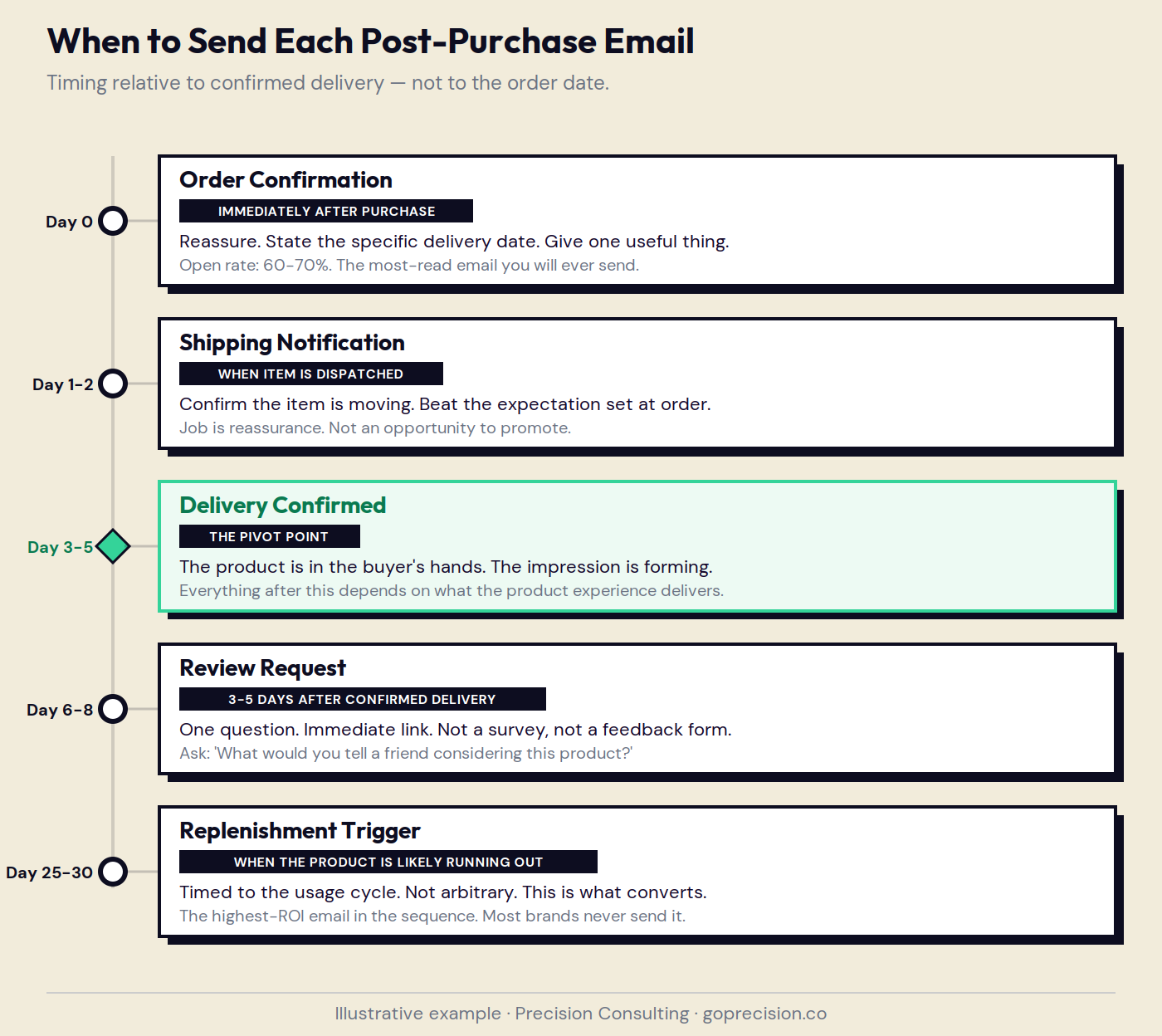
Repeat purchase email timing mapped to usage cycles: the right recommendation at the moment of need outperforms any discount sent on an arbitrary schedule
Precision works with growth-stage e-commerce brands on full-funnel CRO, post-purchase sequence included. If you want to understand where your post-purchase flow is losing repeat buyers, book a call and we will walk through your sequence together. Or take a look at the full audit process to understand what a structured conversion review covers.
Made to Stick by Chip and Dan Heath: explains why unexpected moments create lasting impressions and why the Chewy and Zappos approaches work at a psychological level. The 'unexpected' principle is the mechanism behind post-purchase moments that drive word of mouth and repeat purchase.
The Effortless Experience by Matthew Dixon, Nick Toman, and Rick DeLisi: the research-backed case for why reducing customer effort, particularly in the returns and support process, is the most reliable driver of loyalty. Directly applicable to the returns sequence and review request timing covered in this article.
- Post-purchase experience covers order confirmation, shipping notifications, delivery, packaging, returns, and follow-up communications. It is the phase most stores treat as operations and never review for conversion impact.
- Acquiring a new customer costs five to seven times more than retaining an existing one. Research in Harvard Business Review found that a 5% increase in retention can increase profitability by 25 to 95%. The second purchase is the most important conversion in e-commerce.
- Order confirmation emails achieve 60 to 70% open rates, compared to 21% for standard marketing emails. The job of this email is reassurance and immediate value, not upselling before the product arrives.
- Delivery time accuracy drives repeat purchase more than delivery speed. Set the expectation below what you can reliably deliver, then beat it. The gap between expectation and outcome is the conversion variable.
- Chewy and Zappos both report 75% repeat customer rates. Both use the same mechanism: unexpected post-purchase moments that are impossible to replicate once experienced. Chip and Dan Heath in Made to Stick identify 'unexpected' as the property most responsible for creating lasting impressions.
- 67% of shoppers check the returns policy before they buy (NRF). A returns process that is easy, fast, and clearly communicated turns a potential churn event into a trust signal for the next purchase.
- Send the review request three to five days after confirmed delivery, not after shipping. Ask one question with an immediate link. "What would you tell a friend considering this product?" produces specific, objection-resolving reviews. "Was this what you expected?" produces ratings.
- The most effective repeat purchase trigger is a product recommendation timed to the usage cycle, not a discount code sent immediately after the first order. The discount has no conversion mechanism until the customer has formed a positive impression of the product.
Frequently asked questions
What is post-purchase experience in e-commerce?
Post-purchase experience covers every touchpoint a customer has with your brand after completing a purchase: the order confirmation email, shipping notifications, the delivery and unboxing experience, the returns process if needed, and any follow-up or re-engagement communications. It directly affects repeat purchase rate, review volume, and word-of-mouth referrals.
Why does post-purchase experience affect conversion rate?
Acquiring a new customer costs five to seven times more than retaining an existing one. The second purchase is the most important conversion in e-commerce, because customers who buy twice convert at a significantly higher rate for a third purchase. A poor post-purchase experience, whether a slow return, unclear shipping communication, or no follow-up at all, ends the customer relationship at its most recoverable point.
What makes Chewy and Zappos examples of good post-purchase experience?
Both brands use unexpected post-purchase moments as the mechanism. Chewy sends handwritten condolence cards and flowers when customers lose a pet. Zappos has a 365-day return window with no call scripts and no time limits on support conversations. Neither is primarily about cost. Both are about the impression left after the transaction ends. Chewy and Zappos both report 75% repeat customer rates. The mechanism is what Chip and Dan Heath in Made to Stick identify as the unexpected: moments that are memorable precisely because they fall outside what the customer anticipated.
When is the best time to send a review request email?
Three to five days after confirmed delivery. Not after shipping. A review request that arrives before the product reaches the customer collects meaningless data and creates a poor impression. The format matters as much as the timing: one question with an immediate link to leave a review produces far higher completion rates than a multi-field satisfaction survey.
What is wrong with sending a discount code immediately after purchase?
The timing is wrong, not the mechanism. A discount code sent before the customer has received or formed an opinion of the first product has no conversion mechanism behind it. It is a cost without a trigger. The same discount code sent at the moment of first replenishment need, when the product is running low, attaches to a genuine purchase impulse and converts at a meaningfully higher rate.
How do you improve a returns process to drive repeat purchases?
Three components make a returns process a conversion mechanism rather than a churn event. First, initiation takes under two minutes with no search required. Second, immediate acknowledgement with a specific refund timeline. Third, a post-refund email that invites the customer back with the learning from the return applied: if they returned a size, show the size guide. If they returned a colour, suggest an alternative. That follow-up is almost never sent. It is the one most likely to recover the customer.