Last updated:
CRO improves the conversion of the site you already have using evidence from real user behaviour. A website redesign rebuilds the site from a new structural starting point, often without that evidence. The choice between them is a question of what you actually know about why your store underperforms, not a question of taste.
Most stores spending real money on a redesign should be spending it on CRO instead. The redesign feels like progress because something visible is happening. Six months later, the conversion rate is the same, sometimes worse, and the founder is back where they started with a smaller bank balance and the same unanswered questions about why people were not buying in the first place.
Steve Krug's Don't Make Me Think established the principle behind why this happens. Buyers do not read websites, they scan them, and what makes a site convert is structural clarity at the moment of decision. Visual design is downstream of that. A redesign that changes visual design but not structural clarity does not change the conversion rate.
In my work at Precision, I see this pattern almost monthly. A store that has not converted well in twelve months commissions a complete rebuild. The new site launches. Traffic is the same. Conversion is the same. The friction that was killing sales on the old site is still killing sales on the new one, because no one ever isolated what the friction actually was. The design changed. The problem did not.
This article covers what each approach actually does, where each one wins, where they actually work together, and how to know which one your store needs right now.
What is the difference between CRO and a website redesign?
CRO is a process of improving conversion rates by identifying friction in the existing user journey and removing it through targeted, measurable changes. A website redesign is a structural rebuild of the site, usually changing layout, navigation, brand, and often the underlying platform. CRO is iterative and evidence-led. A redesign is a one-time event that moves you to a new starting point, with or without evidence.
Think of it like a house. CRO is fixing the leaking pipe under your kitchen sink. The redesign is gutting the entire kitchen and starting over. One is precise and addresses the problem you can name. The other is a six-month construction project that may or may not address the leak you came in to solve. Which one you reach for depends on whether the leak is a pipe or a foundation. Most leaks are pipes.
For a fuller breakdown of what CRO actually involves as a discipline, the definition and scope of CRO covers it in detail.
You are confusing visual change with structural change
The two approaches sound related, and the language around them blurs the line further. Agencies often pitch a redesign as "CRO". Designers often describe a new layout as "more conversion-friendly". Founders read both and assume the same outcome. They are different outcomes from different disciplines, and assuming they are the same is how stores end up paying redesign prices for changes that will not move conversion.
Visual change is what most redesigns deliver. New colour palette, refreshed hero, cleaner navigation. Structural change is what CRO delivers. Removing a forced account creation step. Showing shipping costs before checkout. Adding a single benefit line above the fold. The visual changes look more impressive in a slide deck. The structural changes are what actually move the numbers.
You are conflating two different disciplines
CRO asks: where exactly is the current site losing the buyer, and what is the smallest change that moves the metric? A redesign asks: what should the site look like now? One is a diagnostic discipline. The other is a creative project. They produce different outputs, and they should be triggered by different problems.
The fix for "why is conversion dropping at the shipping step" is rarely "redesign the homepage". The fix for "the site no longer represents what we sell" is rarely "run an A/B test". Match the discipline to the problem, and most decisions become straightforward.
CRO and redesign are different disciplines triggered by different problems. Match the tool to the question, not the budget.
Why do most redesigns fail to improve conversion?
Most redesigns do not improve conversion because they change the surface of the site without diagnosing what was broken underneath. A new colour palette and a refreshed hero do not address the fact that buyers are dropping out at the shipping calculator, or bouncing because the product page does not answer the one question they need answered before paying.
The cleanest public example is Marks & Spencer's 2014 website redesign. The new site looked modern and won design awards. Online sales fell by around 8% in the quarter after launch and took roughly 18 months to recover, with industry analysis attributing the drop to changes in the checkout flow and search functionality that the redesign brief had treated as cosmetic. The visual identity improved. The structural usability did not. Buyers who had previously been able to complete a purchase fluently could no longer do so as easily, and they left.
That pattern is not specific to large retailers. It plays out at every scale. The small Shopify store that commissions a Webflow redesign and watches conversion drop by half a percentage point is doing the same thing M&S did. Treating a structural problem as a visual one.
You changed the surface and not the friction
Common friction points that survive a redesign untouched include unexpected shipping costs at checkout, weak trust signals on the product page, slow mobile load times, forced account creation, and confusing or hidden return policies. According to Baymard Institute research across thousands of e-commerce sites, unexpected costs at checkout alone account for 48% of all cart abandonment, and forced account creation drives a further 26%. None of those numbers move because the navigation is now sans-serif. They move because the friction is removed. If you do not know which of these are happening in your store, the traffic-without-sales diagnostic walks through how to find them.
You broke the parts that were quietly working
The other thing redesigns frequently break is the few things that were actually working. A high-converting product page format gets replaced because it does not match the new brand system. A bestselling cart layout gets restructured because the designer thought it was busy. The store loses the unmeasured wins that were quietly carrying the conversion rate, and they do not notice until the numbers drop. In one Precision audit of a mid-sized fashion retailer, the only product page that converted above category benchmark was the one that the new design system had flagged for replacement. The conversion was coming from the layout the designer wanted to retire.
Your reasons for the redesign were emotional, not strategic
Redesigns are often emotional decisions disguised as strategic ones. The site looks dated. The founder is tired of looking at it. A competitor launched something visually stronger. None of those reasons is connected to why customers do or do not convert. But they are powerful enough to justify a six-figure rebuild.
When is CRO the right move?
CRO is the right move when your site converts at all, when you have enough traffic to learn from, and when the structural elements of the site are not visibly broken. If buyers are completing purchases on your current site, even at a rate below what you want, the foundations work. The job is to find the leaks and patch them, not to rebuild the building.
The threshold for CRO to be useful is roughly 10,000 monthly visitors and an existing conversion rate above zero. Below that, you do not have enough data to test reliably, and the bigger lever is usually traffic acquisition. Above that, every percentage point of conversion improvement compounds across all the traffic you are already paying for, with no additional ad spend. The conversion rate benchmarks by category show what "below where it should be" actually looks like for your vertical.
You can already see where buyers are dropping out
Open your GA4 funnel exploration report. Find the step with the worst drop-off relative to the category benchmark. That step is your diagnostic target. If your add-to-cart rate is below 5%, the problem is on your product pages. If your cart-to-checkout rate is below 50%, the problem is with the cart. If both are reasonable, but conversion is still low, the problem is in the checkout itself. Targeted CRO changes will move the metric without touching anything else.
You do not have six months and six figures to wait
CRO costs a fraction of a redesign and produces measurable returns within weeks. A redesign is a six-figure commitment that delivers value in six to twelve months at best. If cash flow matters, CRO is the only honest option. At a major food delivery platform I worked with, a structured CRO programme delivered +58% revenue over six months from existing traffic. The same period spent on a redesign would have produced no measurable change to the conversion rate at all, because the redesign would still have been in design review.
You want to learn what works on your specific audience
Every CRO test produces a piece of knowledge that compounds. After twelve months of testing, you understand your buyers in ways no redesign brief could ever capture. That knowledge is what informs the next redesign, when one becomes necessary. A founder who has run forty tests over a year is not in the same position as a founder who has run none, even if both end up commissioning a redesign in the thirteenth month. The forty tests change what the redesign is for.
When is a website redesign actually justified?
A website redesign is actually justified when the structural foundations of the site genuinely no longer support what the business needs to do. That is a high bar, and most stores do not meet it. The three signals that mean you have crossed it are platform, brand, and accumulated technical debt. If two of these three are true, you are looking at a real redesign case.
Your platform genuinely cannot do what the business needs
The platform signal is the clearest. If you are on a legacy platform that no longer integrates with the apps and tools your business needs, no amount of CRO will fix that. A move from a custom build to Shopify, or from an older Shopify theme to a modern 2.0 theme, is a structural change that CRO cannot make. The Shopify CRO guide covers what platform-level constraints look like in practice on the most common e-commerce stack.
Your brand or business model has fundamentally changed
The brand signal applies when your visual identity, positioning, or product category has fundamentally changed. A pivot from B2C to B2B. A premium repositioning. A category expansion that the current site cannot accommodate. These are real reasons to rebuild because the existing site is solving for a business that no longer exists.
Your technical debt is now a daily tax
The technical debt signal applies when years of patches, third-party apps, custom code, and theme overrides have made the site slow, fragile, or impossible to maintain. Page speed in the red on every PageSpeed Insights report. Apps fighting each other in the cart. A theme so customised that no developer wants to touch it. According to Google's research on mobile speed, a one-second delay in page load reduces conversions by up to 7%, and a three-second load increases bounce probability by 32%. At that point, the cost of continuing to patch exceeds the cost of starting clean.
The signal that a redesign is not justified is the most common one in practice. The founder thinks the site looks dated. That is an aesthetic concern, not a structural one, and it is rarely worth the spend. A targeted refresh of hero imagery, product photography, and typography can solve the visual problem at a fraction of the cost of a full rebuild.
The three signals that justify a rebuild: platform, brand, and technical debt. Two of three is the threshold. Aesthetic boredom is not on the list.
This is the kind of analysis we run in a Precision Deep Dive Audit. If you want to see whether your store needs CRO, a redesign, or both, request your free audit and we will walk through the answer together.
When do redesign and CRO actually work together?
Redesign and CRO work together when the redesign brief is informed by CRO evidence, and the new design system is built around the elements that already convert. That is a fundamentally different project from a redesign briefed by aesthetic preference. Done well, the two disciplines amplify each other. The redesign produces a cleaner foundation. CRO continues to refine within it.
Back to the kitchen. A redesign that integrates CRO is not a demolition crew. It is the rebuild that keeps the drainage system already working, protects the high-pressure pipes you cannot afford to replace, and rebuilds the layout around how you actually cook. The kitchen looks new. The plumbing logic is preserved or improved. The drainage even gets repurposed: instead of dumping greywater into the main line, it now feeds the herb garden out back. Same fundamentals, smarter use of what is already there. That is what a combined CRO and redesign project looks like. Most redesigns are not that. They are demolition crews who arrived without checking which pipes were leaking.
This is not a rare or theoretical possibility. It is what good CRO-led redesign engagements look like, and it is the right answer when the brand, platform, or technical debt criteria from the previous section genuinely justify a rebuild. The mistake is not redesigning. The mistake is redesigning without the evidence to do it well.
The right brief comes from the data, not the moodboard
A combined project starts with months of CRO data, not a Pinterest board. The designer is briefed on what converts and why, and the visual system is built to preserve the working patterns. The hero layout that converts at 12% above benchmark gets protected. The cart upsell module that drove +35% AOV gets carried over. The new design absorbs them as constraints, not as candidates for replacement. A brief that lists "what to keep" alongside "what to change" produces a fundamentally different output from a brief that only lists "what we want the site to feel like".
The right firm runs both disciplines, not one or the other
A firm or team that only does design will struggle to brief itself on what to preserve. A firm that only does CRO will struggle to execute a structural rebuild. Combined projects work when the same team is responsible for both the conversion outcomes and the visual system. That alignment is rare. Most agencies are organised around one discipline or the other, and the brief gets handed across teams that do not talk to each other. When you are evaluating an agency for a combined project, the question is simple: who on the team owns the conversion rate after launch? If the answer is "the client", the project is a redesign with CRO branding, not a combined project.
How does a conversion-focused redesign differ from a standard one?
A conversion-focused redesign starts with a different brief and ends with a different outcome. The brief is built from CRO evidence: what is converting well and must be carried forward, what is breaking conversion and needs to change, and what buyer behaviour data says about how the journey should be restructured. A standard redesign is briefed from aesthetic preference and brand ambition. The designer receives a moodboard, not a conversion report.
The difference shows up at launch. A standard redesign resets your conversion rate, often below where you started. The patterns that were working get replaced because the team building the new site did not know they were working. A conversion-focused redesign protects those patterns and uses the redesign to eliminate the ones that were failing. The result is a new site that converts at or above the previous site from day one, rather than one that spends the next six months recovering.
| Conversion-focused redesign | Standard redesign | |
|---|---|---|
| Brief built from | CRO test results and user behaviour data | Aesthetic preference and brand guidelines |
| Starting question | What is currently converting, and what is blocking it? | What should the site look and feel like now? |
| What is preserved | Tested conversion winners: layouts, CTAs, trust placements that perform above benchmark | Usually nothing. The whole site is treated as a blank page. |
| Conversion rate at launch | At or above the pre-redesign rate | Often lower. Tested patterns replaced without evidence. |
| Post-launch CRO position | Continues within the new system using accumulated buyer knowledge | Starts from zero with no knowledge of how the new site behaves |
| Risk at launch | Low. Decisions are grounded in tested buyer behaviour. | High. Conversion wins can disappear without the team noticing. |
The question to ask any agency pitching a redesign is: what from the current site will you carry forward, and what evidence tells you to keep it? If the answer is "we start fresh", they are pitching a standard redesign regardless of what they call it. A genuine conversion-focused redesign requires knowing which parts of the current site are doing the conversion work. That knowledge comes from CRO data gathered before the design brief is written, not after it.
How big is the cost gap between CRO and a redesign?
The cost gap between CRO and a website redesign is significant in both money and time. CRO ships measurable changes within weeks of starting and costs a fraction of what a redesign requires. A full e-commerce redesign takes four to nine months from kickoff to launch, during which your ability to test, learn, or iterate on the live site is paused.
A real redesign is a multi-month commitment with a high upfront cost
Agency-led e-commerce redesigns take months. The cost depends on the scope. A simple template rebuild sits at the lower end. A custom design across product, cart, and checkout pages sits in the middle. Migrations to new platforms or Shopify Plus checkout extensibility sit at the higher end, often dramatically so. Add internal time spent on briefing, review, and stakeholder management, and the all-in cost climbs further. None of that includes the opportunity cost of the months during which the existing conversion rate is the only conversion rate you have.
CRO ships measurable changes in weeks, not seasons
CRO produces measurable revenue lift in the first 60 to 90 days. The improvements compound month over month as more tests are run. There is no launch event to wait for. The first change ships in week two. The thirtieth change ships eight months later, by which point a redesign would still be in beta. The opportunity cost most founders do not price into a redesign is the lost learning. Six months without testing is six months of not knowing what your buyers respond to, and that lost learning is the most expensive part of a redesign because it never appears on the invoice.
How do you decide which one your store needs?
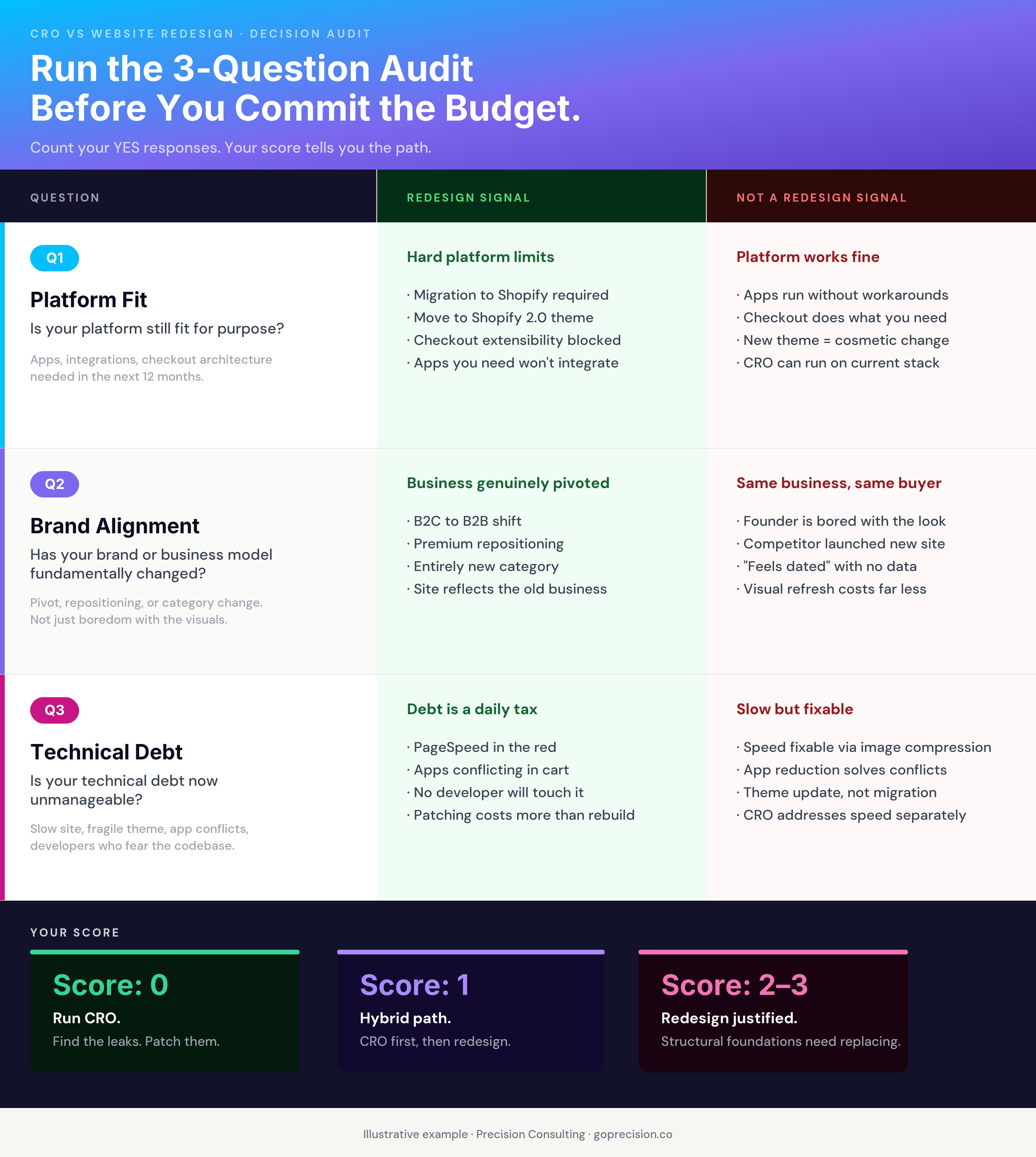
To decide between CRO and a redesign, run a short structural audit before committing to either. The audit answers three questions. Is the platform still fit for purpose? Has the brand or business model fundamentally changed? Is the technical debt unmanageable? If the answer to all three is no, CRO is the correct path. If two or more are yes, a redesign is justified, and the question becomes whether to run it as a combined CRO-and-redesign project or as a pure rebuild.
Run the three-question structural audit
The audit takes a day or two if you have access to your analytics, your PageSpeed Insights scores, and a working knowledge of your platform constraints. The output is a clear yes or no on each question, with a short note on the evidence behind each answer.
For the platform question, list the apps and integrations the business needs in the next twelve months. If the current platform supports them, the answer is yes, the platform is fit. If you are running into hard limits or hostile workarounds, the answer is no.
For the brand question, ask whether the current site reflects what you sell now and who you sell it to. A repositioning, a pivot, or a category change usually means the answer is no. A founder who is bored with the visual identity is not sufficient.
For the technical debt question, look at PageSpeed Insights scores on mobile, the number of installed apps, the volume of theme customisation, and how often things break in production. If the site is slow, fragile, and feared by every developer who touches it, the answer is no.
Score yourself honestly against each question
The score on the audit is not the difficult part. The honesty is. Founders are biased toward the answer that justifies the decision they have already made. If you have been wanting to commission a redesign for six months, the audit will tell you redesign is justified. The fix is to write the answers down before you look at them, and to share the audit with someone who has no stake in the outcome.
If the audit returns a clear case for CRO, the CRO audit checklist is the next step. It walks through the friction points worth diagnosing first.
Should you optimise first, then redesign with the data?
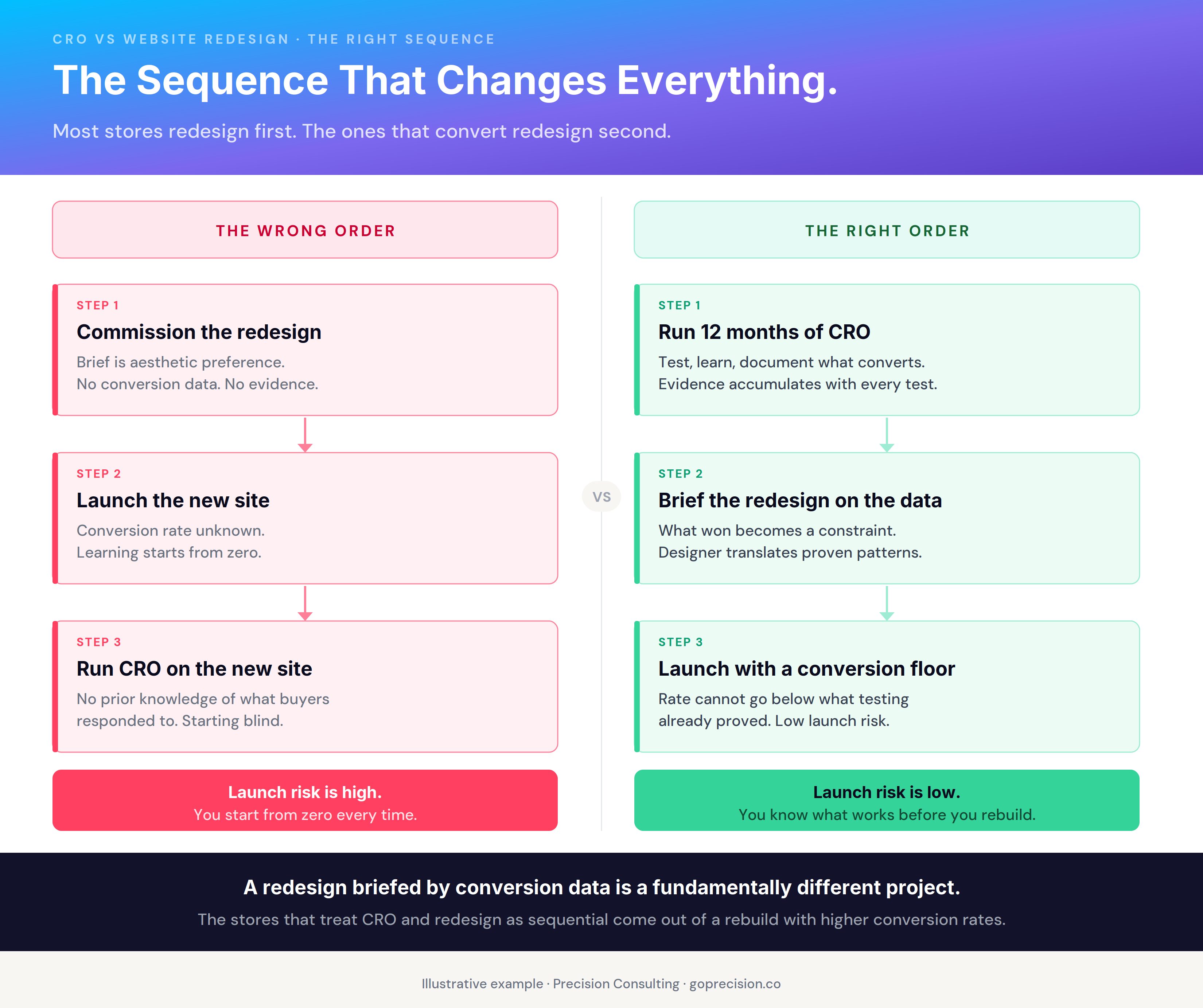
The strongest play for most stores is to optimise first, then redesign with the data the optimisation produced. This sequence costs less, produces faster revenue lift, and ends with a redesign that is actually informed by what your buyers respond to. Going the other way around, redesigning first then trying to optimise the new site, throws away the learning advantage and starts the entire conversion journey from zero.
Run twelve months of CRO before any redesign brief
Run twelve months of structured CRO before any redesign. Test product page layouts, checkout structures, trust signal placement, hero variants, and offer framing. Document what wins and why. The A/B testing guide for founders covers how to design tests that produce a usable answer rather than a coin flip with statistics attached. By the end of that year, you will have a body of evidence about what your buyers actually respond to. That evidence becomes the brief for the redesign.
Brief the redesign on what the data taught you
A redesign briefed by twelve months of conversion data is a fundamentally different project from a redesign briefed by aesthetic preference. The designer is not guessing. They are translating tested patterns into a new visual system. The launch risk drops, the conversion floor stays at or above where it was, and the upside compounds. The stores that treat CRO and redesign as sequential, not alternatives, are the ones that come out of a rebuild with conversion rates higher than they started. The ones that treat them as substitutes usually come out flat at best.
If you redesign first and skip the CRO step, you will still need to run CRO afterwards to find the friction in the new site. You will just be running it without the prior knowledge of what your buyers responded to in the previous version. That is an expensive way to learn what you could have known going in.
Want help deciding whether your store needs CRO, a redesign, or both? See how Precision works with e-commerce brands, or book a free strategy call and we will look at the evidence together.
Steve Krug's Don't Make Me Think is the foundational text on why structural clarity, not visual polish, is what drives conversion. It is the book most often missing from the desk of an agency briefing a redesign that will not move the metric. For the cognitive side, Daniel Kahneman's Thinking, Fast and Slow explains why founders consistently overweight visible change (a new design) over invisible change (a removed friction point), even when the invisible change is the one that matters.
Key Takeaways
- CRO improves the site you have using evidence from real user behaviour. A website redesign rebuilds the site from a new structural starting point, often without that evidence.
- A Precision Deep Dive Audit answers the CRO-vs-redesign question in a day or two by scoring the platform fit, brand alignment, and technical debt against the criteria above.
- Most redesigns do not improve conversion because they change the visual surface without diagnosing the friction underneath. Marks & Spencer's 2014 redesign is the cleanest public example: a modernised site, an 8% drop in online sales, and an 18-month recovery.
- According to Baymard Institute, 48% of cart abandonment is caused by unexpected shipping costs, and a further 26% by forced account creation. Neither moves because the navigation is now sans-serif.
- CRO is the right move when your store has at least 10,000 monthly visitors, converts at any rate, and shows identifiable friction in analytics.
- A redesign is justified when two or more of these are true: the platform no longer fits, the brand or business model has fundamentally changed, or technical debt has made the site fragile.
- Redesign and CRO can work together when the brief is built on CRO evidence, and the same team owns both the conversion outcome and the visual system. Combined projects are not theoretical. They are what good CRO-led redesigns look like.
- A full e-commerce redesign is a multi-month commitment with a high upfront cost. CRO costs a fraction of that and ships measurable changes within weeks.
- The strongest sequence is twelve months of CRO first, then brief the redesign using what the testing taught you. A redesign briefed by conversion data is a different project from a redesign briefed by aesthetic preference.
Frequently Asked Questions
What is the difference between CRO and a website redesign?
CRO is the process of improving conversion rates by identifying and removing friction in the existing user journey through targeted, measurable changes. A website redesign is a structural rebuild that changes layout, navigation, brand, and often the platform itself. CRO is iterative and evidence-led. A redesign is a one-time creative project.
How do I know if my store needs CRO or a redesign?
Run a three-question structural audit. Is the platform still fit for purpose? Has the brand or business model fundamentally changed? Is the technical debt unmanageable? If the answer to all three is no, CRO is the right path. If two or more are yes, redesign is justified.
Will a website redesign improve my conversion rate?
Usually not, unless the redesign is briefed by specific evidence about what is currently losing sales. A redesign that changes the visual surface without addressing checkout friction, trust signals, or mobile usability tends to produce conversion rates similar to the original site, sometimes lower. Marks & Spencer's 2014 site redesign is a documented example of a modernised site that dropped online sales by around 8% in the quarter after launch.
Can a redesign and CRO be combined into one project?
Yes, and the best redesigns are. A combined project starts with CRO data informing the redesign brief, protects the elements that are already converting above benchmark, and assigns the same team responsibility for both the conversion outcome and the visual system. Most agencies are organised around one discipline or the other, which is why combined projects are rarer than they should be.
How much does a website redesign cost compared to CRO?
A full e-commerce redesign is a multi-month project with a high upfront cost that scales further for platform migrations and Shopify Plus checkout work. A CRO programme is materially cheaper, runs over six to twelve months, and starts producing measurable revenue lift within 60 to 90 days.
Can I do CRO and a redesign at the same time?
Only if the same team owns both. Otherwise, you are testing on a site about to be replaced, the wins do not transfer cleanly, and the redesign and the testing programme work against each other. The stronger sequence for most stores is twelve months of CRO first, then a redesign briefed by what the testing taught you.
When should I rebuild instead of optimise?
Rebuild when the platform genuinely cannot support what the business needs, when the brand or business model has fundamentally changed, or when years of technical debt have made the site fragile and slow. Aesthetic boredom is not a sufficient reason. A targeted visual refresh costs a fraction of a full redesign and solves that problem.
