Last updated:
Your ads are running. Your SEO is working. Google Analytics shows thousands of visitors landing on your store every month. But when you check your sales dashboard, the numbers tell a different story. Your e-commerce store gets traffic but no sales.
If this sounds familiar, you are not alone. According to IRP Commerce's e-commerce benchmark data, the average conversion rate sits between 2% and 3%, meaning that for every 100 visitors, 97 leave without making a purchase. And for most stores, the real number is worse. Shopify's published platform data puts the average at just 1.4%.
In most cases, the gap between traffic and revenue is where e-commerce businesses lose the game. Not because their product is wrong or their pricing is off, but because their store is leaking conversions at every stage of the buyer journey.
We have seen this pattern across every type of e-commerce business we have worked with. At a leading food delivery platform, we inherited a product with strong traffic but underperforming revenue. After a systematic audit and six months of psychology-driven experimentation, we drove a 58% increase in total revenue and a 40% improvement in conversion rate.
Here are the 7 most common reasons your e-commerce store gets traffic but no sales, and exactly what to do about each one.
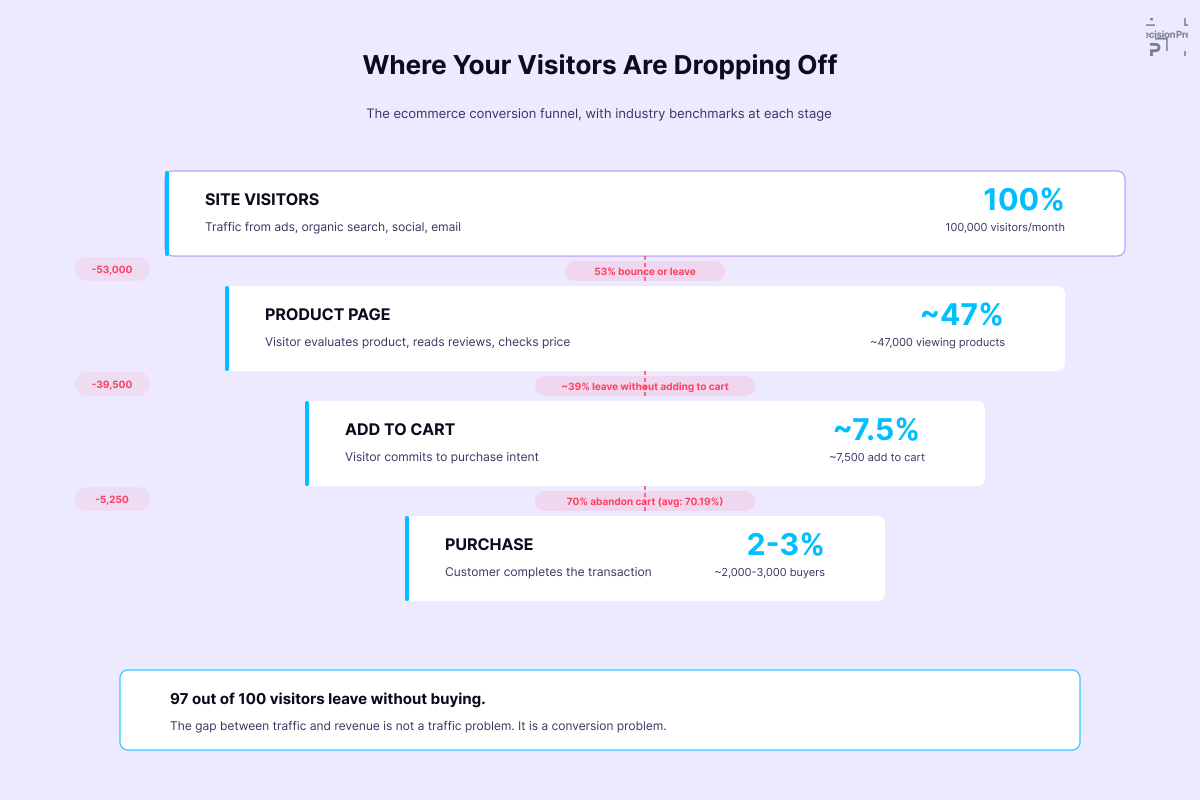
The e-commerce conversion funnel: where 100,000 visitors drop off at each stage.
1. Why are your product pages not converting visitors into buyers?
Your product pages are not converting because they are built like templates rather than conversion tools. Product pages are where buying decisions happen. Not the homepage, not the category page. Yet most e-commerce stores treat them as a fill-in form rather than the place where buyers actually decide.
When we audit e-commerce stores, product pages consistently account for the largest share of lost revenue. The most common issues we see:
- Vague or feature-heavy copy that does not connect to what the buyer actually cares about
- Images that show the product but do not show it in context
- Missing or buried social proof
- A cluttered layout that makes the “Add to Cart” button compete with 15 other elements for attention
This is Hick’s Law: the more choices you throw at someone, the longer they take to decide, and the more likely they are to leave without deciding at all. Your product page is not just a display case. In other words, every extra CTA, every unrelated link, every wall of spec text is a small bet against the sale. Fewer decisions, faster yes.
When we restructured the product discovery experience for a major delivery platform, cutting cognitive noise and grouping by intent rather than category, conversion rates moved measurably. The principle holds across every e-commerce context.
Audit your top 10 product pages by revenue. For each one, answer three questions:
- Is the primary benefit clear within 3 seconds?
- Is the CTA visually dominant?
- Is there social proof (reviews, ratings, purchase count) visible without scrolling?
If the answer to any of these is no, start there. For a full breakdown of what each element should look like when optimised, the product page design guide covers all eight conversion-critical elements in detail.
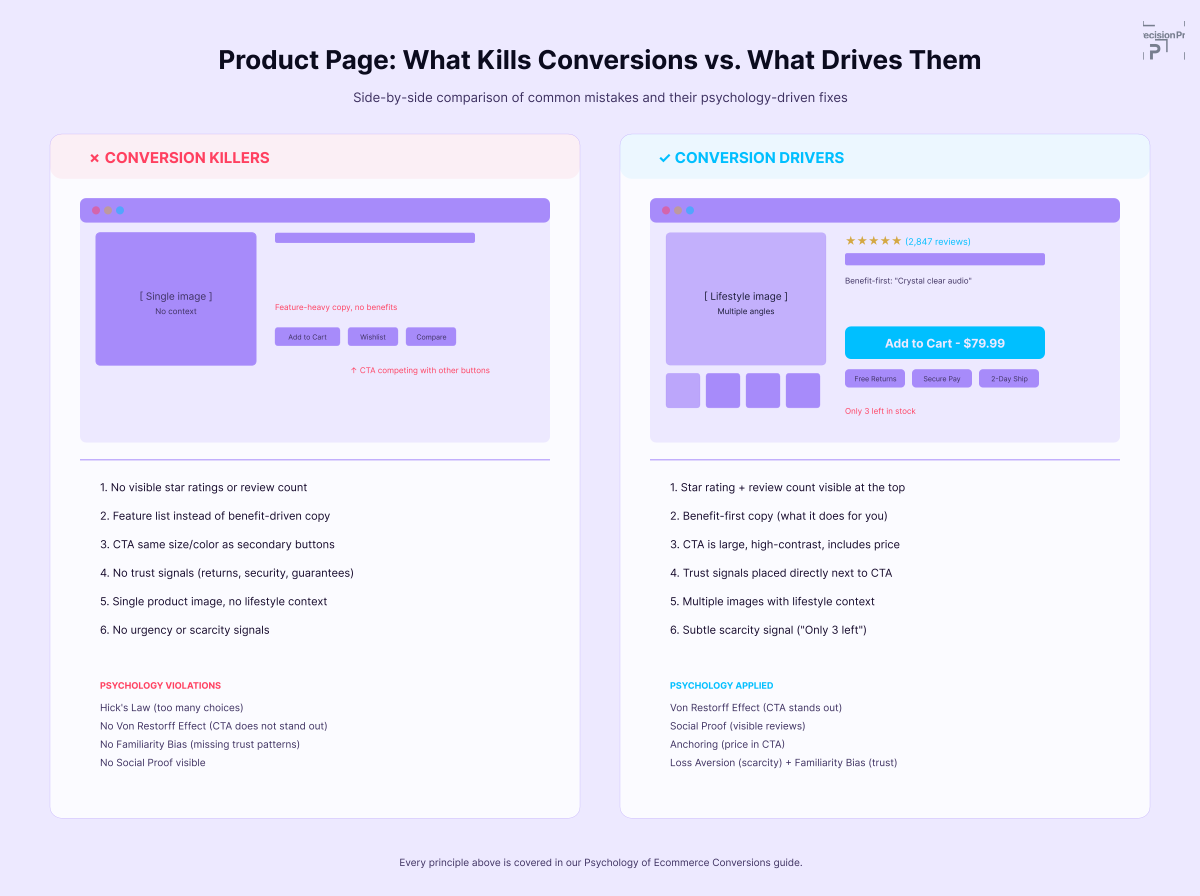
Side-by-side: common product page conversion killers (left) vs. psychology-driven fixes (right).
Traffic but no sales means buyers are dropping off at one specific stage. Find Your Leak, the diagnostic in our kit of 9 fillable PDFs, uses 30 days of your own numbers to find that stage, then points you to the checklist that fixes it. Get the kit on Etsy.
2. Why do missing or misplaced trust signals hurt your conversion rate?
Missing or misplaced trust signals hurt your conversion rate because a buyer cannot complete a transaction with a doubt still in their head. A return policy buried in the footer or security badges only on the About page does nothing at the moment of decision. Buying online requires trust. Visitors are handing over their credit card details to a website they may have never heard of. If your store does not actively earn that trust at the moment of decision, you are leaving revenue on the table.
Trust signals include customer reviews, security badges, clear return policies, recognisable payment logos, and real customer photos. But having them is not enough. Where you place them matters more than whether you have them. For example, a “30-day returns” badge buried in your footer does nothing to help the visitor decide whether to click “Add to Cart” on your product page.
This is Familiarity Bias at work. When your brain encounters something recognisable, star ratings, “Verified Buyer” badges, payment logos, it takes a shortcut: safe. When those patterns are absent, it takes a different shortcut: leave. So trust is not built just by having the right signals. It is built by putting them in the right place, at the right moment.
At a leading food delivery platform, we designed every step of the user journey to set clear expectations for what comes next. That predictability directly reduced anxiety and drop-off. Put simply, if a customer has to scroll past the fold to find a review, you have already lost the moment.
Place your strongest trust signal, review count, guarantee, or security badge, directly next to your “Add to Cart” button. Move your return policy from the footer to the product page. If you have fewer than 10 reviews for a product, prioritise generating reviews over increasing traffic.
3. Why is checkout friction the biggest conversion killer in e-commerce?
According to Baymard Institute’s large-scale checkout usability research, the average cart abandonment rate across e-commerce sites sits at 70.19%. That means 7 out of 10 visitors who want your product enough to add it to their cart still do not buy it.
Baymard’s research identifies the top reasons:
- Unexpected costs at checkout,48% of abandoners
- Forced account creation,26%
- A checkout process that is too long or complicated,22%
The hidden cost of a complex checkout
Baymard Institute’s checkout audit data shows the average e-commerce checkout contains 23 form elements. In practice, their research identifies the ideal as 12–14. That gap represents a 20% to 60% reduction that most stores could make without losing any necessary information.
This is the Peak–End Rule: people do not judge an experience by its average, they judge it by its worst moment and how it ended. If the sharpest pain point in your purchase flow is a 5-step checkout form with surprise shipping costs, that is the feeling your customer takes away. Not “I got a great product.” Just frustration. And frustrated customers do not come back.
Checkout is the first thing we audit at Precision, not because it is glamorous, but because the $260 billion Baymard estimates sitting in abandoned carts is the most straightforward money in e-commerce, if you are willing to get out of your own way. For a deeper look at the psychology behind why shoppers abandon and the tactics that recover the most revenue, the cart abandonment guide covers both sides in detail.
Enable guest checkout, do not force account creation. Show total costs including shipping as early as possible, ideally on the product page or cart page. Reduce form fields to the absolute minimum. If your checkout has more than one page, test a single-page checkout.
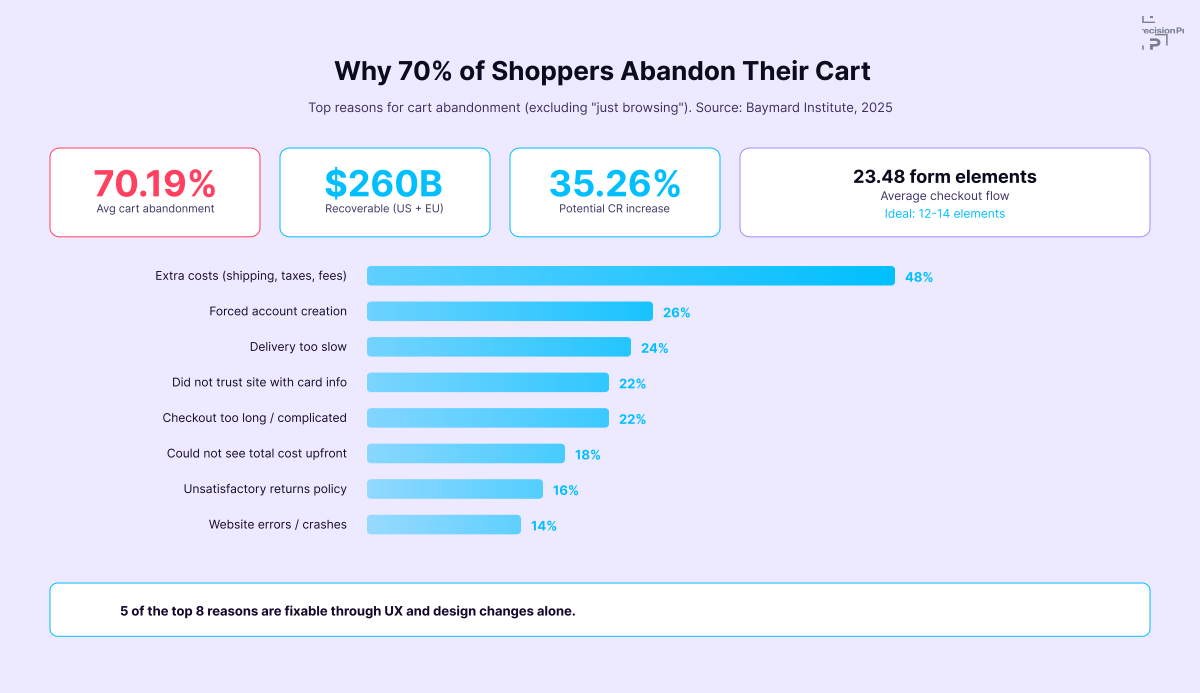
Baymard Institute 2025 data: why 70% of shoppers abandon their cart, and the $260B recovery opportunity.
4. Why does ignoring average order value leave money on the table?
Most e-commerce founders obsess over conversion rate but completely ignore the other half of the revenue equation: how much each customer spends. Average Order Value (AOV) is often the faster, higher-impact lever to pull, and almost nobody is pulling it.
When we analysed the Google Merchandise Store as a case study, we found their AOV was 68% lower than apparel e-commerce benchmarks. Why? No cart-page upselling, no personalised recommendations, no bundle offers. As a result, enormous revenue was being left on the table from customers who were already buying.
At a leading food delivery platform, we addressed this directly by adding a “Popular with your order” product carousel on the cart page, using market basket analysis to recommend complementary products. That produced a +35% increase in Average Order Value.
Two biases do the heavy lifting here. One is the Endowment Effect: once someone adds something to their cart, they already feel a degree of ownership over it. That psychological investment makes them more open to adding more. Another is Anchoring Bias: when you show a bundled price next to the original, the discount does not just look like a saving, it feels like one.
Add complementary product recommendations on your cart page. Set a free shipping threshold just above your current AOV (if your AOV is $45, set free shipping at $55). Test bundle offers that package your bestsellers with related products.
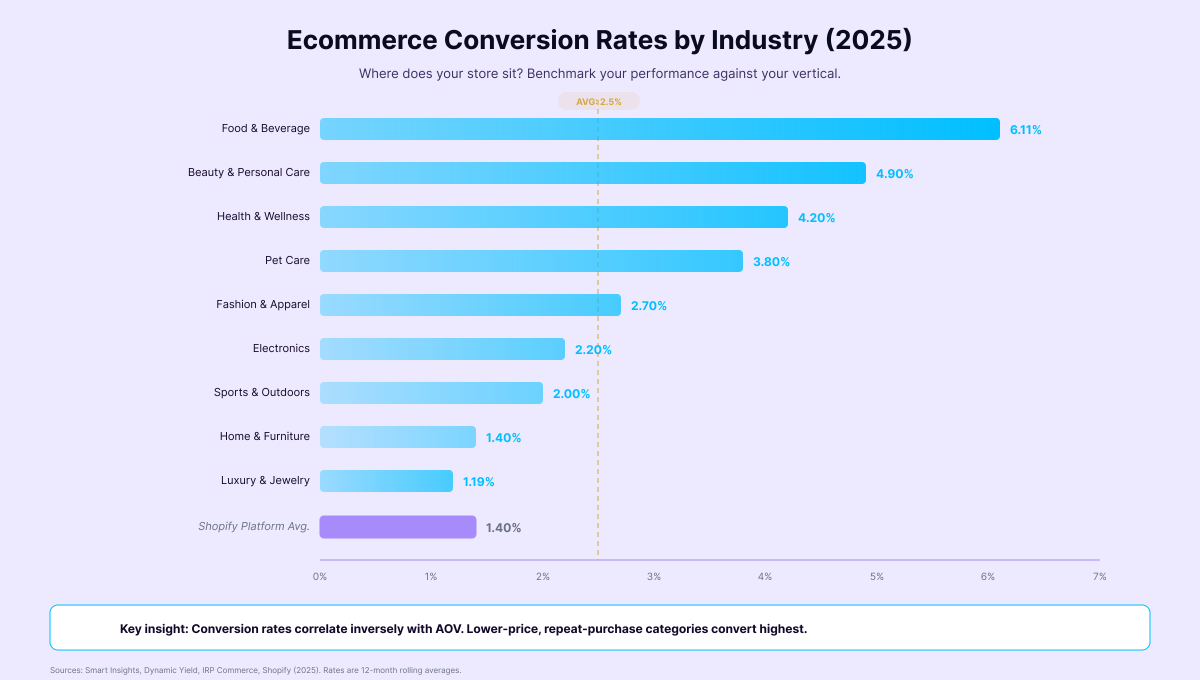
E-commerce conversion rates by industry (2025). Where does your store sit relative to your vertical?
5. How does slow site speed reduce e-commerce conversions on mobile?
Speed is not a nice-to-have. In fact, it is a conversion requirement. According to Deloitte’s “Milliseconds Make Millions” report, a 1-second delay in page load time can reduce conversions by up to 7%. Google’s research on mobile speed shows that when load times go from 1 to 3 seconds, bounce rates increase by 32%. At 5 seconds, that jumps to 90%.
Beyond that, here is why this matters more than ever: according to Statista’s retail traffic data, smartphones now account for roughly 78% of all retail site visits. Yet mobile conversion rates lag far behind desktop, averaging around 1.8% compared to desktop’s 3.9%, according to Contentsquare’s Digital Experience Benchmark. Part of that gap is inherent, but a major part is simply that most e-commerce sites are not optimised for mobile speed and usability.
Run your store through Google PageSpeed Insights right now. Compress images, this is the #1 culprit in most stores. Enable lazy loading for below-the-fold content. If your mobile site takes more than 3 seconds to load, treat it as a revenue emergency.
6. Why does a one-size-fits-all experience reduce conversions?
A one-size-fits-all experience reduces conversions because a first-time browser and a returning cart-abandoner need completely different things at the same URL. If every visitor sees the same homepage, the same product recommendations, and the same pop-ups, regardless of whether they are a first-time browser or a returning customer who abandoned a cart yesterday, you are missing the easiest wins in e-commerce.
Fortunately, personalisation does not require a six-figure tech stack. It starts with basic segmentation: new visitors vs. returning visitors, browsing behaviour, cart history, and geographic location. In practice, even small adjustments, such as displaying different homepage content to first-time visitors compared to returning customers, can significantly boost conversion rates.
One of the most impactful discoveries we made at a leading food delivery platform was through geo-data analysis. We partnered with local telecom companies to analyse user behaviour across regions and discovered that grocery delivery users had entirely different behaviour patterns than restaurant delivery users. By building separate customer personas and tailoring the experience accordingly, we created a targeted expansion strategy that was a foundational driver of the +58% revenue growth.
Start with your two biggest visitor segments: new visitors and returning customers. Show new visitors social proof and your strongest value proposition. Show returning visitors the products they viewed, their abandoned cart, or “back in stock” notifications. This single segmentation can move the needle more than any ad campaign.
7. Why is guessing without data costing your store revenue?
Guessing without data costs you revenue because most opinion-driven changes either do nothing or quietly hurt conversion, and you never know which because you never measured. Most e-commerce businesses approach optimisation as a series of opinions: “I think the CTA should be green,” or “I feel like we should move the reviews above the fold.” Without a systematic testing process, you are making expensive bets with no data to back them up.
Stores that grow consistently have one thing in common: methodology. At Precision, we use a structured 4-phase approach called the Conversion Accelerator: Deep Dive Audit, Quick Fixes, Big Swing A/B Tests, and Fine Tuning. Each phase builds on the last. For a practical guide on how to design and run proper split tests yourself, the A/B testing guide for founders covers the full process from hypothesis to result.
This is exactly how we approached that engagement. Specifically, the deep-dive audit revealed geo-data insights into grocery vs. restaurant users. The results across each phase:
- Quick fixes: +80% email click-through rate
- Cart page upselling: +35% Average Order Value
- Loyalty gamification: +11% orders per customer
Stop guessing. Before you change anything in your store, write down what you expect to happen and why. Then test it. If you do not have enough traffic for A/B testing, start with sequential testing (run version A for two weeks, version B for two weeks, compare). Perfection is not the goal. What matters is replacing opinions with evidence.
The Real Cost When Your E-Commerce Store Gets Traffic But No Sales
The real cost of traffic without sales is the gap between what you are spending to acquire visitors and what you are converting from them. Every percentage point of conversion you leave on the table multiplies through your full ad budget. Here is the maths most founders never do.
If your store gets 100,000 monthly visitors and converts at 1.5% with a $50 AOV, your monthly revenue is $75,000.
A 40% improvement in conversion rate alone, the result we achieved on a six-month engagement, would add $30,000 per month without a single extra visitor.
Now add a 35% AOV boost on top, and you are looking at an additional $66,750 per month. That is $801,000 in annual revenue from the traffic you already have.
The issue is rarely traffic. It is what happens after the click.
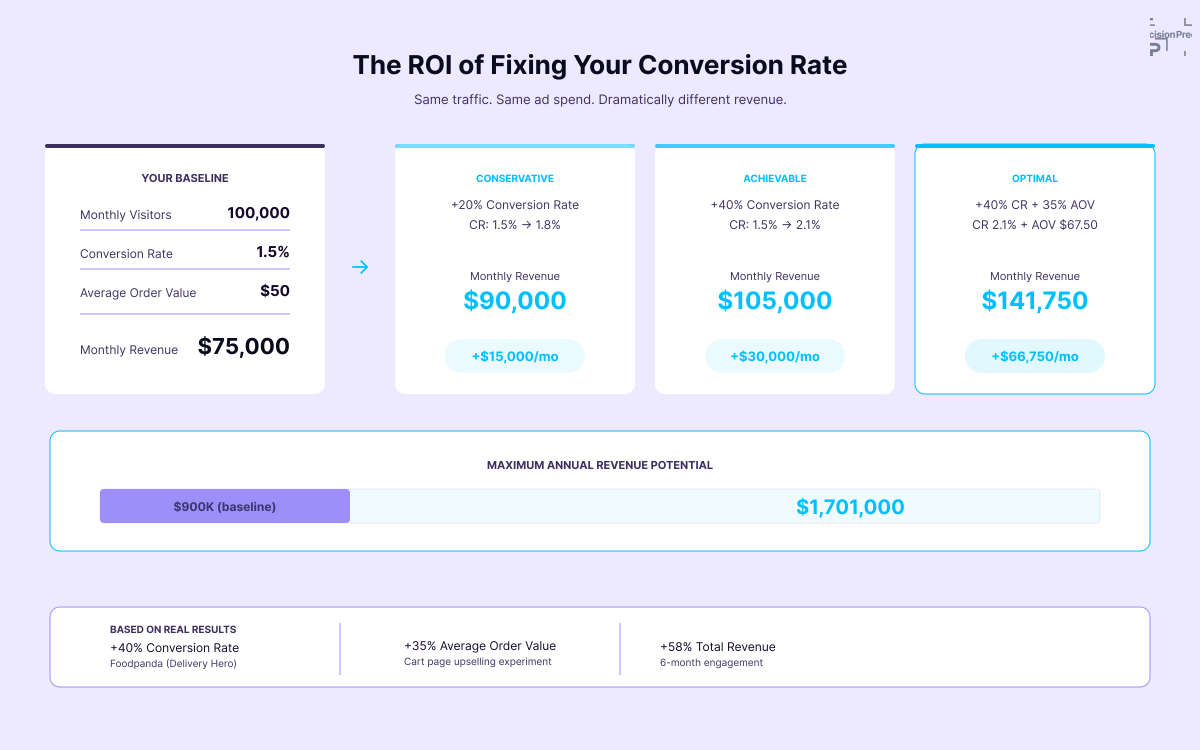
Three growth scenarios from the same 100K monthly visitors: Conservative, Achievable, and Optimal.
What to Do Next
You do not need to fix all seven issues at once. Start with the one that is costing you the most:
- your product pages have low “Add to Cart” rates, start with Reason #1 (product page UX) and Reason #2 (trust signals).
- visitors are adding items to the cart but not buying, focus on Reasons #3 (checkout friction) and #4 (AOV optimisation).
- your bounce rate is high, prioritise Reason #5 (site speed) and Reason #6 (personalisation).
- you are making changes but not seeing results, read Reason #7 (testing methodology) twice.
To work through all seven areas in order of likely revenue impact, the CRO audit checklist gives you a step-by-step diagnostic framework for your entire funnel.
Want to find out exactly where your store is leaking revenue? See how Precision works with e-commerce brands.
Key Takeaways
- The average e-commerce conversion rate is 2–3%. If you are below that, your store has fixable problems.
- The 7 most common conversion killers are: weak product pages, missing trust signals, checkout friction, ignoring AOV, slow site speed, no personalisation, and no testing process.
- Each issue has a specific psychological principle behind it. Understanding why visitors behave the way they do is the key to changing that behaviour.
- A 40% conversion rate improvement on 100,000 monthly visitors at $50 AOV adds $30,000/month. Add AOV optimisation, and the number is even larger.
- You do not need more traffic. You need to convert the traffic you already have.
Frequently Asked Questions
Why is my e-commerce store getting traffic but no sales?
The most common reasons are poor product page UX, missing trust signals, high checkout friction, no AOV optimisation, slow site speed (especially on mobile), lack of personalisation, and lack of a systematic testing process. In most cases, it is a combination of several of these working together to leak conversions at every stage of the buyer journey.
What is a good e-commerce conversion rate?
The global average ranges from 2% to 3%, depending on the source and methodology. Food and beverage e-commerce tends to convert at the highest rate (around 4–5%), while luxury and furniture convert at the lowest (1–2%). More important than hitting a benchmark is understanding your specific funnel: where visitors are dropping off, and why.
How do I increase my e-commerce conversion rate without more traffic?
Focus on the 7 areas outlined in this article. The fastest wins typically come from fixing checkout friction (reducing form fields, enabling guest checkout, showing costs upfront), improving product page UX (clearer CTAs, visible social proof), and adding AOV optimisation (cart-page upselling, bundle offers, free shipping thresholds). A structured CRO audit is the best way to identify which specific fixes will have the highest impact for your store.
How much revenue am I losing to cart abandonment?
With an average cart abandonment rate of 70%, most stores lose significant revenue from visitors who show purchase intent. Baymard Institute estimates that $260 billion in lost orders is recoverable across US and EU e-commerce through better checkout design alone. For your specific store, multiply your monthly cart additions by your AOV, then multiply by 0.70. That is your approximate monthly revenue at risk.
