Last updated:
The question is not which option is better. It is which working relationship your programme needs at this stage. A CRO agency brings team structure, process infrastructure, and the capacity to run multiple workstreams in parallel. A specialist studio or independent consultant brings direct accountability, senior-level attention on every engagement, and a working relationship built on knowing your funnel deeply over time.
Most growth-stage businesses get this choice wrong because they are comparing the wrong variables. They compare team size, or case study logos, or retainer pricing. The right comparison is the kind of working relationship that fits the stage your CRO programme is actually at. Budget matters, but it is not the primary variable. Neither is the size of the agency's client roster. What you are buying in each case is a different kind of engagement, and the wrong one creates friction that no amount of talent resolves.
This is the framework that gets most businesses to the right answer.
At Precision, we run engagements as a specialist studio: a senior-led team working with very few clients at a time, so the depth and attention the programme requires are always available. See how the engagement works before deciding which model is right for your business.
What does a CRO agency actually bring?
A CRO agency brings team structure. There is typically a strategist who manages the relationship, an analyst who owns the data, a designer who builds the variants, and a developer who implements them. The team can run multiple workstreams simultaneously and has built-in redundancy: if one person leaves, the programme does not stop.
Agencies also bring accumulated pattern recognition. A good agency has run programmes across dozens of clients. They have seen what tends to work at different traffic levels, on different product types, in different checkout flows. That accumulated experience can produce faster early wins than starting from first principles on a new engagement.
The third thing agencies bring is process. Structured testing workflows, documentation standards, and reporting cadences. For a business that needs its CRO programme to integrate with a larger growth team, that process infrastructure matters.
The limitations you will not hear about in the pitch
The person you meet in the pitch is rarely the person running your account. This is one of the most consistent frustrations in agency relationships. The senior strategist who articulates the vision hands off day-to-day execution to a more junior team member. The quality of thinking that sold you the engagement is not the quality of thinking that runs it.
Agency programmes also drift toward standardisation. The playbook that worked across previous clients gets applied to yours, sometimes without enough adjustment for what makes your funnel and your buyer different. The result is a programme that has the shape of CRO but is actually a templated sequence of tests. It may or may not address your actual friction points. You will not always be able to tell the difference between the reports.
Speed is the third constraint. An agency with multiple clients, internal review processes, and approval chains between strategy and implementation tends to move slowly. A specialist studio, working with fewer clients and shorter decision chains, can move from diagnosis to live variant significantly faster. That velocity difference compounds meaningfully over a twelve-month programme.
What does a specialist studio bring?
A specialist studio brings direct accountability and genuine seniority on every engagement. You are not dealing with a large team where a junior analyst inherits your account after the pitch. The senior people who understand your funnel are the people running the diagnostic, reviewing the data, and interpreting the results. That consistency is rare in the CRO market, and it compounds over time in ways a larger team structure rarely replicates.
A well-structured studio has the same specialist roles as an agency: an analyst who owns the data, a designer who builds the test variants, and a developer who implements them. The difference is that these specialists work under direct senior leadership on every engagement, not under an account manager who sits between you and the people doing the work. The studio also carries accumulated pattern recognition from previous programmes. The difference from an agency is that the team has the time to interrogate how that experience applies to your specific funnel rather than defaulting to what worked last time.
The working relationship is closer and more iterative. A good specialist studio takes on very few clients at a time precisely so this depth is possible. The team becomes genuinely familiar with your product, your buyer, and your funnel. The hypotheses get sharper as the months pass. The test designs get more targeted. The interpretation of results gets more nuanced. That compounding is something an agency team, cycling through account managers, rarely replicates.
The honest trade-offs
A specialist studio is not the right fit for every stage. If you are a large retailer running simultaneous CRO programmes across a B2B and B2C funnel, testing across 20 or more category pages at once, managing paid acquisition landing pages for five different campaigns, and rebuilding checkout at the same time: that level of parallel execution across multiple business units is where a larger agency team has the raw bandwidth advantage. The question is not scope breadth. It is simultaneous volume at scale.
The in-house discipline range also varies significantly by studio. Some cover the full stack: strategy, analytics, UX design, variant development, and copywriting. Others are strong on strategy and experimentation and bring in trusted external partners for design and development. It is worth asking specifically what is delivered in-house and what is coordinated externally, so there are no surprises mid-engagement.
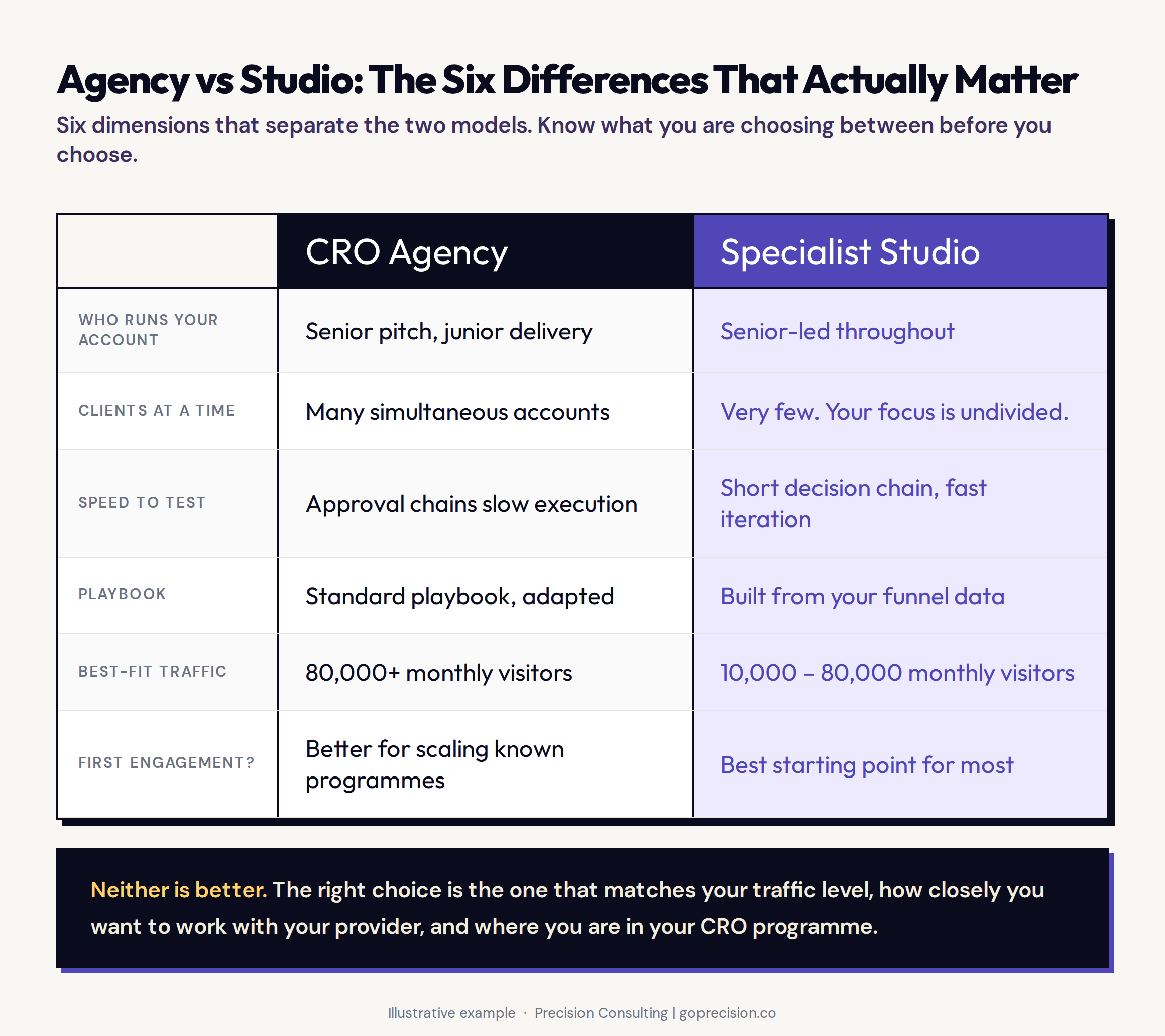
How the two models differ: team structure and scalability versus senior-led depth and direct accountability.
Not sure which model fits where your programme is right now? Request your free audit and we will assess your current funnel, traffic level, and CRO maturity so you can make the right call before signing anything.
How do you decide which model is right for your programme?
There is no universal answer. But four questions reliably get most businesses to the right one for their stage.
How much traffic do you have?
Between roughly 10,000 and 40,000 monthly visitors, a specialist studio handles the full programme without velocity constraint. Below 10,000 monthly visitors, controlled A/B testing is not yet viable regardless of who runs it. At that stage, direct fixes and qualitative research are the right levers, and the diagnostic skills of a specialist studio still apply.
Above 80,000 to 100,000 visitors with multiple high-traffic pages, parallel testing across several funnels, and a large internal team to coordinate with: a larger agency structure starts to make more operational sense. The question is not scope breadth. It is simultaneous volume at scale.
How close do you want to be to the work?
A specialist studio relationship is collaborative by nature. You will be close to the diagnostic, involved in prioritisation, and present in working sessions with senior people. If that kind of involvement is the right use of your time, a studio suits you. If you want to largely delegate and receive structured reporting, an agency's account management model is more appropriate.
Neither is better. They suit different founders and different ways of working. The risk is the mismatch: hiring a specialist studio and expecting the arm's-length relationship of an agency, or hiring an agency and expecting the proximity of a focused studio. Both frustrate everyone involved.
What is the scope of work?
Scope breadth is not what differentiates studios from agencies. A well-run specialist studio can cover the full conversion programme: funnel diagnostic, analytics audit, product page optimisation, category page improvements, checkout testing, landing page work for paid campaigns, and post-purchase flow. The scope is not the constraint.
What a studio cannot match is running all of that simultaneously across a large enterprise with dozens of stakeholders and dozens of pages in flight at the same time. If you need one focused, high-quality programme delivered with senior attention at every step, scope is not a reason to choose an agency over a studio.
Have you run a CRO programme before?
A first engagement benefits significantly from the diagnostic depth a specialist studio provides. The goal is to understand your funnel, validate your analytics, build the friction hierarchy, and establish the testing methodology. That work is better done by a focused team who will dig into your specific funnel than by a larger agency applying a standard playbook to a programme they have not yet understood.
If you have already been through a well-structured engagement and have a validated programme foundation, scaling it with an agency team is a natural next step. The foundation exists. The agency adds velocity.
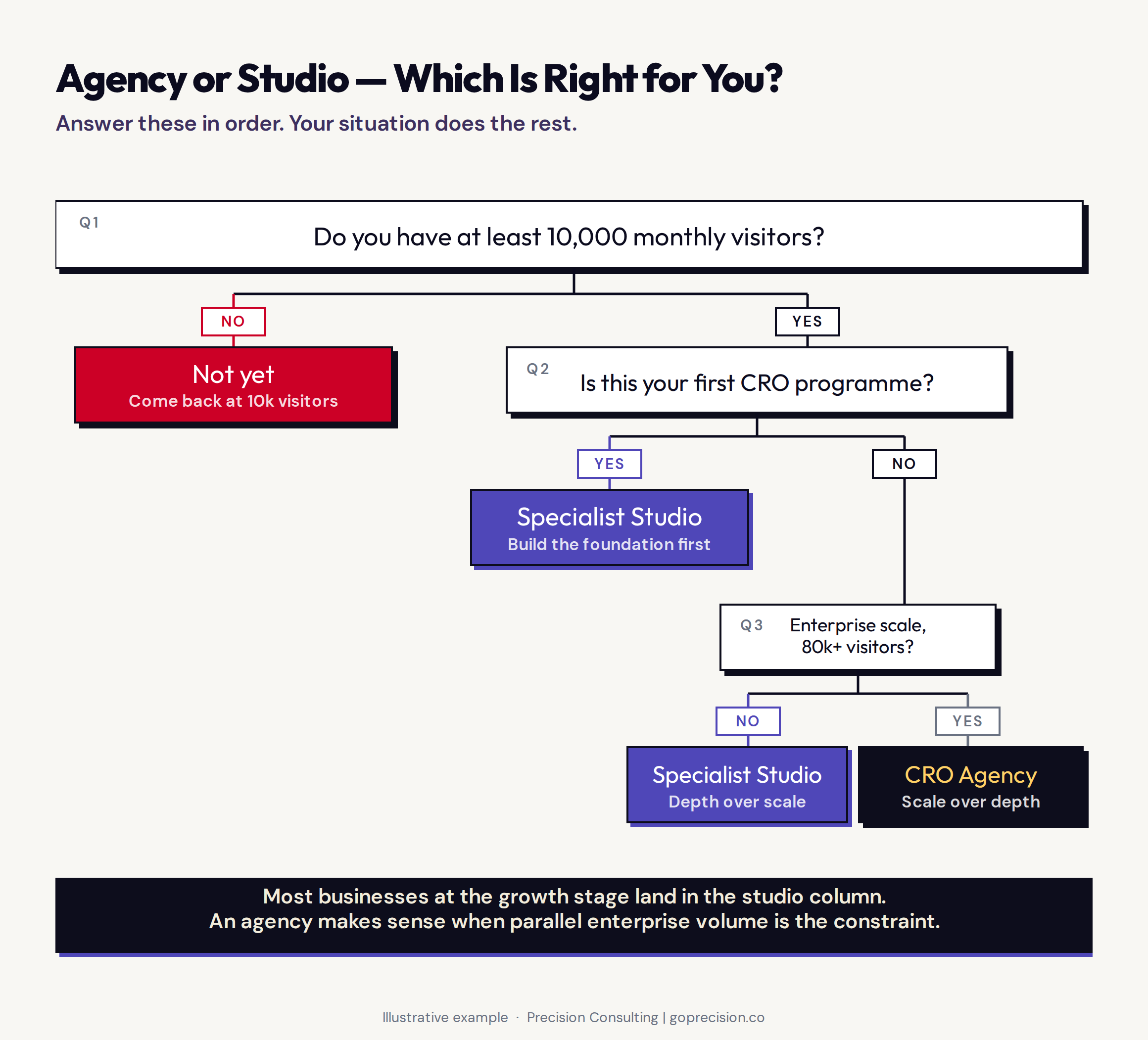
The decision framework: four questions that reliably get most businesses to the right model for their stage.
What should you look for in any CRO provider?
Whether you choose an agency or a specialist studio, diagnostic quality is the single most important thing to evaluate. Any provider who tells you what they will test before they have seen your data is applying a template. The programme that follows will reflect that.
The questions that separate diagnostic thinkers from template appliers
Ask how they approach the initial diagnostic and what data sources they use. Ask them to describe a specific hypothesis they formed from session recordings rather than from a best-practice list. Ask what they do when a test is inconclusive. Ask how they prioritise which friction points to address first.
The quality of those answers tells you everything. Diagnostic thinkers describe specific findings from real programmes. Template appliers give general answers that could apply to any business. You want specificity. Vague answers to specific questions are the most reliable red flag in a CRO pitch.
The questions also work in reverse. A good provider will ask about your traffic volumes, your analytics setup, and whether you have confirmed product-market fit before recommending an approach. The CRO audit checklist covers the data hygiene and analytics foundation checks that any serious diagnostic starts from.
Red flags to watch for
Be cautious of providers who lead with their testing tool rather than their diagnostic process. Tools do not run CRO programmes. Thinking does. Be cautious of guaranteed conversion improvements before they have seen your data.
Be very cautious of any provider who cannot explain the difference between a statistically significant result and a commercially meaningful one. Those are different things, and conflating them is how months of testing produce reports full of green ticks and zero revenue impact.
Ask to see an example of a test that was inconclusive and how they handled it. Providers who only share winning tests have not run honest programmes. The best CRO practitioners talk about their inconclusive and negative tests as openly as their wins, because that is how evidence-based work actually functions.
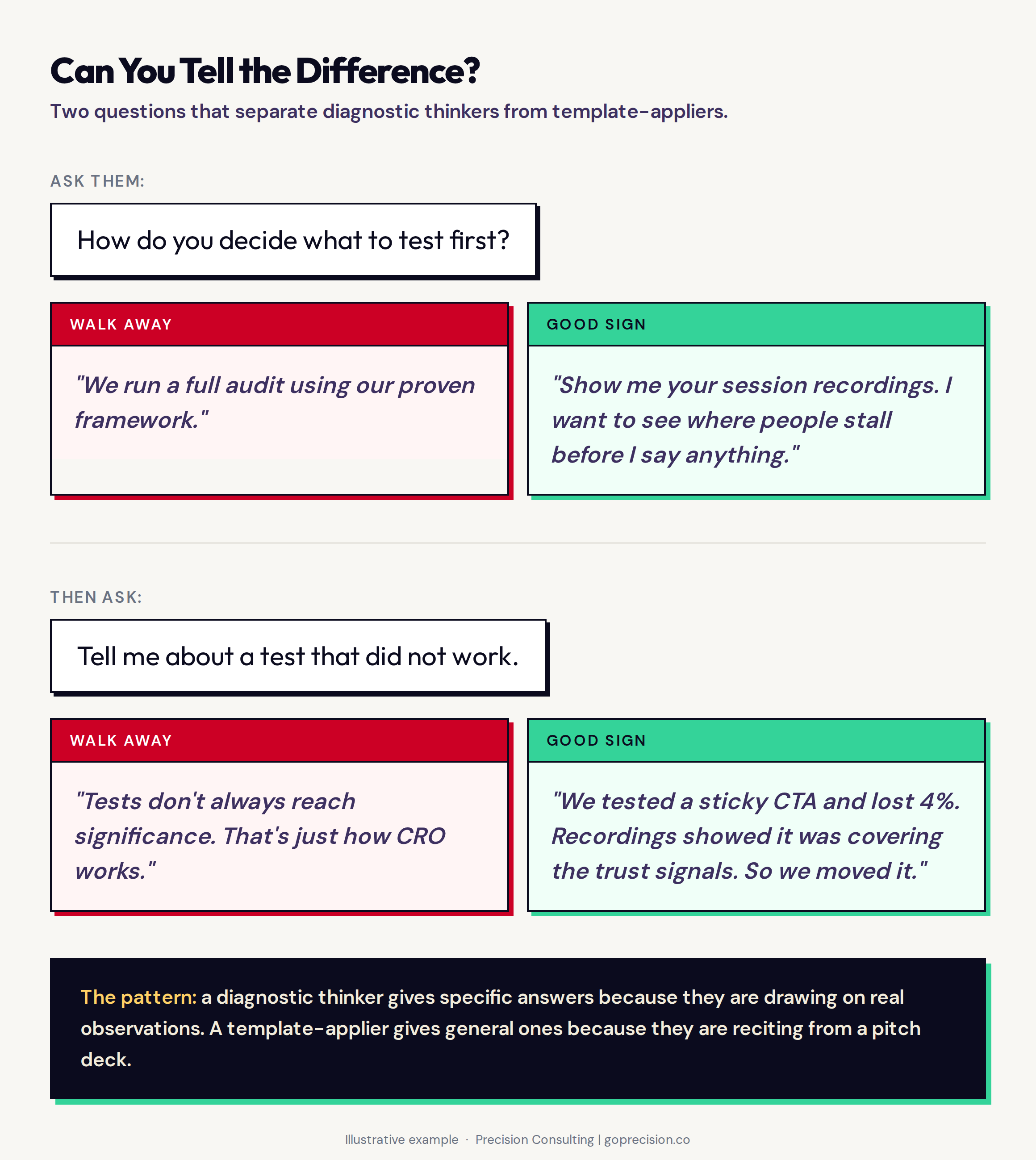
How to evaluate any CRO provider: the questions that separate diagnostic thinkers from template appliers.
If you want to understand what a specialist studio engagement looks like in practice and how it compares to an agency relationship, see how Precision structures its CRO programmes. For a deeper look at what the consultant role actually involves day to day, the full breakdown is in what a CRO consultant actually does. Or book a free strategy call to walk through your current funnel together.
Don't Make Me Think by Steve Krug covers usability principles that are directly relevant to evaluating whether a CRO provider is working from genuine diagnostics or from generic best-practice checklists.
Key Takeaways
- A specialist studio brings senior-led diagnostic depth, direct accountability, and a close working relationship built on keeping very few clients at a time. An agency brings team structure, built-in process, and the ability to run multiple workstreams simultaneously.
- The primary variable in the decision is not the budget. It is what your programme needs at this stage: depth and proximity, or breadth and scalability.
- Between 10,000 and 40,000 monthly visitors, a specialist studio handles the full programme without velocity constraint. Above 80,000 to 100,000 visitors with large parallel testing needs across multiple funnels, a larger agency team starts to make more operational sense.
- A first CRO engagement benefits from the diagnostic depth a specialist studio provides. A programme with a validated foundation is a better candidate for agency-led scaling.
- The person you meet in the pitch is not always the person running your account. Ask directly who leads the day-to-day work and at what experience level before you sign anything.
- Diagnostic quality is the most important thing to evaluate in any provider. Ask to see an inconclusive test and how they interpreted it. Providers who only show winning tests have not run honest programmes.
- Neither model is universally better. The right choice matches your traffic volume, how closely you want to work with your provider, your programme scope, and your CRO maturity stage.
Frequently Asked Questions
What is the difference between a CRO agency and a CRO consultant?
A CRO agency provides a large team of specialists under one contract, built for scale and breadth across multiple clients. A specialist studio or independent consultant is a small, senior-led team that takes on fewer clients at a time, with direct involvement from senior practitioners at every stage. Agencies offer breadth and scalability. Specialist studios offer depth, focused attention, and direct accountability.
Which is more expensive, a CRO agency or a consultant?
It depends on scope and seniority. Specialist studios often charge comparable rates to agency retainers while delivering more focused, senior-led work. The better question is not which costs more but which produces more return for your programme at this stage. A cheaper engagement that applies a generic playbook to your funnel is not better value than a more focused one that addresses the actual friction points.
How do I evaluate a CRO provider before hiring them?
Ask how they approach the initial diagnostic and what data they use to form hypotheses. Ask to see examples of programmes they have built from scratch, not just winning tests. Ask what happens when a test is inconclusive. Providers who think diagnostically answer these questions with specifics. Providers applying templates give general answers that could apply to any business.
How long should a CRO engagement last?
A minimum of six months to see meaningful compound improvement. The first six to eight weeks are typically diagnostic and foundation-building. Meaningful conversion improvement begins to materialise between weeks six and twelve and compounds from there. Short-term engagements that promise quick results are almost always delivering quick fixes rather than a structured programme.
Can a small business afford CRO consulting?
A well-structured engagement should pay for itself from the revenue improvement it produces. The relevant comparison is not the consulting cost versus zero. It is the consulting cost versus the revenue impact of a 0.3 to 0.5 percentage point improvement in conversion rate on your current traffic. For most growth-stage businesses, that improvement covers the investment within the first few months.
