Last updated:
A CRO consultant analyses your store's data and user behaviour to identify where visitors are dropping off, diagnoses the reasons why, and then designs and tests changes to increase the percentage of visitors who convert into customers. That is the job in one sentence. But most descriptions of it stop there, which is why so many founders hire the wrong person or hire at the wrong time.
Here is a pattern I see constantly. A founder has a store doing 15,000 visitors a month. Conversion is sitting at 0.9%. They have tried changing the hero image, rewriting the product description, and installing a countdown timer. Nothing moved. So they start looking for a CRO consultant, ideally someone who can tell them what to do differently.
Sometimes that is exactly what they need. Sometimes the problem is not conversion at all. It is traffic quality, product-market fit, or pricing. A good consultant distinguishes between those things immediately. Most pitch pages do not.
This is the diagnostic framework we apply at Precision when evaluating whether a store is ready for CRO and where to begin. The questions below are worth asking before any engagement starts.
What a CRO consultant actually does
A CRO consultant does three things: diagnoses where and why your conversion funnel is breaking, designs evidence-based changes to fix those breaks, and builds a structured testing programme so improvements are validated rather than guessed at.
Think of it like a GP versus a pharmacist. A pharmacist gives you something for the symptoms you describe. A GP runs the diagnostic first to find out whether the symptoms are telling the real story. Most stores have been taking the pharmacist route: someone suggested a sticky add-to-cart button, someone else read that exit-intent popups recover abandonment, so they have installed both and are watching conversion charts for any sign of life. A CRO consultant is the GP. The work starts with the diagnostic, not the prescription.
The diagnostic comes first, and it is of most value
Before anything is changed, a consultant maps your conversion funnel end to end and identifies the specific points where visitors are falling out. A homepage losing people before they reach a product page is a different problem from a checkout losing people at the payment step. Both are conversion problems. The fixes are completely different.
In practice, this involves pulling data from Google Analytics or Shopify Analytics, reviewing session recordings in Hotjar or Microsoft Clarity, and often running a short survey to hear directly from visitors what stopped them from buying. What you find in most audits is that the store's biggest conversion problem is not where the team assumed it was. Usually it is one or two steps upstream from where they have been focused.
The combination of quantitative data and qualitative insight is what separates a proper diagnosis from guesswork. Quantitative data tells you where the drop-off is happening. Session recordings and surveys tell you why. Without both, you are optimising blind.
Hypotheses come from data, not intuition
Once the diagnostic is done, a CRO consultant builds a prioritised list of hypotheses. Each one connects a specific observed behaviour to a possible cause and a proposed fix. The most common scoring framework is ICE: Impact, Confidence, and Ease. High-impact, high-confidence hypotheses with low implementation cost go first. Low-impact tests go at the back of the queue or not at all.
This prioritisation is where a lot of DIY CRO fails. Without a diagnostic, founders test what they find interesting or what an article told them to test, in no particular order. A testing calendar built on intuition will produce the occasional win by chance and a lot of noise. A calendar built on prioritised hypotheses from real data produces results reliably.
Testing means something specific, not just 'trying things'
Testing means A/B testing where traffic volumes support it: two versions of a page element run simultaneously, with traffic split between them, until there is enough data to be 95% confident that any difference in conversion is real and not random variation. Where traffic volumes are too low for that, a consultant adjusts the methodology. Qualitative validation and direct high-confidence improvements replace controlled testing.
A consultant who proposes A/B testing a 300-visitor-a-month store is not doing CRO. They are generating inconclusive data and billing you for it. A good consultant tells you this upfront and recommends the right approach for your traffic level.
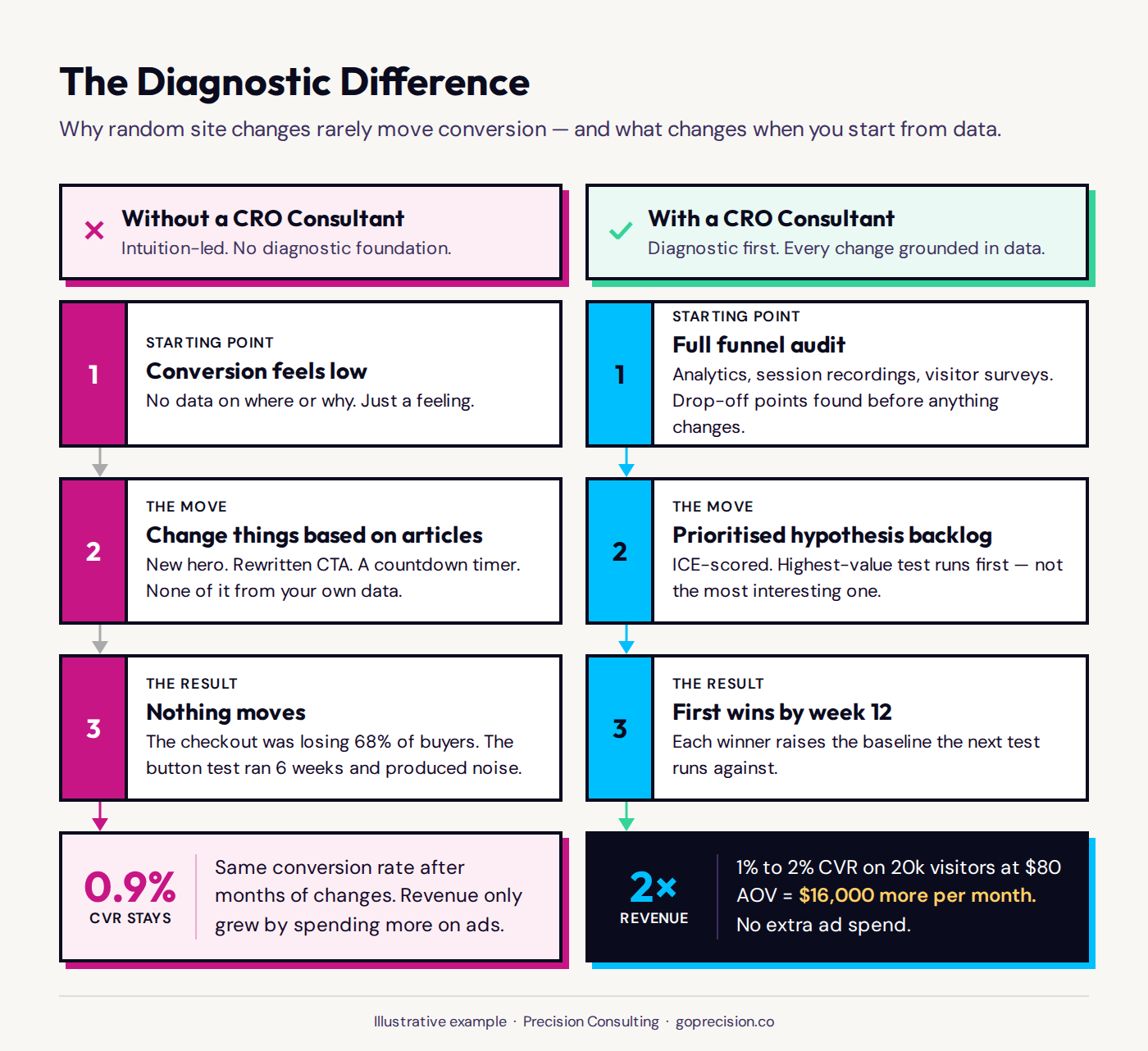
The diagnostic difference: structured evidence-gathering versus isolated guesses.
What a CRO consultant is not
A CRO consultant is not a web designer. They are not building new pages, redesigning your brand, or creating marketing assets. Their role is to improve what already exists based on evidence of what is and is not working. The two disciplines overlap in execution, but they start from different places. A designer starts with a brief. A consultant starts with data.
They are also not a paid media specialist. If your conversion problem is fundamentally a traffic quality problem, no amount of site improvement will fix it. A good consultant identifies this early and says so. If the visitors coming in have low purchase intent because your ad targeting is too broad, the conversion problem is upstream of the site entirely.
And a CRO consultant is not an analytics implementation agency. If your tracking is broken, the first job is fixing that. CRO without clean data is not CRO. It is renovation work on a building without floor plans. The CRO audit checklist covers the tracking and data hygiene checks that need to be in place before any optimisation programme begins.
When should you actually hire a CRO consultant?
You are ready for a CRO consultant when you have enough traffic for data to be meaningful, you are already spending on acquisition, and your product has demonstrated market fit. Below those conditions, the constraint is somewhere else, and CRO investment will not fix it.
The clearest signal is a store with 10,000 or more monthly visitors, a reasonable product, and a conversion rate sitting stubbornly below 1.5%. The traffic is qualified, the product is good, but something in the journey between arrival and purchase is broken. That is the environment where a structured CRO engagement produces reliable returns.
Your traffic is paying for itself, but your conversion is not
Every dollar you spend on ads brings a visitor to your site. If that visitor does not convert, you have paid for nothing. The more you scale ad spend without addressing conversion, the more expensive each non-purchase becomes.
The maths is straightforward. A store with 20,000 monthly visitors, a 1% conversion rate, and an $80 average order value is generating 200 orders and $16,000 per month. Getting to a 2% conversion rate doubles that to 400 orders and $32,000 per month. The traffic cost stays the same. Nothing about the product changes. The conversion funnel changes. That $16,000 difference is the case for CRO, stated plainly.
You have tried things, and the numbers have not moved
If you have been making changes based on intuition or best-practice articles and conversion has not shifted, that is a signal that you need a more systematic approach. Isolated changes without a diagnostic foundation are unlikely to move conversion in any reliable direction.
This is the equivalent of rearranging furniture in a room and wondering why the damp patch on the wall is still there. The visible changes feel productive. The underlying problem has not been identified, let alone addressed.
Your checkout abandonment is high, but you do not know which step
According to the Baymard Institute, the average documented checkout abandonment rate across e-commerce is approximately 70%. Most stores accept this number as a fact of life. It is not. It is a diagnostic signal. A consultant will tell you which specific checkout step is losing the most buyers, why, and what to change.
The difference between a 70% checkout abandonment rate and a 55% rate, on a store doing 500 checkouts a month with an $80 AOV, is 75 additional completed orders and $6,000 per month. That number makes the cost of a consultant look different.
When should you hold off on hiring a CRO consultant?
If your store receives fewer than 5,000 monthly visitors, you do not have enough data for A/B testing to produce statistically reliable results within a reasonable timeframe. The constraint at that stage is traffic, not conversion. Spending on CRO before you have solved the traffic problem is the wrong order.
If you have not confirmed product-market fit, conversion optimisation is also the wrong investment. No amount of funnel improvement will make people buy a product that does not resonate with them. The priority is finding out whether you have the right product for the right audience, not optimising the funnel around the wrong one.
And if your analytics tracking is unreliable, fix that first. Clean data is the foundation of every decision a CRO consultant makes. Without it, the diagnosis is guesswork, and the interventions will be too.
Not sure whether your store is ready for CRO, or where the biggest friction points are? Request your free audit and we will tell you exactly where you stand and what to address first.
What does a CRO engagement actually look like?
Engagements vary by scope, but most follow a recognisable structure. The starting point is always an audit: a deep diagnostic review of your analytics, session recordings, user flows, and any existing research. The output is a prioritised list of friction points and hypotheses, ranked by expected impact.
From there, the engagement moves into a testing programme. Hypotheses are designed as A/B tests, implemented, and run until they reach statistical significance. Winners are implemented. The cycle repeats. The best engagements run for three to six months minimum, because conversion optimisation compounds and the first wave of wins funds the next. If you want a detailed breakdown of what drives that timeline, how long CRO takes covers what to expect at each stage and why the answer varies by traffic volume.
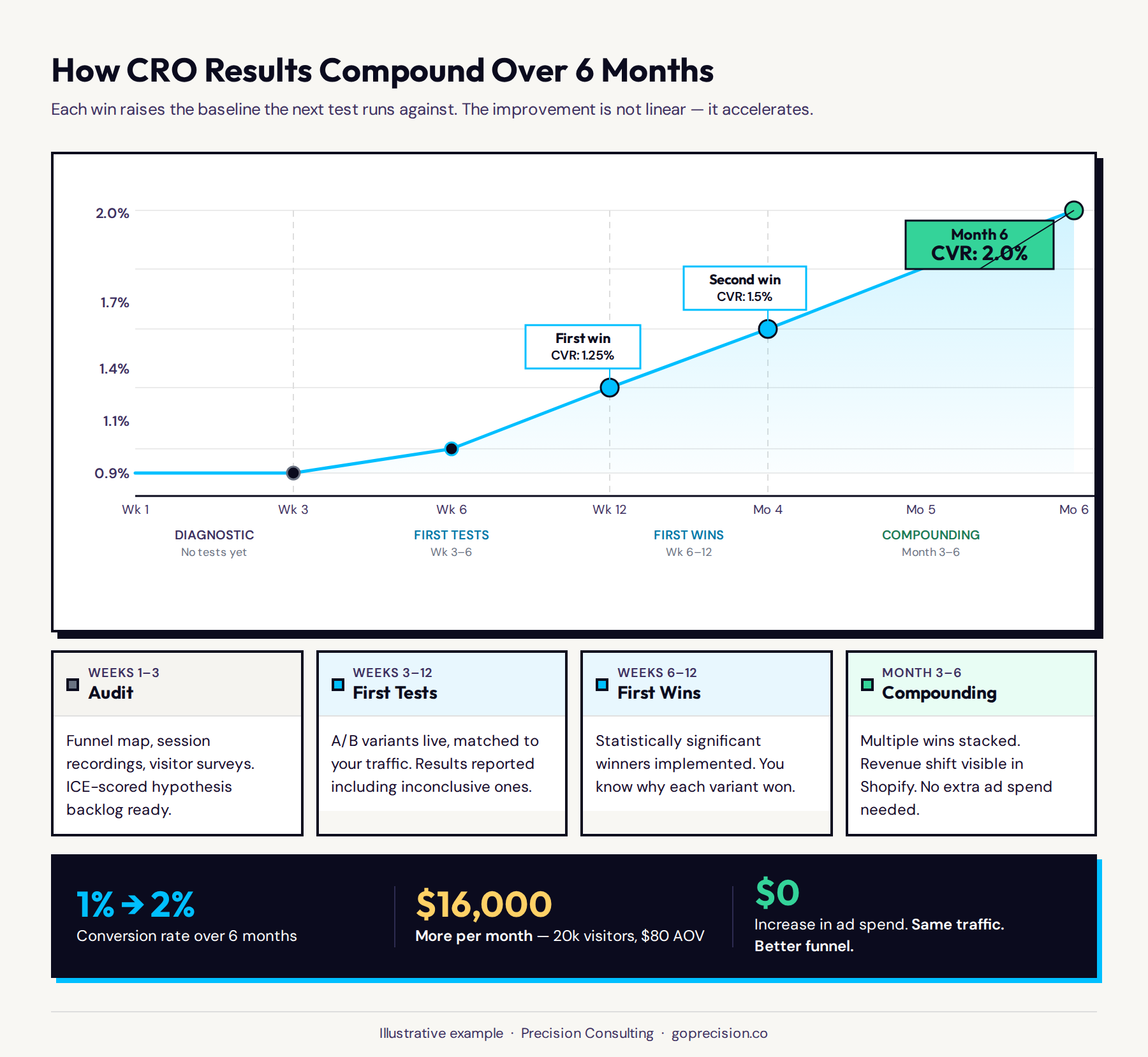
CRO compounds: each winning test raises the baseline against which the next test runs.
What you should receive at each stage
At the audit stage: a clear diagnosis of where in your funnel visitors are dropping off, with supporting data from your analytics and session recordings. You should understand not just where the drop-off is happening but why, grounded in evidence rather than opinion.
During the testing phase, you should receive documented hypotheses with the reasoning behind each one, a testing plan with realistic timelines based on your actual traffic volumes, and regular reporting on results. Every test should connect back to a specific observed behaviour you can verify in your own data.
If you reach the end of an engagement and you do not understand why the winning variants won, something has gone wrong. Learning is part of the value. A consultant who delivers results without transferring understanding has not fully done the job.
What a good consultant tells you that others will not
A good CRO consultant will tell you when the problem is not your site. If the issue is traffic quality, product-market fit, pricing, or fulfilment experience, they say so. The goal is revenue growth, not keeping the engagement running.
They will also tell you when your traffic volume is too low to test reliably. Running an A/B test on 2,000 monthly visitors and declaring a winner after two weeks is not CRO. It is noise dressed up as data. A consultant who tells you this is protecting your investment. One who runs the tests anyway is not.
How should you evaluate a CRO consultant before you hire?
The single most important thing to evaluate is process. A consultant who cannot clearly explain how they diagnose a conversion problem, how they prioritise hypotheses, and how they measure results is likely to deliver the CRO equivalent of interior decoration: visible changes, unclear impact, and difficult to attribute.
Ask to see examples of previous work. Not just the results, but the diagnosis that preceded them. How did they identify the problem? What data did they use? What was the hypothesis, and how was it tested? The answers tell you whether you are talking to a practitioner or someone who has read about the practice.
The questions worth asking in the first call
Ask them to walk you through their diagnostic process. Ask how they handle situations where test results are inconclusive. Ask what they do when the conversion problem turns out to be a traffic quality problem rather than a site problem. Ask for a specific example of a test that did not win and what they learned from it.
Good consultants welcome every one of those questions. They have specific, grounded answers because they have done the work. Vague answers about holistic approaches and data-driven strategy are a signal to keep looking.
Red flags that are easy to miss
A consultant who proposes a testing programme in the first conversation, before asking about your traffic volumes, is skipping the qualification step. That qualification protects you, not them. The right approach is to understand your situation before recommending a methodology.
Similarly, a consultant who cannot show you a documented hypothesis backlog from previous work, or who cannot explain why a specific test was prioritised above others, has likely been making it up as they go. Prioritisation is the hardest part of CRO. If they cannot explain theirs, it probably does not exist.
CRO consultant, agency, or in-house: which fits your stage?
A specialist consultant typically works as an individual or within a small team. An agency brings more resources but also more overhead and account management layers. In-house means building the capability internally. Each fits a different situation.
For most growth-stage e-commerce businesses, a specialist consultant offers the best combination of focus and flexibility. You get senior-level thinking applied directly to your specific problem, without the work getting passed to a junior team member three weeks in. The person you spoke with in the sales call is the person doing the work.
Building in-house CRO capability takes time and requires a specific combination of analytical, strategic, and technical skills that is hard to find in one hire. Most businesses at the growth stage are better served by external expertise as the business scales. When conversion is consistently above 3% and the team has the analytics foundation in place, bringing it in-house starts to make sense.
For a detailed comparison of the trade-offs at each stage, the article on CRO agency vs in-house covers each option in full.
If you want to know whether your store is ready for CRO and where the highest-return friction points are, see how Precision structures its engagements, or book a free strategy call to walk through your current numbers together.
Influence by Robert Cialdini remains the foundational text on why people make decisions and what prevents them. Predictably Irrational by Dan Ariely covers the systematic, repeatable nature of buyer irrationality that CRO is built around. Both are practitioner reading, not theory. If you want one book that explains why conversion optimisation works, Ariely is it.
Key Takeaways
- A CRO consultant diagnoses where and why your conversion funnel is breaking, then designs and tests evidence-based improvements. The diagnosis comes first. Everything else follows from it.
- CRO is not web design, not paid media, and not analytics implementation. It is the structured practice of finding friction in your customer journey and removing it systematically.
- You are ready for CRO when you have at least 10,000 monthly visitors, are spending on acquisition, and have confirmed product-market fit. Below those conditions, a different constraint is driving the problem.
- The maths: a store with 20,000 monthly visitors at 1% conversion and an $80 AOV generates $16,000 per month. At 2% conversion, that becomes $32,000. The traffic cost does not change.
- A good CRO consultant will tell you when the problem is not your site. That honesty is part of the value, not a sign that the engagement is not working.
- Evaluate process, not just case study results. Ask how they diagnose, how they prioritise, and what they do when a test fails to produce a clear winner.
- CRO compounds over time. Each improvement raises the baseline against which the next test runs. The first three months of a programme look different from months four to six, and deliberately so.
Frequently Asked Questions
What does a CRO consultant do?
A CRO consultant analyses your store's traffic data, session behaviour, and user research to identify where visitors drop off and why. They then design and test changes to increase the percentage of visitors who complete a purchase. The work is diagnostic first, interventional second. Unlike a web designer or paid media specialist, a CRO consultant starts with data, not a brief.
How much does a CRO consultant cost?
Rates vary by scope and experience. Project-based audits typically start from a few thousand dollars. Ongoing retainer engagements for testing programmes generally range from several hundred to several thousand dollars per month. The right evaluation frame is not the cost but the return: what is the monthly revenue impact of a one-percentage-point improvement in your conversion rate at your current traffic and AOV?
How long does it take to see results from CRO?
An initial audit can surface quick wins within the first few weeks. A/B tests typically run for two to four weeks per test to reach statistical significance at meaningful traffic levels. Meaningful, measurable conversion improvement generally emerges over three to six months of consistent testing. CRO is not a one-time fix. It is an ongoing programme that compounds over time.
What is the difference between a CRO consultant and a CRO agency?
A consultant typically works as an individual practitioner or within a small specialist team, applying senior-level thinking directly to your business. An agency brings more resources and a broader service offering, but also more overhead and account management layers. For most growth-stage e-commerce businesses, a specialist consultant offers better focus and direct access to the person doing the work.
When should I not hire a CRO consultant?
Do not hire a CRO consultant if your store receives fewer than 5,000 monthly visitors, if you have not confirmed product-market fit, or if your analytics tracking is unreliable. In each case, the constraint is elsewhere, and CRO investment will not produce reliable returns until those foundations are in place.
What is CRO?
CRO stands for conversion rate optimisation. It is the process of increasing the percentage of website visitors who take a desired action, typically a purchase on an e-commerce store. It combines data analysis, behavioural psychology, UX design, and structured experimentation to systematically remove the friction that prevents visitors from buying.
