Last updated:
CRO typically shows initial results within four to eight weeks, with meaningful compound improvement emerging over three to six months of consistent, well-structured work. What happens far more often is that the timeline doubles because the programme gets abandoned before the compounding starts. A founder runs tests for three months, results trickle in slowly, and the question becomes whether they have picked the wrong channel. So they pause CRO and go back to increasing ad spend. Six months later, they are in the same position, just with a higher CAC.
The question of how long CRO takes is the right question to ask before you start. Not after three months of inconclusive data. Here is the honest answer, with the numbers behind it.
Most founders ask this question three months in, when they are already frustrated. The structure below is what a well-run programme looks like from week one. If you want to see how we structure engagements, see how Precision works.
What drives your CRO timeline above everything else?
Traffic volume and diagnostic quality. Everything else is secondary. Traffic volume determines how quickly you reach statistical significance in an A/B test. Diagnostic quality determines whether the tests you run have any meaningful chance of working in the first place.
High traffic with poor diagnostic quality means you are generating fast, confident answers to the wrong questions. Strong diagnostic quality with low traffic means you have excellent hypotheses and no way to validate them within a practical timeframe. The fastest path to meaningful results is both. The most common programme fails on both counts.
Traffic volume is the clock
Statistical significance requires enough visitors to both variants of a test to be confident that what you are observing is real and not noise. Most practitioners work to a 95% confidence threshold. How quickly you get there depends entirely on how much traffic the tested page receives.
For a store with 50,000 monthly visitors and a 1.5% conversion rate, a well-designed test on a high-traffic page can reach significance in two to three weeks. For a store with 8,000 monthly visitors, the same test might take six to eight weeks, and on lower-traffic pages it may never reach significance at all. That is not a reason to avoid CRO at lower traffic levels. It is a reason to change the methodology.
Diagnostic quality is the multiplier
A thorough diagnostic identifies the specific funnel steps where visitors drop off and the specific reasons why. Tests built on that foundation are more likely to produce meaningful results because they address friction that is actually there, not friction that someone assumed must exist.
What you find in most stores that have been running CRO without results is tests designed before any diagnosis was done. A common version: a founder has read that the homepage hero, CTA copy, and welcome banner are the things to optimise. So they apply a framework to those components, test different headlines, change the button copy, and run a banner experiment. Months pass. Conversion barely moves. Nobody looked at what was actually being communicated to the first-time visitor, whether the message matched their intent, or whether the page answered the question they were already asking. The framework got optimised. The actual problem did not.
The fastest path to meaningful results is diagnosis first, targeted tests second. That sequence reliably outperforms a calendar built on industry best practices applied without data.
What does a CRO results timeline actually look like?
The following is what a well-structured programme looks like in practice. Not in ideal conditions. In a real business with real constraints.
Weeks 1 to 3: diagnostic and audit
The first stage is not testing. It is understanding. This means pulling your analytics, mapping the funnel, identifying drop-off rates at each step, watching session recordings, and often running a short visitor survey. The output is a ranked list of hypotheses, ordered by the combination of expected impact and confidence in the diagnosis.
There are no conversion improvements here yet. This stage is the one that determines whether your programme produces results in month two or month eight. Skipping it is the single most common reason CRO programmes run indefinitely without meaningful movement.
Weeks 3 to 6: quick wins and first tests
Not everything identified in the diagnostic needs a controlled test. Some findings are clear enough to act on immediately. A broken mobile nav. A product description that does not answer the most obvious buyer question. A checkout that asks for account creation before showing the order total. These are not hypotheses to be validated. They are friction points that experience tells you to remove now.
Prioritising these direct fixes by potential impact means you can start reducing friction before the more rigorous testing programme has fully ramped. One business we worked with unlocked an additional 11% in monthly sales from fixes like these alone, before a single formal A/B test had run. For stores with lower traffic, this approach also sidesteps the statistical significance problem for changes where the evidence is already strong enough to act.
Alongside these quick wins, the first wave of tests goes live for changes where the right answer is not obvious. Depending on traffic, you may have one, two, or three tests running simultaneously on different pages or elements so they do not interfere with each other. Expect some of these early tests to produce inconclusive results. That is normal, and it is informative.
Weeks 6 to 12: first meaningful results
Most programmes see their first statistically significant wins between weeks six and twelve. These tend to be on high-traffic pages where the diagnosis was clearest and the friction most acute. A checkout page losing a high percentage of buyers at a specific step. A product page with a significantly lower add-to-cart rate on mobile than on desktop. A cart page with unusually high abandonment relative to category benchmarks.
At this stage, the improvement is real but not yet compounding. You have raised the baseline on one or two funnel steps. Overall conversion may have moved by 0.2 to 0.4 percentage points. That does not sound dramatic until you apply it to real traffic and a real AOV. At 30,000 monthly visitors and $75 AOV, 0.2 percentage points of conversion improvement is $4,500 per month. Before you have touched anything else.
Months 3 to 6: compounding improvement
This is where CRO separates itself from almost every other revenue growth lever. The mechanism is the same one that makes compound interest feel unintuitive: the gains in period one raise the baseline that period two's gains are applied against. Each win does not just lift revenue. It raises the floor for the next test.
A store that started at 1.2% conversion and built four meaningful wins over six months might finish at 1.9% or 2.1%. Applied to 30,000 monthly visitors with an AOV of $75, that shift from 1.2% to 2.0% conversion is an additional $18,000 per month. No new traffic. No new products. No changes to the advertising budget. Only the funnel. The ROI of CRO calculator covers exactly how to model this compounding effect for your specific numbers.
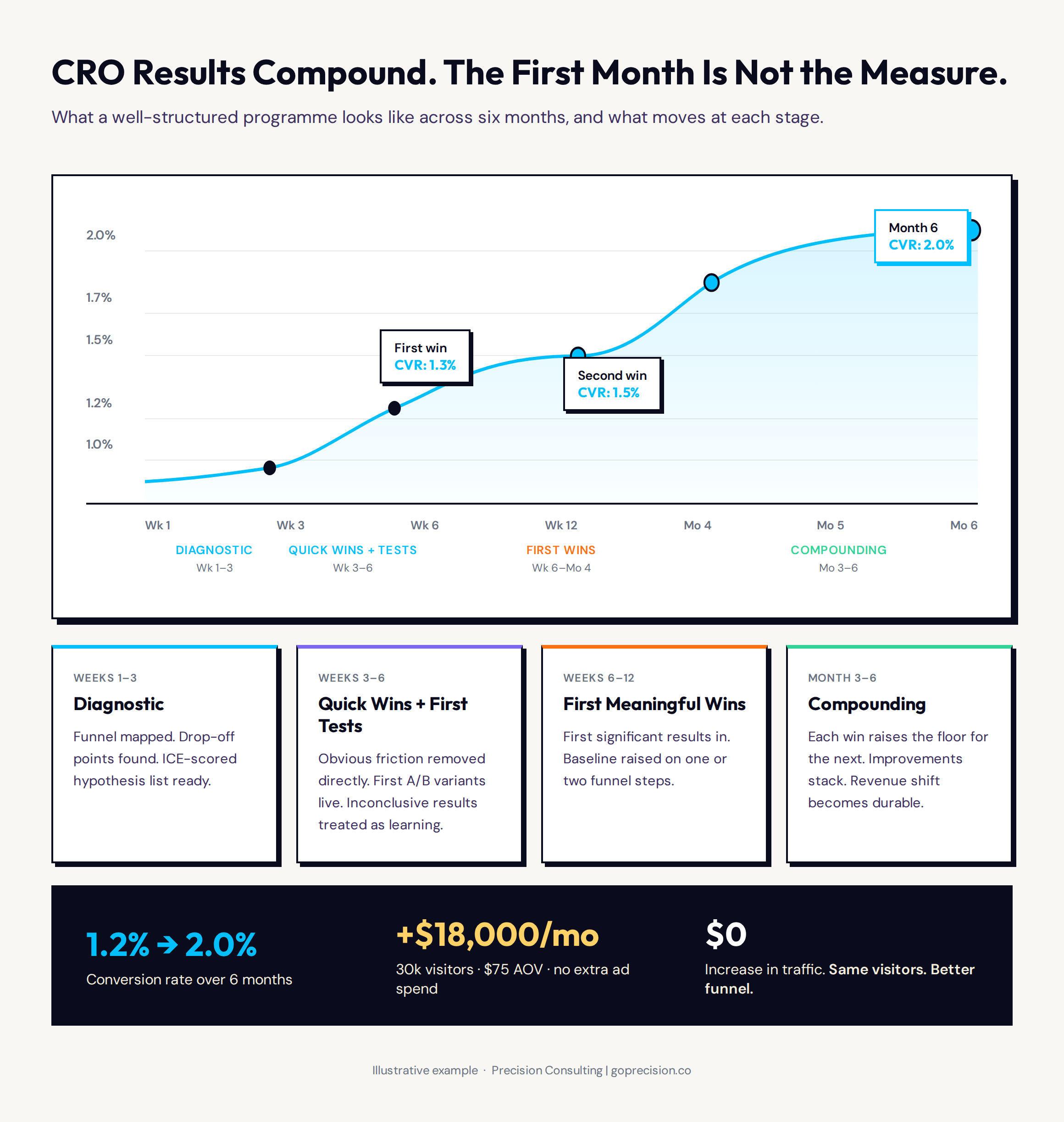
The CRO results timeline: from diagnostic through first wins to compounding improvement over six months.
Why do some CRO programmes take far longer than they should?
Every factor below is predictable. None of them is inevitable. Understanding them before you start is the difference between diagnosing a slow programme correctly and abandoning one that was two months from its first meaningful win.
Your tracking is broken, and your diagnostic will point to the wrong place
Bad analytics data is invisible from the inside. It looks like real data. It produces real-looking reports. The diagnostic phase runs, hypotheses are generated, tests are designed and executed, and nothing moves. The problem is not the tests. The problem is that every conclusion in the diagnostic was based on measurements that did not reflect what was actually happening in your funnel.
Before starting any CRO programme, audit your analytics implementation. Confirm that your checkout funnel is tracked end to end, that add-to-cart and checkout initiation events are firing correctly, and that your conversion goal is measuring accurately. In most stores, this takes two to three days of technical work. It is not glamorous, and it does not feel like CRO. It is the most important thing you can do before spending a single hour on test design.
Your traffic is too low for A/B tests to produce reliable results
Low traffic is the most common cause of extended CRO timelines, and the most commonly misunderstood. A test that needs eight weeks to reach significance rather than three does not mean CRO is not working. It means your methodology needs to change.
Below roughly 10,000 monthly visitors, the most effective approach is qualitative research combined with direct high-confidence changes rather than controlled A/B testing. Session recordings, user interviews, and expert heuristic review produce interventions you can implement directly without waiting for statistical significance. The testing programme scales up when traffic grows. The diagnostic work is never wasted.
You are testing the wrong things in the wrong order
Most pages have one or two friction points that account for the majority of conversion loss. The rest are marginal. Running a sequence of marginal tests while the primary friction point sits untouched is the most expensive version of this mistake, because it feels productive. Tests are running. Results are being recorded. Nothing meaningful is changing.
A testing calendar built on prioritised hypotheses from a real diagnostic will produce results in a fraction of the time of a calendar built on industry best practices or intuition. Impact prioritisation is not a refinement you add later. It is what determines whether the programme produces results in months rather than years.
Your best test result came during a sale, and it will not hold
Buyer behaviour during a promotional period is not the same as buyer behaviour during normal trading. The people arriving at your store during a flash sale are further down the decision funnel, more price-motivated, and more tolerant of friction than your regular visitors. A test that wins against that audience may not win against the audience you actually spend most of your time serving.
Where possible, run tests during stable periods. If your business is highly seasonal, plan your testing calendar around your traffic patterns and be conservative about any results that came from an anomalous period. A winner from Black Friday week is a hypothesis worth re-running in February, not a change worth permanently implementing.
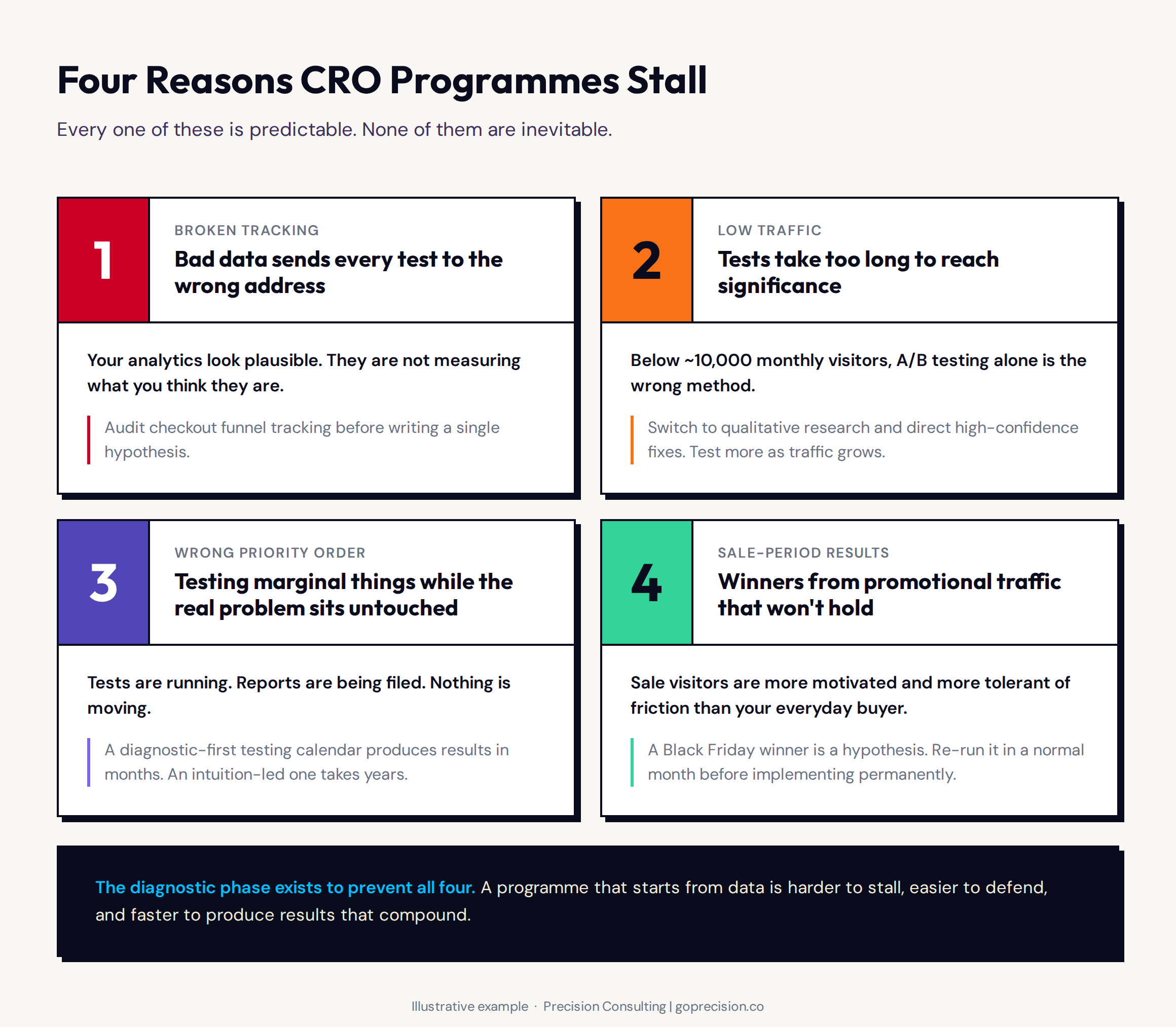
The four most common reasons CRO programmes run longer than they should, and what to do about each.
If your CRO programme has been running for more than three months without directional improvement, the diagnostic probably needs revisiting before you run another test. Request your free audit and we will identify exactly where the programme is stalling and why.
How to tell whether your CRO programme is working
Most founders ask this question at the wrong time. They ask it at week eight, when the first few tests have produced inconclusive results and the investment feels like it has produced nothing. Week eight is too early to answer this question. Here is the framework for answering it correctly.
Your programme is working even if it does not feel like it yet
The signs are: statistically significant wins on at least 30% of tests run, clear documentation linking each test to a specific observed behaviour in your analytics, each test cycle producing cleaner data than the one before, and conversion rate moving directionally upward over any rolling three-month window.
Also watch the intermediate metrics before the headline one moves: add-to-cart rate, checkout initiation rate, product page scroll depth. These shift before the overall conversion rate does, and when they move in the right direction, it confirms that the funnel changes you are making are landing, even if the outcome number has not caught up yet.
Three months of inconclusive tests is a diagnostic problem, not a testing problem
If you are seeing consistently inconclusive tests, the same elements being retested without clear learning, and no directional movement in conversion over four months, something in the foundations is wrong. Either the original diagnostic was incomplete, the test priorities do not match where the actual friction is, or there is a structural issue with the store that CRO cannot address on its own.
This is not a failure of CRO as a practice. It is a signal that the programme needs to go back to the diagnostic stage before running more tests. Continuing to run tests on top of a weak diagnosis is the most common way to spend twelve months and produce nothing.
If you want to understand what a well-structured CRO timeline looks like for your specific store and traffic level, see how Precision structures its engagements, or book a free strategy call to walk through your current numbers together.
Don't Make Me Think by Steve Krug covers the principles of usability that most commonly create friction in e-commerce conversion funnels. Predictably Irrational by Dan Ariely provides the psychological framework for understanding why certain friction points have outsized effects on conversion. Influence by Robert Cialdini covers the persuasion principles that underpin high-converting e-commerce experiences and helps explain why some tests produce large effects while others produce noise.
Key Takeaways
- CRO typically shows initial results within four to eight weeks. Meaningful compound improvement emerges over three to six months of consistent, well-structured work.
- Traffic volume and diagnostic quality are the two primary drivers of timeline. High traffic with poor diagnosis produces fast results on the wrong things. Good diagnosis with low traffic produces slower but reliable results.
- The diagnostic phase is not optional. Skipping it is the most common reason CRO programmes run for months without meaningful results.
- At lower traffic volumes, qualitative research and direct high-confidence changes outperform A/B testing as a methodology. The testing programme expands as traffic grows.
- Broken or incomplete analytics tracking reliably extends timelines by misdirecting the diagnostic. Audit your tracking before you start.
- A testing programme where 30% of tests produce statistically significant wins is performing well. Not every test should win. Every test should produce learning.
- Compound improvement is what makes CRO a durable revenue investment. A store going from 1.2% to 2.0% conversion on 30,000 monthly visitors with a $75 AOV gains $18,000 per month without any increase in ad spend.
Frequently Asked Questions
How long does CRO take to show results?
CRO typically shows initial statistically significant results within four to eight weeks for stores with sufficient traffic volume (above 10,000 monthly visitors). Meaningful compound improvement, where multiple wins stack and the overall conversion rate shifts materially, generally takes three to six months of consistent testing.
How many tests should I run per month?
For most growth-stage e-commerce stores, running one to three tests per month is realistic and effective. Running too many tests simultaneously on the same page creates interference and makes it difficult to attribute results. The quality of test design matters far more than the quantity of tests run.
What is a statistically significant result in CRO?
A statistically significant result is one where you can be confident with at least 95% probability that the observed difference between variants is real and not due to random variation. Reaching this threshold requires a sufficient number of visitors to each variant, which is why traffic volume is a primary driver of how long individual tests take.
Can I do CRO with a small store?
Yes, but the methodology needs to be adjusted. Below 5,000 monthly visitors, A/B testing is unlikely to produce statistically reliable results within a practical timeframe. At that stage, qualitative research through session recordings, user surveys, and expert heuristic review produces more reliable guidance. Direct implementation of high-confidence improvements is more appropriate than controlled testing.
What is the ROI of CRO?
The ROI of CRO varies by business, but the frame for evaluating it is consistent. Calculate the monthly revenue impact of improving your conversion rate by 0.5 percentage points at your current traffic and AOV. That is the potential return from a single meaningful win. Multiple wins stacked over six months typically deliver five to ten times the cost of the programme in additional annual revenue.
How do I know if CRO is working?
Look for statistically significant wins on at least a third of tests run, directional improvement in overall conversion rate over rolling three-month periods, and improvement in intermediate metrics like add-to-cart rate and checkout initiation rate. If you are running tests but seeing none of those signals over four months, the diagnostic needs to be revisited.
