VWO is the most recommended paid testing platform for growth-stage e-commerce businesses in 2026. Whether it is the right choice for your store comes down to three questions: how much traffic you have, whether you have a live hypothesis backlog, and whether you need the full diagnostic stack in one platform. In the work we do at Precision, those three questions are the starting point before any platform recommendation.
The mistake most teams make is not choosing the wrong platform. It is buying before the programme is ready to use it. Buying VWO before you have a testing cadence is like buying a professional camera before you have learned to take a photo. The camera does not make you a photographer. The platform does not make you a tester. Teams buy VWO, set it up, and run roughly the same number of tests they always did. Occasionally fewer, because the new platform has a learning curve. The tool changed. The testing discipline did not.
This article covers VWO specifically: what it does, how it compares to Convert.com and AB Tasty, and whether your store fits the profile that makes it worth the cost. If you want the full comparison across all eight Google Optimize alternatives, that is covered in the Google Optimize alternatives guide on this site.
What VWO actually does
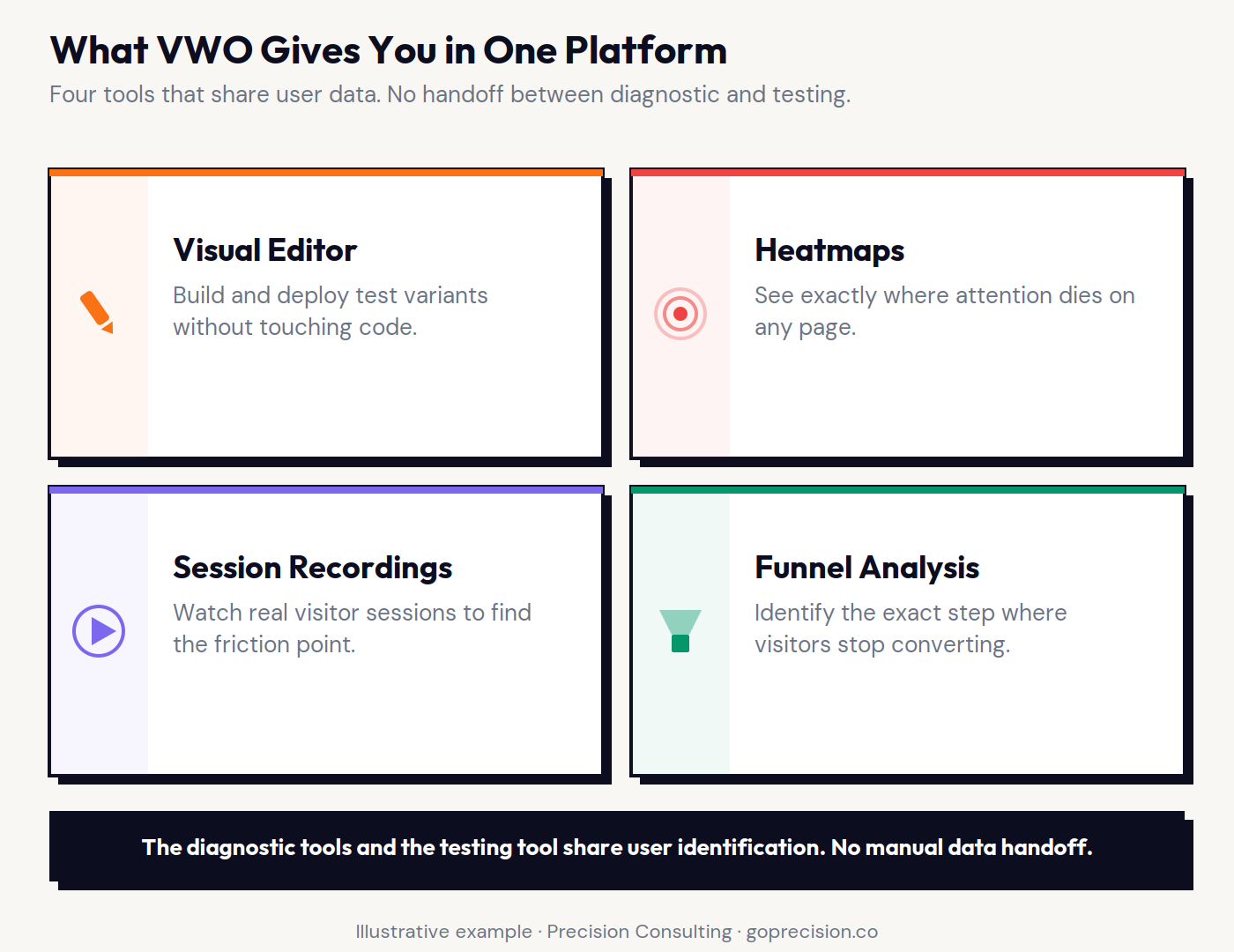
VWO is an all-in-one conversion optimisation platform. At its core: an A/B testing tool with a visual editor that allows non-developers to build and deploy variants without touching code. Around that core: session recordings, heatmaps, funnel analysis, on-page surveys, and a hypothesis management system. The consolidation is the point. Most testing programmes fail not because teams lack a testing tool but because they lack good hypotheses. A test run from a heatmap observation consistently outperforms a test run from intuition. VWO gives you the diagnostic tools and the testing infrastructure on the same platform, with shared user identification across them.
The visual editor
The visual editor is where non-technical operators spend most of their time. Select an element on the page, change it (headline text, CTA copy, button colour, image, section visibility), and VWO builds the variant. No code is required for standard tests. The practical quality of a visual editor is measured by one thing: how many of your hypotheses you can execute without a developer. A brittle editor that breaks on complex page structures means every interesting test goes into a developer queue, which is where most tests die. VWO's editor handles the majority of page-level tests reliably enough that a non-technical operator can run a meaningful testing cadence without engineering dependency. That independence is what makes the difference between a CRO programme that runs weekly and one that runs quarterly.
The behaviour toolset
Heatmaps and session recordings are where VWO's real value lives for most teams. These are the diagnostic tools I use before writing a single test hypothesis. The heatmap tells you where attention dies on a page. The recording tells you why. A heatmap on a product page shows visitors are not scrolling past the product description. That observation alone could mean the description is the problem, but it could also mean the top of the page already answered the question. A recording clarifies which: you see a visitor read the description, reach a specific line, pause, and leave. The pause is the signal. That sentence is the test.
Cognitive switching cost: Every data handoff between separate tools (heatmap tool to recording tool to testing tool) breaks context. When analysis lives in three platforms with no shared user identity, you spend time reconciling data instead of forming hypotheses. The best diagnostic insight is the one that flows directly into a test without a manual join. Platform consolidation is not a convenience feature. It is a hypothesis velocity feature.
Before evaluating VWO: map your current diagnostic stack. List every tool you use for heatmaps, recordings, analytics, and testing. Count the manual steps between a heatmap observation and a live test variant. If the answer is more than two, consolidation is producing a measurable cost. If the answer is one or fewer, the consolidation benefit is smaller than the subscription cost.
VWO consolidates the diagnostic and testing stack in one platform with shared user identification across all tools.
How VWO compares to its closest alternatives
VWO sits alongside Convert.com and AB Tasty in the mid-market paid tier. The three are closely matched on core testing capability. The differences are in compliance architecture, personalisation depth, and what each platform prioritises.
VWO vs Convert.com
Convert.com is purpose-built for teams where privacy compliance is a hard requirement. Its data processing is cookieless and EU-based. GDPR and CCPA compliance are architecture, not configuration. For stores in regulated markets or with privacy-sensitive audiences, Convert.com removes a category of risk that VWO requires additional setup to address. On pure A/B testing capability at comparable traffic volumes, the two platforms are closely matched. VWO has the broader feature set (heatmaps, recordings, surveys) within a single subscription. Convert.com's advantage is the compliance architecture. If GDPR is a primary architectural requirement, the choice is already made. If it is not, VWO's consolidation gives you more diagnostic infrastructure for the same budget, and in a testing programme, more diagnostic infrastructure means better hypotheses and better tests.
VWO vs AB Tasty
VWO and AB Tasty merged under a unified entity called Wingify in June 2026. Both platforms continue operating independently with their own product positioning, pricing, and customer contracts unchanged. The underlying engineering and data infrastructure is merging step by step, with a shared AI layer called Wandz introduced for campaign optimisation across both platforms. The selection guidance between the two still holds.
AB Tasty sits in the same price tier as VWO with stronger AI-driven personalisation features at the entry level. For stores where personalisation is the primary use case (serving different content to different segments rather than pure A/B conversion testing), AB Tasty is a more focused fit. For stores primarily running conversion tests rather than personalisation, VWO's diagnostic stack gives you more hypothesis-generation infrastructure within the same subscription. Personalisation is a stage-three problem. Conversion friction is a stage-one problem. Fix stage one first.
When to consider the free alternatives instead
GrowthBook (open-source) and Statsig (generous free tier) are the right tools for stores under 50,000 monthly visitors with engineering capability. At that traffic level, standard A/B tests take too long to reach statistical significance for a paid testing cadence to be sustainable. Both platforms deliver equivalent testing rigour at no cost while you build toward the traffic threshold where VWO earns its price.
Feature gravity bias: Teams evaluate platforms on features they do not yet need. The personalisation suite, the AI-driven segmentation, the server-side testing API. These are real capabilities that matter at scale. They do not matter at 30,000 monthly visitors with two tests a month. Evaluating a platform against a future state you have not reached yet produces a purchase decision optimised for a programme you do not have. Buy for the programme you are running, not the one you are imagining.
Use this decision sequence before purchasing: If GDPR compliance is a hard architectural requirement, choose Convert.com. If personalisation is the primary use case and A/B testing is secondary, consider AB Tasty. If you have fewer than 50,000 monthly visitors, start with GrowthBook or Statsig. If none of the above apply and you need heatmaps, recordings, and testing in one platform, VWO is the right fit.
Platform selection mapped to three variables: compliance requirements, personalisation ambition, and traffic volume. Most growth-stage stores fall in the VWO column.
When VWO is the right choice
VWO is the right choice when three things are all true at the same time.
You have the traffic
A standard A/B test requires approximately 17,000 conversions per variant to reach statistical significance at 95% confidence with a 10% minimum detectable effect. At a 2% store conversion rate, that is 850,000 sessions for a simple two-variant test. Most stores are not running at traffic volumes where they can generate that within a reasonable test window. The consequence is not just wasted money on VWO. It is worse: a testing programme that calls winners on statistically meaningless results and makes changes based on noise. Every change implemented on insufficient data makes the store harder to reason about. At 50,000 or more monthly visitors on your primary test pages, you are in a range where meaningful tests are possible within a three to four-week window. Below that, GrowthBook or Statsig gives you the same testing discipline at no cost.
You have a hypothesis backlog
A testing tool without hypotheses is expensive software running idle. The CRO audit checklist is the right starting point for building that backlog systematically. In a Precision audit on a DTC brand with 80,000 monthly visitors, the team had VWO running for four months before we engaged. They had run two tests. Both were called winners based on two weeks of data at traffic volumes that required six weeks for statistical significance. Neither result held on retest. The tool was not the problem. The testing methodology was. If you do not have a live hypothesis backlog grounded in analytics data, install GA4 and Microsoft Clarity (both free) and spend 90 days building the diagnostic picture. Clarity's session recordings are free, unlimited, and good enough to generate a meaningful backlog for most stores. Come back to VWO when the backlog is real.
You need the full stack in one place
If your programme needs A/B testing, heatmaps, session recordings, and on-page surveys with shared user identification across all of them, VWO at its price point is the most efficient consolidation available. The alternative is GA4 plus Clarity plus a heatmap tool plus a survey tool, with no data handoff between them. In Precision audits, teams running that fragmented stack spend 30 to 40% of their programme time on data reconciliation rather than test design. VWO removes that friction. At the volume where you are running multiple tests per month, the time saving compounds into a meaningfully faster CRO programme.
Premature optimisation: Teams buy better tools before they have exhausted the value of simpler ones. A free heatmap and a testing discipline beats a paid platform with no hypothesis backlog, every time. The bottleneck in most testing programmes is not tool capability. It is the speed at which good hypotheses are generated and prioritised. Buy the platform after you have validated the programme, not before.
Answer these three questions before purchasing VWO. How many tests did you run in the last 90 days? Do you have a live backlog of hypotheses grounded in analytics data? Do you have 50,000 or more monthly visitors on your primary test pages? If the answers are none, no, and no: start with GrowthBook or Statsig and build the programme. Come back to VWO when the answers change.
Choosing the right platform is one question. Building the programme that makes it worth paying for is another. If you want to know which tool fits your traffic, team, and testing ambition, request your free audit and we will walk through it together.
Why VWO is not the right choice for every team
Four cases where VWO is not the answer.
Fewer than two tests per month: free tools produce identical results at that cadence, and the additional features go unused. Paying for VWO at one test a month is paying for a gym membership and going once.
GDPR compliance as a hard architectural requirement: Convert.com is purpose-built for that. VWO can be configured for compliance, but it is not its native design. Do not buy the wrong architecture and then configure your way into the right one.
The testing roadblock is hypotheses, not infrastructure: buying a more capable testing platform does not accelerate the diagnostic work that produces good tests. It adds a monthly subscription to the same bottleneck. Build the backlog first, then buy the platform.
Standard Shopify and checkout testing as the priority: VWO cannot test inside the Shopify checkout without Shopify Plus. If checkout testing is the goal, resolve that constraint before the tool choice matters. The Shopify vs WooCommerce guide covers exactly where that ceiling sits and what it costs to raise it.
The pattern is the same across all four. Not a platform problem. A programme problem. The platform is ready when you are. Most teams buy it before they are ready. The A/B testing guide for founders covers what a programme-first approach looks like in practice, including how to build a hypothesis backlog before committing to paid tooling.
Tool rationalisation: Once a team has purchased a platform, they find reasons to justify the spend rather than reasons to question it. Tests are called early. Results are interpreted generously. The platform becomes a sunk cost that shapes methodology rather than the other way around. The correct order is always: build the programme, validate the methodology, then buy the tool that the programme requires.
If you already have VWO and are under-using it: do not renew until you have run at least four tests in the last 90 days, each run to full statistical significance. If you cannot hit that cadence with the tool you have, the problem is not the tool. Address the hypothesis backlog, the test review process, or the developer dependency before paying for another year.
How much does VWO cost in 2026?
VWO prices on monthly tested users, not sessions. Entry-level plans in 2026 start at approximately $200 per month for 10,000 monthly tested users, scaling with traffic volume and feature set. The all-in-one plan that includes testing, heatmaps, recordings, and surveys is priced above the testing-only entry point. Enterprise plans with server-side testing are quoted on request. At higher traffic volumes, its cost per tested user is competitive with AB Tasty and Convert.com. At lower volumes, you are paying for capacity you cannot productively use.
Model on tested users, not sessions. The key variable when forecasting what VWO will actually cost is tested users at your traffic level, not your total session count. A store with 200,000 monthly sessions running tests on two pages might have 40,000 monthly tested users. Check vwo.com for current pricing tiers and model your expected tested user volume before committing to a plan. Overestimating capacity is common and expensive.
Precision works with growth-stage businesses to build testing programmes that compound, starting with the diagnostic work that produces good hypotheses rather than the platform that runs them. If you want a clear view of which tool fits your traffic volume and testing ambition, book a call and we will walk through your programme together. Or start with the full audit process to understand what a structured review looks like before committing.
Further Reading
Super Thinking by Gabriel Weinberg and Lauren McCann covers statistical significance and sample size, which underpins the traffic threshold argument throughout this article.
Hooked by Nir Eyal covers what makes users return to products without prompting, which informs how you form better test hypotheses about engagement and activation.
Key Takeaways
VWO earns its cost at 50,000 or more monthly visitors with a live hypothesis backlog and a need for the full diagnostic stack in one platform. All three conditions must be true simultaneously.
The most common mistake is not choosing the wrong platform. It is buying before the programme is ready to use it. The tool changes. The testing discipline does not.
VWO vs Convert.com: if GDPR compliance is a hard architectural requirement, Convert.com is purpose-built for that and is not configurable after the fact. If compliance is not the deciding factor, VWO's consolidation is the better value.
VWO vs AB Tasty: both platforms merged under the Wingify suite in June 2026 and continue to operate independently with unchanged pricing and contracts. If personalisation is the primary use case, AB Tasty has stronger AI-driven personalisation at entry tier. If you are focused on conversion friction, VWO's diagnostic stack is the stronger starting point.
A standard A/B test requires approximately 17,000 conversions per variant at 95% confidence. At a 2% conversion rate, that is 850,000 sessions. Most stores are not at volumes where VWO is earning its cost.
If you do not have a live hypothesis backlog, start with GA4 and Microsoft Clarity. Build the diagnostic picture for 90 days. Then buy the platform.
Standard Shopify plans block checkout A/B testing. VWO cannot test inside the checkout without Shopify Plus. Solve that constraint before the tool choice matters.
Not a platform problem. A programme problem. The platform is ready when you are. Most teams buy it before they are ready.
Frequently asked questions
What is VWO?
VWO (Visual Website Optimizer) is an all-in-one conversion optimisation platform that includes A/B testing, multivariate testing, heatmaps, session recordings, funnel analysis, and on-page surveys. It is one of the most widely used paid testing platforms for growth-stage e-commerce businesses.
Is VWO worth it?
VWO is worth it if you have 50,000 or more monthly visitors on your primary test pages, a live hypothesis backlog built from analytics data, and a need for testing and diagnostics in one platform. Below that traffic threshold, free tools like GrowthBook and Statsig produce equivalent results at no cost. The platform is only as valuable as the testing programme behind it.
How much does VWO cost in 2026?
VWO's entry-level plans start at approximately $200 per month for 10,000 monthly tested users. Pricing scales with traffic volume and feature set. The all-in-one plan including heatmaps, recordings, and surveys is priced above the testing-only entry point. Enterprise plans are quoted on request. VWO prices on tested users rather than sessions, which is the key variable to model when forecasting cost at your traffic level.
VWO vs Convert.com: which should I choose?
Choose Convert.com if GDPR and CCPA compliance are a primary architectural requirement. Its data processing is cookieless and EU-based by design, not configuration. Choose VWO if compliance is not the deciding factor and you want heatmaps, session recordings, and A/B testing consolidated in one subscription. On pure testing capability at comparable traffic volumes, both platforms perform similarly.
VWO vs AB Tasty: which is better for CRO?
VWO and AB Tasty merged under Wingify in June 2026. Both platforms continue operating independently with unchanged pricing and contracts. For conversion rate testing focused on reducing friction and improving funnel performance, VWO's diagnostic toolset (heatmaps, recordings, funnel analysis) is the stronger starting point. For stores where AI-driven personalisation and audience segmentation are the primary use case, AB Tasty's entry-tier personalisation features are more developed. The distinction is testing-focused versus personalisation-focused.
What is the minimum traffic needed to use VWO effectively?
50,000 monthly visitors on primary test pages is a practical threshold. Below that, standard A/B tests take too long to reach statistical significance for a sustainable testing cadence. GrowthBook and Statsig deliver equivalent testing rigour at no cost for stores building toward that level.
Can I use VWO on Shopify?
Yes, VWO works on Shopify for product pages, collection pages, and landing pages. Standard Shopify plans block A/B testing inside the checkout. To test checkout layout, CTA copy, or field order, you need Shopify Plus and the Checkout Extensibility API. If checkout testing is your priority and Plus is not in your budget, resolve that constraint before choosing a testing platform.
Ammarah helps growth-stage e-commerce and SaaS brands increase revenue through psychology-driven CRO and UX strategy. With over a decade of experience across major tech platforms in Asia and the Middle East, she combines behavioural psychology with conversion data to identify and fix the specific points where browsers become buyers.
Weekly CRO Notes
The Mailer
Never miss an insight
Weekly CRO breakdowns and the tactics seven-figure e-commerce brands are using right now.