Last updated:
Prioritising a CRO experimentation roadmap means ordering tests by expected impact, confidence in the hypothesis, and implementation cost, not by who in the business most recently requested them.
Most CRO programmes that fail do not fail because they ran bad tests. They fail because they ran tests in the wrong order. A team that spends the first quarter redesigning the homepage has used its bandwidth on a high-cost, high-uncertainty test when several high-confidence, low-effort improvements were waiting on the product page and at checkout. The work was done. The return was not there.
The question prioritisation answers is not what we should test. Every team has more ideas than capacity. The question is what we should test first, given our traffic volume, our confidence in the hypothesis, and the cost of running the experiment. Answer that question with a framework, and the roadmap takes care of itself. If you are new to the mechanics of running individual experiments, the A/B testing guide for founders covers hypothesis design, statistical significance, and the traffic thresholds required for valid results.
This is the prioritisation logic we apply at Precision when auditing and rebuilding experimentation programmes. The framework holds whether you are running two tests a quarter or twenty.
Why do most experimentation roadmaps fail before a test even runs?
Most experimentation roadmaps fail because they are built from opinions rather than evidence, and ordered by organisational pressure rather than potential return. The most common failure mode is what practitioners call the HiPPO problem: the Highest Paid Person's Opinion dictates the test queue. The CEO saw a competitor's redesign. The marketing director read an article about social proof. The developer has always believed the navigation is the problem. Everyone is probably partially right. None of it is ordered by evidence.
A second failure mode is the novelty trap: testing interesting things rather than important things. Personalisation engines, AI-powered recommendations, and dynamic pricing are compelling experiments. They are also high-cost, high-uncertainty tests that require significant traffic to produce valid results. Most stores run them before they have addressed the checkout friction that is visibly costing 30% of buyers at the payment step. The exciting test displaces the impactful one.
What makes a roadmap work is a consistent scoring method applied to every idea before it enters the queue. Not a tool or a template but a shared answer to the question: how do we decide what comes next?
What qualifies as a quick win in CRO?
A quick win in CRO is a test with high confidence in the hypothesis, low implementation cost, and a clear measurable outcome. It is not simply an easy change. Ease and confidence are not the same thing. A quick win requires both.
High confidence means there is behavioural evidence supporting the hypothesis. Session recordings show buyers hesitating at the same point. Click maps show a non-clickable element receiving a high click share. Funnel data shows an unusual drop-off at one specific step. The hypothesis is grounded in observed behaviour, not in assumption or preference.
Low implementation cost means the change can be deployed, tested, and analysed without consuming significant developer time or design resources. Copy changes, button text adjustments, trust signal placement, image sequencing, form field reduction, and CTA positioning are all low-cost to implement. A full page restructure is not, regardless of how confident the team is in the outcome.
What a genuine quick win looks like
- Removing mandatory account creation before checkout. The Baymard Institute's research identifies forced account creation as one of the top three reasons for checkout abandonment. The test takes hours to implement and the hypothesis is based on observed data from hundreds of audits.
- Adding a clear returns policy adjacent to the Add to Cart button. Buyer hesitation at the point of purchase is frequently linked to uncertainty about returns. Moving the policy summary from the footer to the product page is a low-cost change with a clear hypothesis grounded in documented friction.
- Reducing form fields from eight to four by moving optional fields post-purchase. Baymard Institute research shows the average checkout contains 23 form fields when 12 to 14 is the optimum. The evidence is strong, the implementation is straightforward, and the outcome is measurable.
Before labelling any test a quick win, check two things: is the hypothesis grounded in observed user behaviour (session recordings, heatmaps, funnel data) rather than an assumption? And can the change be implemented and fully tested in the current sprint? If the answer to either is no, it is not a quick win. It is an opinion or an undertaking.
What makes something worth a big swing?
A big swing is a test with high potential impact and high implementation cost. It requires significant resources to build, run, and analyse. It is worth including on a roadmap when two conditions are met: the evidence base is strong enough to justify the cost, and no high-confidence quick win covering the same friction has been left untested.
The mistake most teams make with big swings is running them too early. A full checkout redesign might be exactly the right intervention for a store. But if the checkout has never had its copy audited, its form fields optimised, or its trust signals adjusted, those quick wins should run first. Each one produces learning. Together, they tell you whether the redesign is justified or whether targeted interventions have already addressed the problem.
When a big swing is the right call
A big swing is justified when the quick wins have been exhausted, the evidence points to a structural problem rather than a surface-level one, and the expected return justifies the cost. A product page with strong copy, a clear CTA, good social proof, and a simplified form that still converts at 1.2% on 50,000 monthly visitors may genuinely need a full layout restructure. The decision is justified by the evidence, not by enthusiasm for redesign.
Some changes that feel large are actually high-confidence quick wins when the evidence base is strong and the implementation is more contained than it looks. Adding a sticky Add to Cart bar to mobile is not a redesign. It is an element addition that addresses a documented usability gap.
Before committing to a big swing, list every quick win that addresses friction in the same area. If you can identify three or more high-confidence quick wins in that funnel step, run them first. The results will either solve the problem or sharpen your understanding of what the redesign needs to achieve. A big swing without that context is an expensive guess.
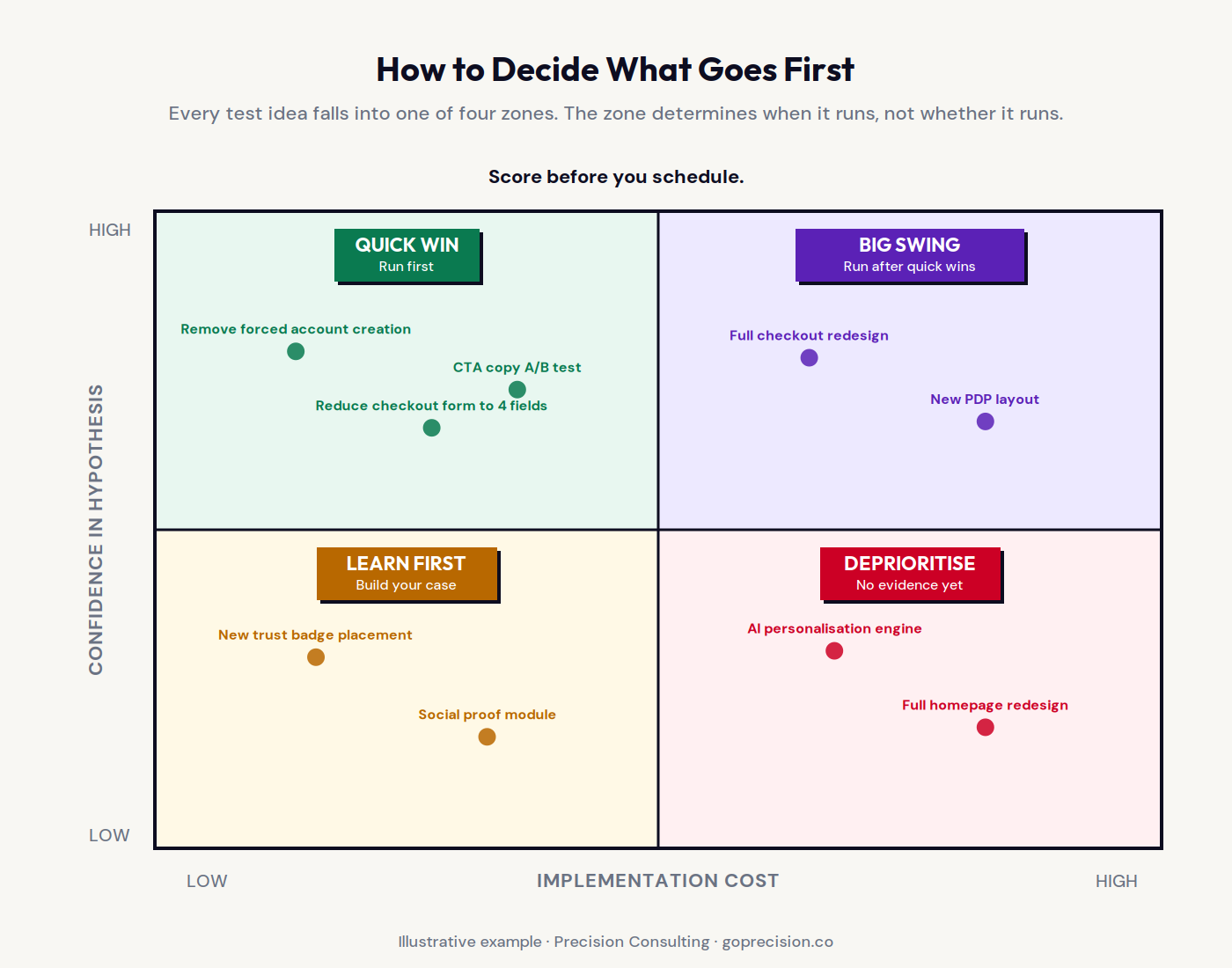
How to decide what to test first: four quadrants plotted against implementation cost and confidence in hypothesis.
Which CRO prioritisation frameworks are worth using?
Two frameworks dominate practical CRO prioritisation: ICE and PIE. Both produce a numerical score for each test idea that makes it easier to compare and order a queue. Neither is precise. Both are useful because they force the conversation about trade-offs before resources are committed.
ICE: Impact, Confidence, Ease
ICE scores each idea on three dimensions: expected Impact on the primary metric (typically conversion rate), Confidence in the hypothesis based on available evidence, and Ease of implementation. Each dimension is scored on a scale of one to ten. Multiply the three scores to produce an ICE score. Ideas with higher ICE scores enter the queue ahead of lower-scoring ones.
ICE is fast to apply and works well for teams early in their CRO programme. Its weakness is that Confidence often ends up reflecting how persuasively the test was argued rather than the strength of the evidence behind it. Build in a forcing question: what user behaviour data supports this hypothesis? If the answer is none or intuition, the Confidence score should be low regardless of how logical the test sounds.
PIE: Potential, Importance, Ease
The PIE framework, developed by Widerfunnel, scores ideas on Potential (how much improvement is possible compared to the current state), Importance (how much traffic or revenue is at stake in that area), and Ease (how difficult the test is to build and run). The distinction from ICE is the Importance dimension: a test targeting a page that receives 2% of traffic scores lower on Importance than the same test applied to the checkout, which every buyer passes through.
PIE is more appropriate for teams with a large idea backlog covering multiple page types. It prevents the roadmap from filling with improvements to low-traffic pages that individually score well on Potential and Ease but do not move the overall conversion rate. The Importance dimension keeps the roadmap focused on high-traffic funnel steps.
Which to use
For most growth-stage stores, ICE is sufficient when the team is disciplined about what counts as evidence for Confidence. Use PIE when the roadmap spans multiple page types and there is a risk of over-investing in low-traffic pages. In either case, the framework is a starting point, not the final answer. Apply it consistently, and override it only when you can articulate a clear reason.
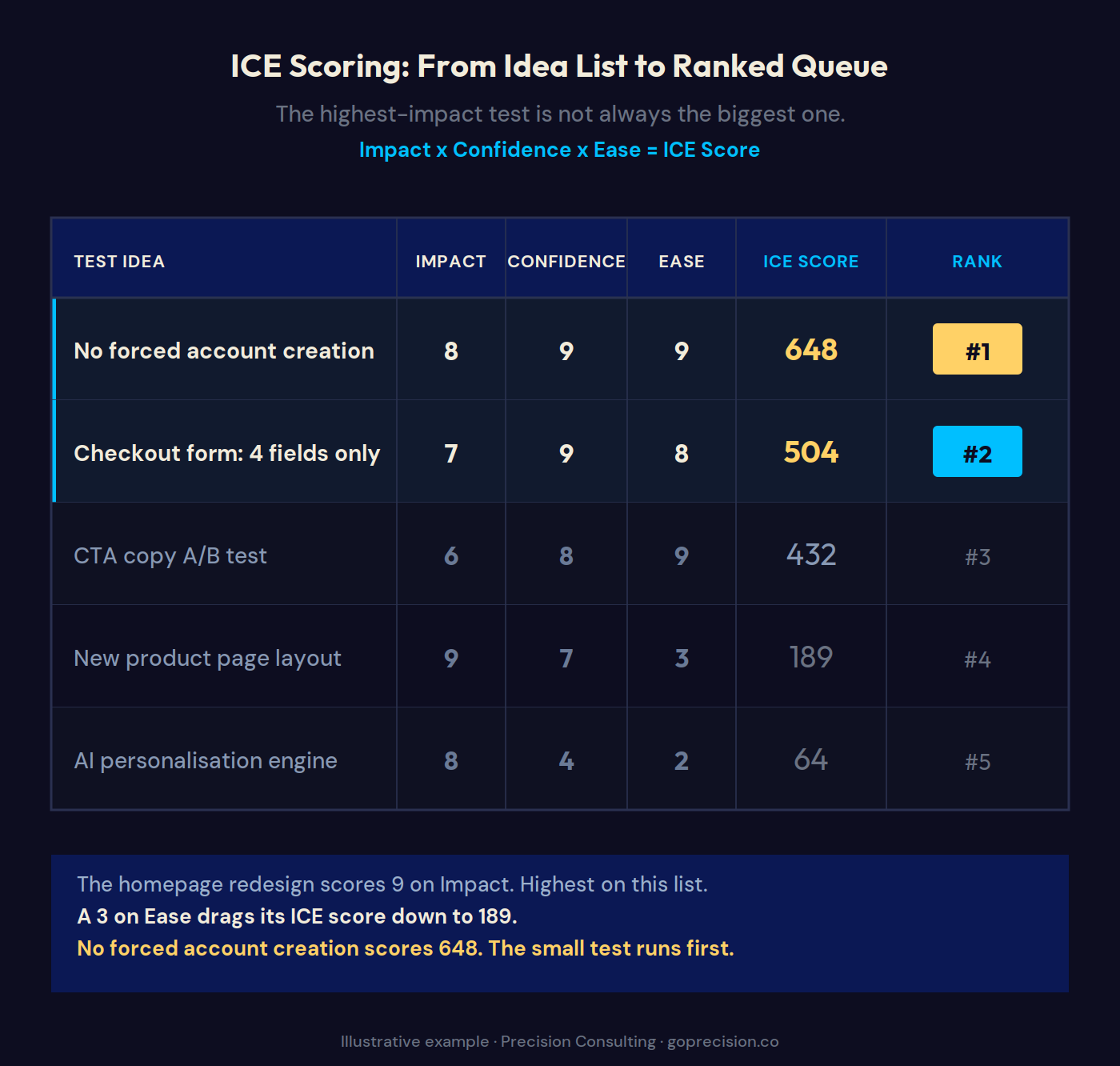
The ICE framework in practice: how a small, high-confidence test outranks a large but uncertain redesign.
Building a ranked, evidence-based list of the highest-impact tests for your specific store is exactly what we do in a Precision Deep Dive Audit. Request your free audit and we will build the prioritised roadmap for your funnel.
How should you sequence a real experimentation roadmap?
A well-sequenced roadmap alternates between quick wins and big swings rather than depleting bandwidth on one type alone. Quick wins build confidence in the testing programme, produce early revenue impact, and generate data that informs the big swings. Big swings produce the compounding step-changes that quick wins alone cannot deliver.
A reasonable sequencing principle for a quarter with limited testing capacity: run two quick wins per big swing. The quick wins should address known, evidenced friction. The big swing should address a structural problem that quick wins have confirmed is real. If two quick wins in the checkout address form friction and trust signal placement and both produce lifts, and the overall checkout conversion is still low, the evidence for a checkout redesign is now much stronger than it was at the start of the quarter.
The test velocity trap
There is a common belief that running more tests produces better results. It does not. Running more tests faster reduces the quality of each test's learning. Statistical significance requires a minimum sample size, and splitting traffic across multiple simultaneous tests dilutes that sample. A team that runs three tests simultaneously at 80% statistical significance produces noisier results than the same team running one test at 95%. Speed through the queue is not the goal. Learning per test is.
Most growth-stage stores with 20,000 to 100,000 monthly visitors have enough traffic to run two well-designed simultaneous tests at most. Below 20,000 monthly visitors to the page being tested, running tests sequentially almost always produces better data quality than running them in parallel. The implication for the roadmap: prioritise more aggressively, not more generously. A queue of ten tests run one at a time produces better compounding results than a queue of thirty with five running simultaneously.
What do most teams get wrong about their experimentation roadmap?
The most common structural mistake is building the roadmap from features to test rather than from problems to solve. A feature-driven roadmap asks: we have a new product recommendations widget, should we test it? A problem-driven roadmap asks: buyers are leaving the product page without adding to the cart. What is the most likely cause, and what test addresses it directly? The second framing produces tests with clearer hypotheses, better success criteria, and more actionable results.
A second consistent mistake is not defining success before the test runs. A test with no agreed success metric produces a result that everyone interprets in light of their prior belief. The team that wanted the feature declares it a success. The sceptical team declares the data inconclusive. Pre-register the success metric and the minimum detectable effect before the test launches. If the test cannot produce a meaningful result at your traffic volume, do not run it at all.
What to do when you do not have enough traffic to test
Below approximately 5,000 monthly visitors to the page being tested, formal A/B tests rarely produce statistically valid results within a reasonable time frame. The alternative is not abandoning improvement altogether. It is using qualitative methods to build confidence before committing to a change. Session recordings, usability tests with five to seven users, and customer interviews all produce evidence that informs hypothesis quality. Apply the changes with high confidence based on the evidence and treat the post-change analytics as directional rather than conclusive.
The CRO audit checklist includes specific guidance on the qualitative methods to use when traffic is too low for formal testing.
If you want a ranked, evidence-based list of the highest-impact tests for your specific store, see how Precision builds experimentation roadmaps, or book a free strategy call to walk through your current queue together.
Super Thinking by Gabriel Weinberg and Lauren McCann covers expected value, prioritisation under uncertainty, and compounding mental models that apply directly to building an experimentation roadmap that produces improved returns over time. Indistractable by Nir Eyal offers a framework for distinguishing between traction and distraction that translates cleanly to the test velocity trap: doing more is not the same as achieving more.
Key Takeaways
- Prioritising a CRO roadmap means ordering tests by expected impact, confidence in the hypothesis, and implementation cost. Ideas that score well on all three move to the front of the queue regardless of organisational seniority.
- A quick win requires both high confidence in the hypothesis and low implementation cost. Ease alone does not qualify a test. The hypothesis must be grounded in observed user behaviour.
- Big swings belong after quick wins in the same funnel area have been exhausted. The quick wins either solve the problem or produce the evidence that justifies the structural change.
- ICE scores each idea on Impact, Confidence, and Ease. PIE adds Importance (traffic volume at stake). For most stores, ICE is sufficient when Confidence scores are anchored in behavioural data.
- A practical sequencing rule: run two quick wins per big swing. Quick wins produce early lift and sharpen the case for structural changes. Big swings produce the compounding step-changes quick wins alone cannot deliver.
- Test velocity is not the goal. Running fewer, better-designed tests at adequate sample sizes produces more actionable learning than running many tests simultaneously at insufficient significance.
- Below 5,000 monthly visitors to the test page, qualitative methods produce more reliable insight than formal A/B tests. Use session recordings, usability tests, and customer interviews to build hypothesis confidence before committing to changes.
Frequently Asked Questions
What is a CRO prioritisation framework?
A CRO prioritisation framework is a structured scoring method for ordering test ideas by their expected return relative to their cost. The most common frameworks are ICE (Impact, Confidence, Ease) and PIE (Potential, Importance, Ease). Both assign numerical scores to each test idea across two or three dimensions, producing a ranked queue that guides the order in which experiments are run. The primary function is to prevent the roadmap from being driven by organisational opinion rather than evidence.
What is the ICE score in CRO?
The ICE score is a prioritisation method that rates each test idea on Impact (expected effect on the primary metric), Confidence (strength of the evidence supporting the hypothesis), and Ease (cost and difficulty of implementation). Each dimension is scored on a scale of one to ten, and the three scores are multiplied. Tests with higher ICE scores enter the queue ahead of lower-scoring ideas. ICE is most effective when Confidence scores are anchored in observed user behaviour rather than intuition.
What is the difference between ICE and PIE?
ICE measures Impact, Confidence, and Ease. PIE (developed by Widerfunnel) measures Potential, Importance, and Ease. The primary difference is the Importance dimension in PIE, which accounts for how much traffic or revenue passes through the area being tested. PIE prevents the roadmap from over-investing in high-Potential improvements to low-traffic pages. For stores with test ideas spanning multiple page types, PIE keeps the roadmap focused on high-impact funnel areas.
How do I know if something is a quick win or a big swing?
A quick win has high confidence in the hypothesis (grounded in session recordings, heatmaps, or funnel data) and can be implemented and tested within a single sprint. A big swing has high potential impact but significant implementation cost, and at least some hypothesis uncertainty. The practical test: if three or more quick wins addressing the same friction have already been run and the problem persists, a big swing is justified. If the quick wins have not been run yet, they come first.
How many tests should I run at once?
Most stores with 20,000 to 100,000 monthly visitors can support two well-designed simultaneous tests with adequate statistical power. Below 20,000 monthly visitors to the page being tested, sequential testing almost always produces better data quality than parallel testing. The instinct to run more tests faster is counterproductive if it reduces the sample size available to each test. One test at 95% confidence is more valuable than three tests at 80%.
