Last updated:
Marketplace CRO is the practice of improving conversion rates on a multi-vendor platform, where the levers are fundamentally different from those in single-brand e-commerce. You do not control the product, the price, or the listing content. What you control is the discovery layer, the vendor quality standards, and the checkout and payment experience. Getting those three things right produces conversion improvements that no amount of product page testing can replicate. The scope of what a structured programme looks like in practice is covered on the Precision services page.
Here is a pattern that comes up every time a marketplace team tries to apply a single-brand CRO framework to a platform context. They run A/B tests on homepage layout when the real conversion driver is vendor selection quality. They optimise the checkout when the biggest drop-off is in search. They invest in reviews on individual listings when the real trust problem is at the category level. The framework is not wrong. It is being applied to the wrong layer.
A marketplace is not a store. It is a mall. Improving the mall's signage helps, but if the anchor tenants are not performing, the signage improvement shows up as noise in your conversion data. The first principle of marketplace CRO is identifying which layer the problem actually lives in. Most of the time, it is not where the team is looking.
Two books inform the principles in this article. Information Architecture for the Web and Beyond by Peter Morville and Louis Rosenfeld covers search systems, findability, and the architecture of discovery in ways that apply directly to marketplace search design. Influence by Robert Cialdini covers social proof at scale, which is the mechanism behind category-level trust on a marketplace.
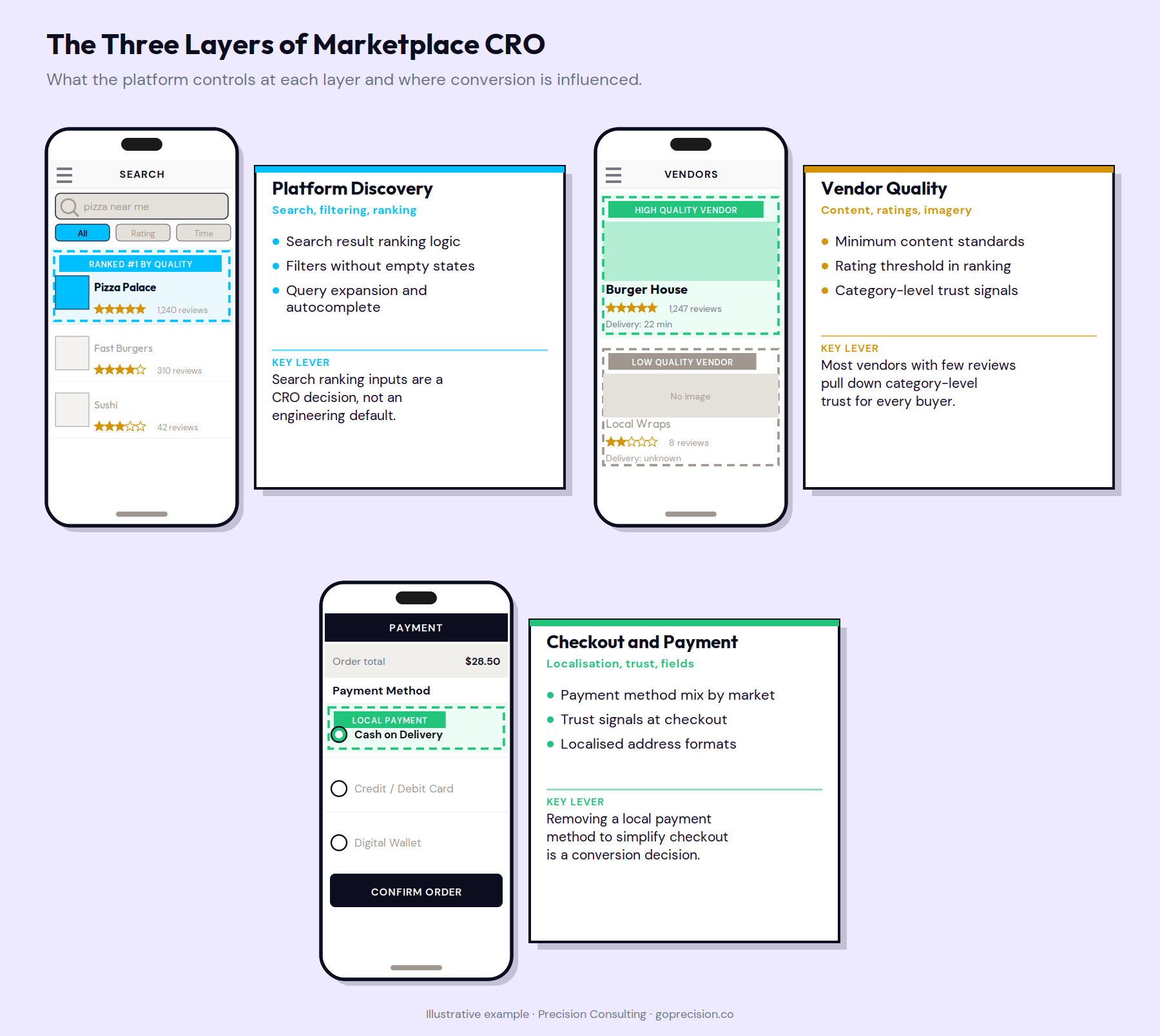
Marketplace CRO operates at three distinct layers. Most conversion losses happen in discovery and vendor quality, not at checkout.
What makes marketplace CRO different from single-brand CRO
In single-brand CRO, you own the full stack: product selection, pricing, imagery, copy, page layout, checkout flow. When you change an element and conversion moves, you can attribute the change with reasonable confidence. In a marketplace, the product selection is the vendor's. The pricing is set by vendors. The imagery and copy are submitted by vendors. The platform controls the shell: search, filtering, ranking, category pages, checkout, trust infrastructure, and payment options.
The attribution problem
When conversion changes on a marketplace, the attribution problem is significant. Did conversion improve because the platform improved discovery, or because a high-performing vendor joined, or because a low-performing vendor left? This is not a rhetorical question. I have seen platform teams celebrate a conversion improvement that was entirely driven by a single high-quality vendor entering a category. The platform changed nothing.
This attribution complexity is why most marketplace teams under-invest in CRO. It is harder to measure, harder to claim credit for, and harder to resource. But the opportunity is proportionate to the complexity. A marketplace converting at 2% instead of 3% across 10 million monthly visits is leaving 100,000 transactions per month on the table. The scale amplification of conversion improvements on a marketplace is unlike anything in single-brand retail.
The control problem
The practical implication of not controlling the product is that your CRO levers are indirect. You cannot rewrite a vendor's listing title, but you can define minimum standards that vendors must meet to appear in search. You cannot reprice a vendor's products, but you can rank price-competitive vendors higher. You cannot improve a vendor's imagery, but you can deprioritise vendors with low-quality images in the category page display.
The platform's leverage is through standards, ranking logic, and tooling, not direct editing. Define what "acceptable" looks like for each quality dimension, build those standards into your ranking algorithm, and measure the conversion impact at the category level, not the listing level.
Why most marketplace conversion problems are discovery problems, not checkout problems
Most marketplace conversion problems are not checkout problems. They are discovery problems. A buyer who reaches the checkout has already made the most important decision. A buyer who cannot find what they are looking for, or who finds it but not from a vendor they trust, does not reach the checkout. The conversion work that matters most happens before the product page.
Search quality as a conversion variable
Search is the primary navigation on most marketplaces. A buyer who types a query and receives results that are irrelevant, out of stock, or ranked in an order that does not reflect quality is a buyer who exits. The search result page is a product page for the marketplace itself. Poor search results are a trust signal failure, not a technical failure.
In work across food delivery platforms in MENA, search result quality was one of the most directly measurable conversion variables on the platform. A search that returned restaurants with poor ratings or inaccurate delivery time estimates produced measurably lower order rates than the same search returning well-rated restaurants with accurate ETAs. The platform did not change. The quality of the result changed. Conversion followed.
Search ranking logic is a product decision, not an engineering decision. The question of what should appear first in search results is a conversion rate optimisation question. The answer involves rating, review count, vendor reliability, delivery time accuracy, and historical conversion rate for that vendor. Teams that leave ranking logic to the engineering team without defining the conversion-weighted inputs are leaving conversion on the table.
What filtering gets wrong on most marketplaces
Filter options are a conversion lever that most marketplace teams treat as a UX feature. The most common filtering error is offering options that produce empty result states. A buyer who filters for 4 stars and above and receives "No results found" exits the category. Show filter options only when there are results behind them. For a deeper look at how mobile filtering specifically compounds this issue, our article on mobile CRO covers the reload behaviour that drops buyers back to the top of the page on filter apply.
Hick's Law: the time it takes to make a decision increases with the number of choices available. A marketplace with 2,400 results and no meaningful filtering is not offering choice. It is offering paralysis. The filtering system converts a large, overwhelming choice set into a manageable one. A well-designed filter that narrows 2,400 results to 24 produces faster decisions and higher conversion, even when the 24 are a subset of the same products the buyer would have found anyway.
Audit your zero-result filter states before anything else. Pull a report of which filter combinations return zero results and either remove those options from the filter UI or add a fallback that shows the nearest results with a note. A filter that dead-ends a buyer is worse than no filter at all.
How vendor quality affects platform conversion rate
The quality of vendors on a marketplace is a conversion variable that the platform controls indirectly through onboarding standards, quality thresholds, and ranking logic. Most marketplace teams think of vendor quality as an operations problem. It is a conversion rate optimisation problem.
The vendor quality threshold that changed platform conversion
At a major food delivery platform, the highest-impact conversion intervention was not a platform design change. It was a vendor quality threshold in search ranking. Vendors below a defined rating threshold and delivery time accuracy threshold dropped in search rank. Within four weeks of implementation, platform-wide conversion improved. Not because the platform changed for buyers. Because the quality of what buyers found when they searched improved.
The relationship between vendor quality and platform conversion is non-linear. A marketplace with 20% of vendors underperforming will not see a 20% conversion impact. It will see a higher impact because underperforming vendors appear disproportionately in search results and produce exit events that spread across the session, not just the vendor visit.
Social proof at the category level
On a marketplace, trust operates at three levels simultaneously: the platform, the category, and the individual vendor. A breakdown at any level produces abandonment. Most marketplace teams invest heavily in platform-level trust infrastructure and underinvest in category-level trust. A food delivery category where 40% of restaurants have fewer than 10 reviews is a lower-trust category than one where most vendors have 100 or more. The trust problem is not with any individual vendor. It is the aggregate signal the category creates. For how trust signals work at the individual listing level, our article on e-commerce trust signals covers the mechanism and placement in detail.
Social proof at scale: Cialdini's research in Influence identifies social proof as the mechanism by which people use the behaviour and judgements of others to guide their own decisions, particularly when uncertain. On a marketplace, the buyer is uncertain by definition. They are evaluating vendors they have not used before. Category-level review aggregation is the most powerful trust signal available because it answers the question of whether this category of the marketplace is worth buying from before the buyer has evaluated any individual vendor.
Set a category-level review floor as part of your vendor quality standards. If a category has a meaningful proportion of vendors with fewer than 10 reviews, treat that as a CRO problem, not a vendor management problem. Either gate low-review vendors to secondary positions in search results or run a review generation programme targeted at the category.
How payment localisation affects marketplace conversion rate
Payment method availability is a conversion variable on marketplaces that single-brand CRO frameworks consistently underweight. In MENA markets, as recently as 2020, cash on delivery accounted for 40 to 60% of transactions on major delivery platforms. Removing or deprioritising cash on delivery to simplify the checkout flow would have been a catastrophic conversion decision, regardless of what any A/B test on checkout field count suggested.
The principle extends beyond payment methods. Language, currency display, address format, phone number format, and date conventions all affect checkout friction for buyers in markets where these differ from the platform's default configuration. A checkout that requires a buyer to work around a format mismatch produces abandonment that looks like checkout friction but is actually localisation friction. These are different problems with different fixes.
What localisation actually means in practice
In scaling food delivery across 9 markets in MENA and APAC, the localisation work that produced the most conversion impact was not translation. Translation is table stakes. The work that mattered was payment method configuration, address format adaptation, and delivery time communication in market-appropriate formats. A delivery time displayed in a format that does not match local conventions is a trust signal failure, even when the ETA is accurate.
The checkout-specific improvements that apply to both marketplace and single-brand contexts, including field reduction, guest checkout, and payment option placement, are covered in our article on checkout optimisation. The principles transfer. The payment method mix does not.
Localisation friction is invisible to teams based in the platform's home market. When a buyer abandons a checkout because the address field does not accept their format, they do not leave a feedback form explaining why. The abandonment looks identical to any other checkout drop-off in the data. This is why checkout A/B test results from a home market do not reliably transfer to other markets, even when the test reaches statistical significance in the original context.
Before touching a checkout A/B test on a marketplace, audit the payment method mix by market. If cash on delivery or a local payment method represents more than 20% of transactions in any market, that payment method is not optional. Deprioritising it in a "simplified" checkout flow is a conversion decision masquerading as a UX decision. Map the payment method distribution by market before designing or testing any checkout change.
What transfers across markets and what does not
The most dangerous assumption in cross-market CRO is that what works in one market transfers directly to another. It does not. Not because the buyers are different people. Because the context they are operating in is different.
What transfers: the underlying psychological mechanisms. The Goal Gradient Effect works in Riyadh and in London. Social proof works in Jakarta and in Berlin. Friction reduction in the checkout works everywhere. These principles are not market-specific.
What does not transfer: the specific implementations of those principles. The payment method mix, the trust signal formats, the review volume thresholds that signal credibility, and the delivery time frames that set expectations correctly. These are market-specific and must be calibrated locally. A checkout design validated in a high digital payment adoption market will perform differently in a cash-heavy market. A review volume that signals credibility in a saturated market may signal inauthenticity in a growing one.
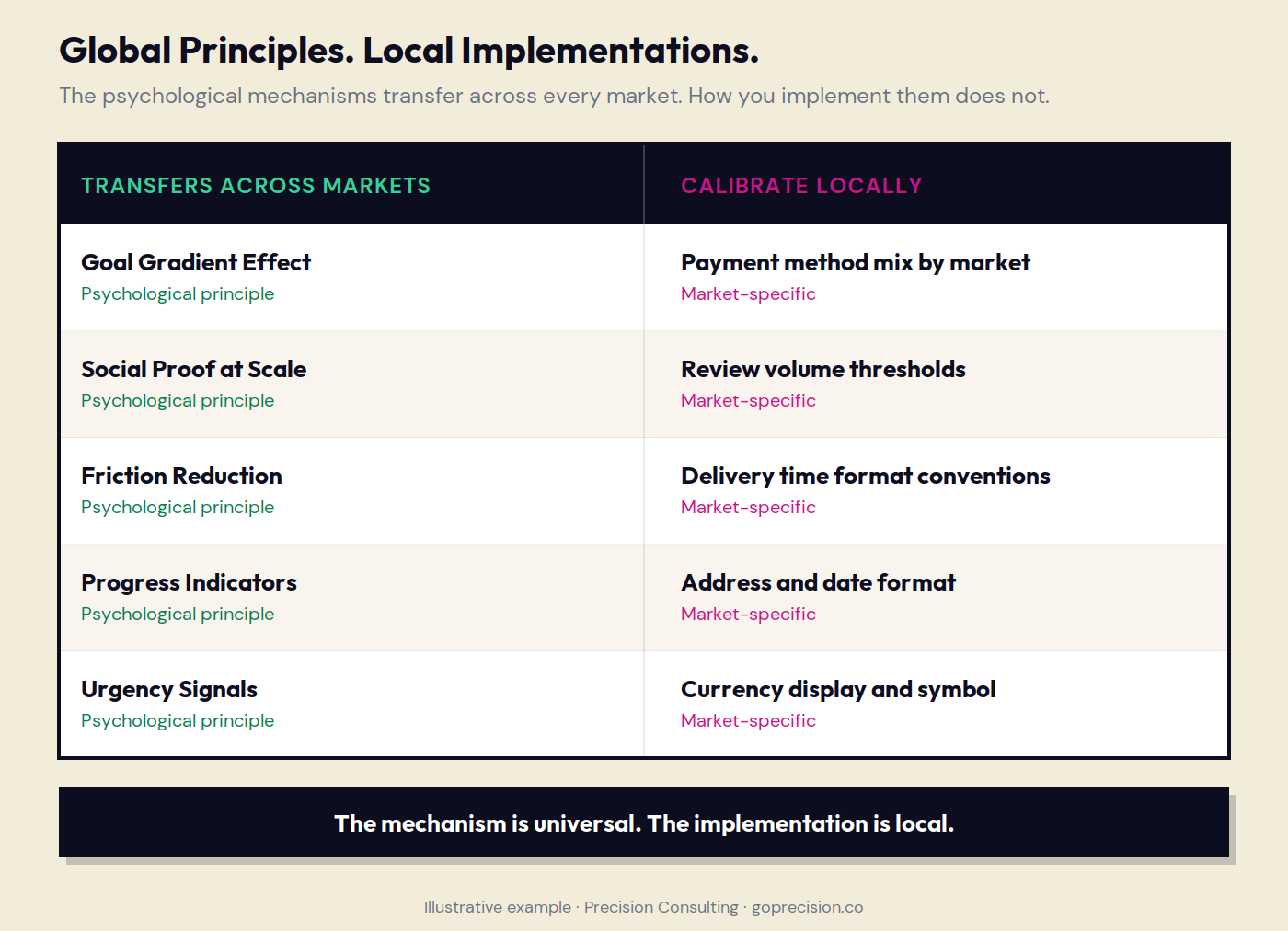
Psychological principles transfer across markets. Specific implementations, including payment methods, trust formats, and review thresholds, must be calibrated locally.
Run the psychological principles globally. Calibrate the implementations market by market. The team that confuses the two will repeatedly apply validated learnings to contexts where they do not apply and wonder why results do not replicate. Document what was tested, in which market, and under what conditions. The conditions are as important as the result.
If you are working on a marketplace or multi-vendor platform and want to apply a structured CRO framework to the discovery, vendor quality, and checkout layers, request your free audit and we will map the funnel with your specific platform context.
How to measure CRO impact in a multi-vendor marketplace
Measuring CRO impact in a marketplace requires longer baselines and cross-segment validation because vendor changes, seasonality, and paid marketing constantly shift the baseline. A conversion improvement that coincides with a high-performing vendor joining cannot be cleanly attributed to any platform change. Our article on A/B testing for founders covers the statistical framework that underlies marketplace experimentation, including how to set significance thresholds and minimum detectable effects.
A platform change that produces a positive directional effect in seven of ten market segments is more credible evidence than a change that shows statistical significance in one segment during a period of high vendor volatility. Marketplace CRO requires a higher evidence bar, not a lower one.
The vendor change problem in experiment design
The biggest disruptor in marketplace experiments is vendor change. A vendor joins, a vendor leaves, a vendor runs a promotion. Each of these events shifts the conversion baseline. Control for vendor-level changes in your experiment design by running tests in markets or categories where vendor composition is stable, by logging vendor-level changes during the test period, and by treating any period with significant vendor change as a confounded window that should be excluded from analysis.
This is not a reason to avoid experimentation on marketplaces. It is a reason to design experiments that account for the specific sources of variance. Single-brand CRO teams can afford to be less rigorous because their baseline is more stable. Marketplace CRO teams cannot. The extra rigor is not bureaucracy. It is the minimum required to distinguish a real signal from vendor-driven noise.
Before running any platform-level test, document the vendor composition in the test cohort at the start of the experiment. Log any vendor joins, exits, or promotions during the test window. If significant vendor change occurs, extend the test or exclude the affected period before drawing conclusions. A result contaminated by vendor change is not a failed test. It is no test at all.
How to prioritise when you cannot fix everything at once
Every marketplace team has more CRO opportunities than resources to pursue. The prioritisation framework is straightforward: fix the layer closest to the most buyers first.
Discovery problems affect every session. A search quality issue that causes 15% of searches to return poor results is affecting 15% of all buyers who use search. That is most of your traffic. Vendor quality problems affect every session in the categories where low-quality vendors appear. These are first-tier priorities.
Checkout problems affect only the buyers who make it to the checkout. On most marketplaces, this is a smaller proportion of total sessions than the discovery layer covers. This does not mean checkout is unimportant. It means the sequence matters. Fix discovery first, then vendor quality, then checkout.
Run a layer-by-layer audit before committing to a CRO roadmap. Measure exit rates at search results, at category pages, at listing pages, and at checkout. The layer with the highest exit rate and the highest session volume is the right starting point, not the layer that is easiest to test. Discovery is harder to instrument than checkout, but it is also where the highest-volume losses are happening.
Marketplace CRO operates at three layers: discovery, vendor quality, and checkout. Most teams start at checkout because it is the most instrumented part of the funnel and the easiest place to run tests. The highest-volume losses are almost always upstream. If you want to map where your specific platform is losing buyers across all three layers, the Precision services page describes how a diagnosis-led engagement works and who it is right for.
Information Architecture for the Web and Beyond by Peter Morville, Louis Rosenfeld, and Jorge Arango: covers search systems, findability, and the architecture of discovery in ways that apply directly to marketplace search design and filtering logic.
Influence by Robert Cialdini: the definitive account of social proof as a persuasion mechanism, directly applicable to understanding why category-level review density drives conversion on multi-vendor platforms.
Hooked by Nir Eyal: a framework for habit-forming product design, relevant to understanding how repeat buyer behaviour compounds the conversion flywheel on marketplace platforms.
- Marketplace CRO operates at three layers: discovery (search, filtering, ranking), vendor quality (content standards, imagery, rating thresholds), and checkout (payment localisation, field reduction, trust signals). Most teams optimise the checkout layer while the biggest losses are in discovery.
- Search ranking logic is a CRO decision. The inputs that determine which vendors appear first in search results are the highest-leverage conversion lever available on a marketplace platform. Leaving these inputs undefined or defaulted to engineering logic leaves the biggest single conversion opportunity unmanaged.
- Hick's Law applies directly to marketplace filtering. A result set of 2,400 with no meaningful filtering produces paralysis, not choice. Show filter options only when there are results behind them. Empty result states after applying a filter are a discovery failure that looks like a UX problem.
- Vendor quality is a platform conversion variable. At a major food delivery platform, introducing a vendor quality threshold in search ranking improved platform-wide conversion within four weeks. Not because the platform changed for buyers. Because what buyers found when they searched improved.
- Social proof on a marketplace operates at the category level, not just the listing level. A category where most vendors have fewer than 10 reviews sends a trust signal to every buyer who enters it, regardless of the individual vendor they are considering.
- Payment method localisation is not optional. In MENA markets, cash on delivery represented 40 to 60% of transactions as recently as 2020. Removing or deprioritising it in a checkout redesign is a conversion decision, not a UX decision.
- What transfers across markets: the psychological mechanisms (Goal Gradient Effect, social proof, friction reduction). What does not transfer: the specific implementations. Run principles globally. Calibrate implementations market by market.
- Marketplace CRO requires a higher evidence bar for experimentation. Vendor changes, seasonality, and paid marketing constantly shift the conversion baseline. Design tests with longer baselines, control for vendor-level changes, and look for consistent directional effects across segments before claiming a result.
Frequently asked questions
What is marketplace CRO?
Marketplace CRO is the practice of improving conversion rates on a multi-vendor platform by optimising the layers the platform controls directly: discovery quality (search, filtering, ranking), vendor quality standards (content, imagery, rating thresholds), and the checkout and payment experience. It differs from single-brand CRO because the platform does not control the product, price, or listing content, so the optimisation levers are indirect, operating through standards, ranking logic, and tooling rather than direct editing.
Why is marketplace CRO harder to measure than single-brand CRO?
Attribution is more complex on a marketplace because conversion is affected by factors outside the platform team's control: vendor changes, vendor promotions, seasonality, and paid marketing all shift the conversion baseline independently. A conversion improvement during a test may be entirely explained by a high-quality vendor entering the category, not by any platform change. This requires longer baselines, cross-segment validation, and control for vendor-level changes in experiment design.
What is the highest-leverage CRO lever on a marketplace?
Search ranking logic is consistently the highest-leverage lever because it affects every buyer who uses search, which is most buyers on most marketplaces. The inputs that determine which vendors appear first in search results are a CRO decision: rating, review count, vendor reliability, historical conversion rate, delivery time accuracy. Leaving these inputs undefined or defaulted to engineering logic leaves the biggest single conversion opportunity on the table.
How does vendor quality affect marketplace conversion rate?
Vendor quality affects marketplace conversion at the category level, not just at the individual listing level. A category where low-quality vendors appear disproportionately in search results produces exit events that spread across sessions, not just to the vendor's own listing. The platform's leverage is through quality thresholds in ranking: vendors below a defined performance standard drop in search rank, improving the quality of what buyers find without the platform touching any individual listing.
How should marketplace teams prioritise CRO investments?
Fix the layer closest to the most buyers first. Discovery problems affect every session. Vendor quality problems affect every session in the relevant categories. Checkout problems affect only the buyers who make it to checkout, which is a smaller subset. The sequence is: fix discovery, then vendor quality, then checkout. This does not mean checkout is unimportant. It means the order of operations matters for maximising conversion impact relative to the resource invested.
What CRO approaches transfer across markets on a global marketplace?
The underlying psychological principles transfer across markets: the Goal Gradient Effect, social proof, friction reduction in the checkout. What does not transfer are the specific implementations. Payment method mix, review volume thresholds that signal credibility, delivery time communication formats, and address format requirements are market-specific. Run experiments on principles globally. Validate and calibrate the implementations locally.