Last updated:
Generative engine optimisation (GEO) is the practice of making your brand, products, and content visible in the answers generated by AI search tools such as ChatGPT, Perplexity, Gemini, and Google's AI Overviews. Where traditional SEO gets you a ranking in a list of links, GEO gets you cited inside the answer itself.
Here is what makes this different from every other channel shift you have lived through. When someone asks ChatGPT which moisturiser to buy, there is no list to scroll through. There is one answer. Two or three brands get mentioned. Everyone else does not exist for that query.
Adobe's analysis of US retail traffic found that buyers arriving from AI tools convert at roughly five times the rate of standard organic search. They are not browsing. They have already decided. They want to confirm the recommendation and buy.
That pattern holds across categories and business types. In the work we do at Precision, the stores most affected are often the ones doing everything right by conventional metrics: strong organic rankings, solid paid spend, decent conversion on the traffic they can see. The channel that is changing is the one that does not show up cleanly in the dashboard.
What does a generative engine do differently from Google?
Think of it like the difference between a library and a research assistant. The library hands you a list of books. The research assistant reads them, picks the relevant parts, and gives you the answer. You never see the list.
That is what ChatGPT and Perplexity do. The buyer asks a question. The AI reads across hundreds of sources, synthesises a direct answer, and cites the handful of brands or pages it drew from. The buyer does not browse. They act on what the AI tells them.
The practical implication is significant. Where traditional SEO and CRO work together to attract visitors and then convert them, AI search compresses that funnel. A buyer who arrives from an AI recommendation has already been told which brand to consider. They are not evaluating: they are confirming. The session starts much closer to a decision than any Google-referred visitor.
Psychologically, this is the difference between a choice architecture where the buyer selects from a set, and one where the AI has already pre-selected. Loss aversion and decision fatigue do not apply in the same way when the recommendation has already been made. The buyer's cognitive job is simply to verify what they have been told, not to evaluate from scratch. That is why conversion rates from AI-referred traffic are consistently higher than from standard organic.
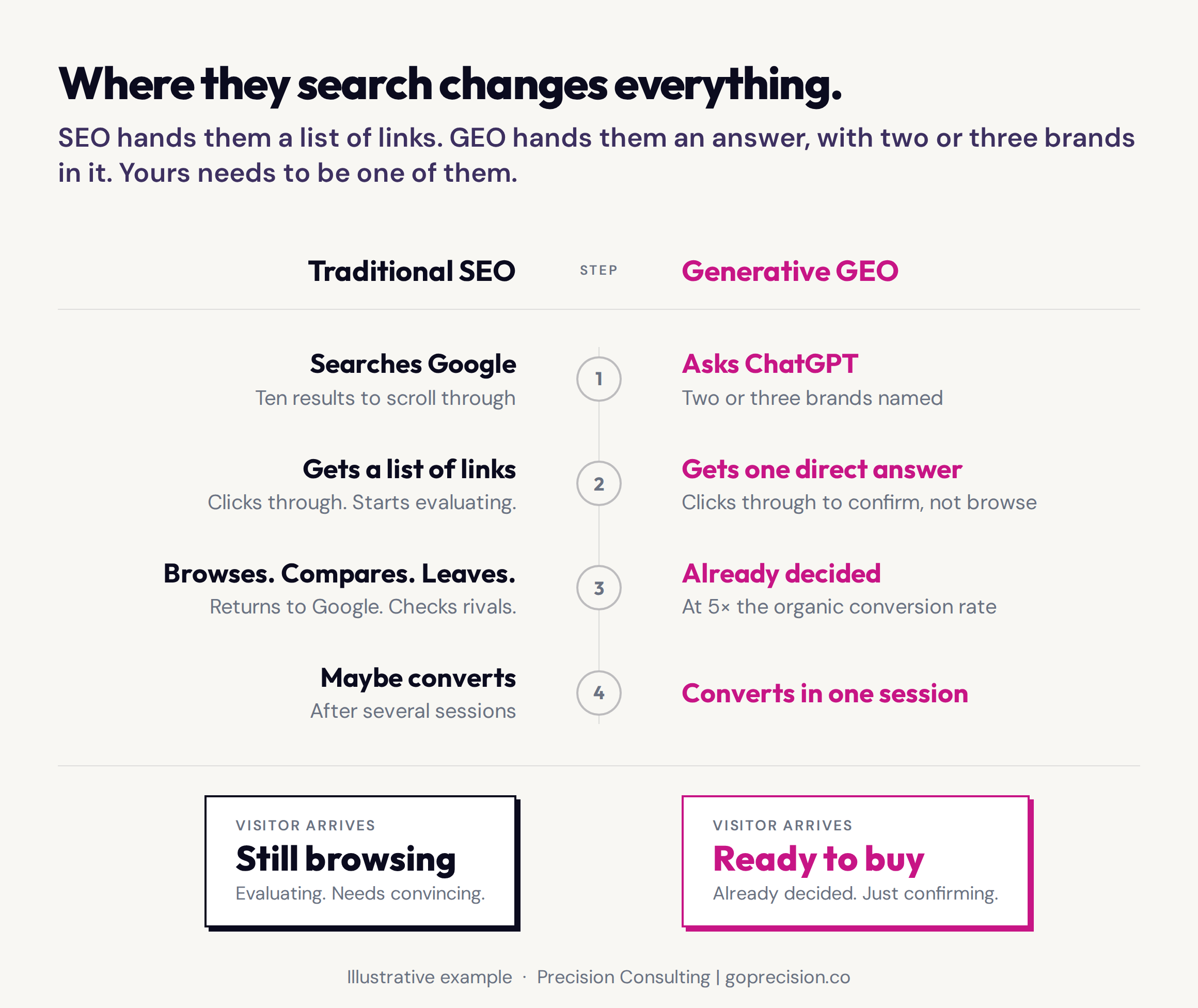
SEO earns a position in a list of links. GEO earns a place inside the answer itself. The buyer's journey looks fundamentally different depending on which route they took.
Why is GEO specifically an e-commerce problem?
The stores affected most are not necessarily the ones doing things wrong. They are often the ones doing everything right by conventional metrics: strong organic rankings, solid paid spend, decent conversion on visible traffic. But acquisition cost has been creeping up for eighteen months, and nobody can fully explain why. The channel that is changing is the one that does not show up cleanly in the dashboard.
The 'best X under Y' query
The query type that has shifted most dramatically is the category recommendation. 'Best moisturiser for dry skin under £40.' 'Most durable running shoes for wide feet.' 'Sustainable home office chair under £300.' These are purchase-intent queries where the buyer is ready to buy and asking for a steer.
In the old world, these queries produced comparison articles and product round-ups, and the brands featured in those articles got the traffic. In the AI-search world, the generative engine synthesises the comparison directly. The brands cited in the AI answer get the traffic. The brands cited in the old round-up articles are irrelevant unless those articles are themselves cited by the AI.
Previsible's AI Traffic Study, published in 2026, tracked 6.77 million LLM-driven sessions and found that 28.8% of ChatGPT traffic lands on internal search results pages because the model trusts the domain but cannot identify the specific product. That is a significant conversion opportunity if your internal search is effective, and a significant loss if it is not.
The compound authority problem
SEO is a long game because authority builds over time. GEO works the same way, but what the AI is looking for is different. A generative model does not just read your website. It cross-references you across the internet: reviews, press mentions, comparison guides, forum discussions, content from people who have used your products. A brand with a strong, consistent presence across those sources is easier to cite confidently than one that only exists on its own pages.
That external presence is not built overnight. The brands that start building it now will have an easier time in two years than the ones that wait. This is not a reason to panic, but it is a reason to start.
Test your brand's AI visibility today. Open ChatGPT, Perplexity, and Gemini. Search the category-level queries your buyers use: "best [your product type] for [use case]" and "top [category] brands." Note what comes back. If competitors appear consistently and you do not, the gap is telling you something actionable now, not in six months.
What does GEO actually require from your content and brand?
GEO is not a replacement for SEO. It is an extension of it. The foundation is the same: accurate, complete, well-structured content. What GEO adds is a set of specific practices that make your content easier for a generative model to extract, trust, and cite.
Structured product data
The JSON-LD product schema that earns rich results in Google also gives generative engines the entity clarity they need to confidently surface and recommend a product. Product name, description, price, availability, reviews, and attributes all need to be machine-readable. The same Product schema that helps Google understand your product page is what ChatGPT can extract when a buyer asks about options in your category.
Inconsistency is a citation killer. When your product is described differently on your site, your marketplace listings, and your press mentions, generative models lose confidence in the data and become less likely to recommend it. This is explored further in our guide to product page design, which covers how structured, attribute-rich descriptions influence both human buyers and machine retrieval systems.
Answer-formatted content
Generative models prefer content that is already structured as a direct answer to a question. FAQ sections, buying guides, comparison tables, and how-to content are particularly well-suited to being extracted and cited. Content that is heavy on marketing language and light on specific, factual attributes is harder for a model to use.
Here is the practical test. A product description that says "our bestselling serum, loved by thousands, perfect for glowing skin" is almost useless for GEO. A description that says "a 30ml retinol serum with 0.3% retinol concentration, suitable for dry and combination skin, designed for nightly use over a minimum 12-week cycle" is the kind of specific, extractable content that a generative model can actually use to answer a buyer's question. Marketing language does not cite well. Specific attributes do.
The reason specific attributes outperform marketing language is not just technical. A generative model mimics the judgment of an informed recommender. When someone asks a knowledgeable friend which retinol serum to buy, that friend does not say "it is our bestselling one, loved by thousands." They say "it has 0.3% retinol, right for a first cycle, and you use it at night." Specificity is the currency of a confident recommendation, for both humans and AI systems.
External authority signals
This is the part of GEO that most resembles traditional link building, but the mechanism is different. Where backlinks pass PageRank, external mentions pass credibility. Generative models cross-reference information across multiple independent sources to assess whether a brand is trustworthy and worth citing.
Press coverage in relevant publications, product reviews on independent sites, mentions in buying guides, and appearances in community forums all contribute to the model's assessment of your brand. The strategies for building this kind of external presence are covered in detail in our article on improving your brand's AI citation probability, which covers both the content and the off-site signals.
The product feed as a GEO asset
For e-commerce brands, the product feed is often the highest-leverage GEO asset and the most neglected. AI engines and agents that support shopping behaviour pull directly from structured product feeds. If your feed has vague titles, missing attributes, stale pricing, or inconsistent categorisation, it is failing on both the SEO and GEO surfaces simultaneously.
Long, descriptive product titles that include the key attributes buyers search for. Complete attribute sets for every product. Accurate, current pricing. Size, material, and colour details that give an AI enough to answer a comparison query without needing to infer. These are not advanced GEO tactics. They are table stakes that most feeds still do not meet.
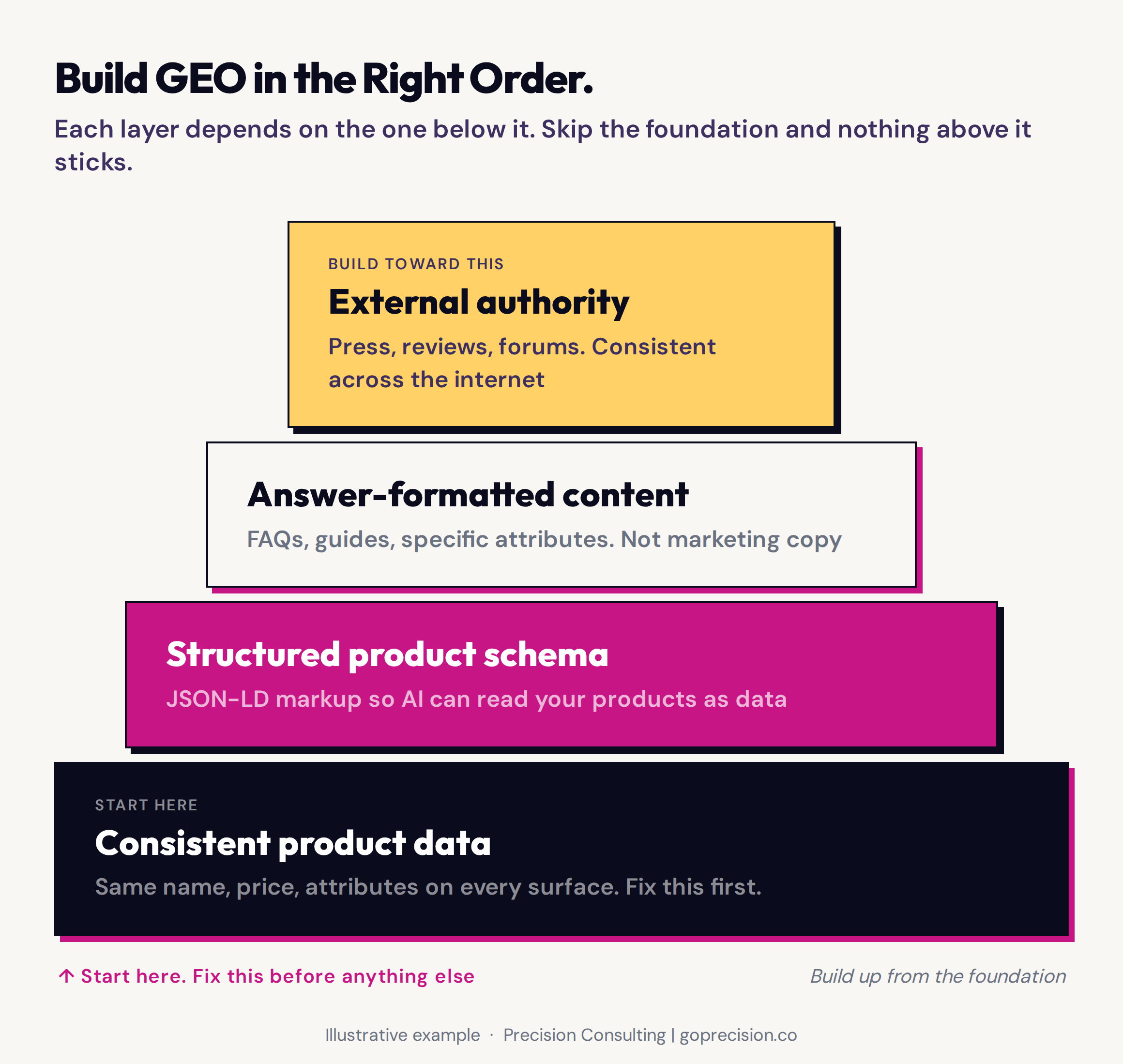
The four GEO signals that determine whether a generative engine can find, trust, and cite your brand. Most e-commerce stores are weak on at least two of them.
Audit your top twenty products for GEO readiness. For each: do the descriptions contain specific attributes rather than marketing language? Are dimensions, materials, and use-case details present? Is the product information consistent across your site, any marketplace listings, and your product feed? This audit typically takes two to three hours and reveals the most impactful gaps.
If you want a structured assessment of where your content and product data stand against GEO criteria, request your free audit and we will review your current setup against the signals generative engines look for.
How do you measure GEO progress?
GEO measurement is less mature than SEO measurement. AI platforms do not share prompt-level query data, and standard analytics tools were not built for this channel. But the metrics exist, even if the tooling is still catching up.
Citation monitoring
The most direct measure is whether your brand is being cited in AI answers to queries relevant to your category. Three free tools are worth starting with. HubSpot's AI Search Grader runs a one-time scan across ChatGPT, Perplexity, and Gemini with no account required, useful as a quick baseline. OpenLens (tryopenlens.com) is fully free and tracks brand mentions, sentiment, and competitive share of voice across ChatGPT, Claude, Gemini, Perplexity, and DeepSeek on an ongoing basis. Ahrefs' free AI Visibility Checker gives a snapshot using prompts derived from real search behaviour rather than synthetic questions.
AI referral traffic in your analytics is a lagging indicator. Citation monitoring is the leading one. If you are being cited consistently, traffic and revenue will follow. If citations are low, the traffic numbers will tell you slowly and at high cost. Start with the free tools to understand where you stand before committing to paid monitoring.
AI referral traffic in GA4
GA4 can be configured to segment traffic by referral source. Sessions originating from chat.openai.com, perplexity.ai, gemini.google.com, and similar sources are your AI referral traffic. Create a custom segment that captures these sources and monitor it separately from organic. Watch both volume and conversion rate, as they tend to behave differently: AI-referred buyers often convert at higher rates with lower session counts.
According to SE Ranking's AI traffic research published in 2026, AI referral traffic jumped 51% month over month in September 2025, the largest single-month increase in the dataset. The seasonal pattern is becoming recognisable, with peaks in autumn and recovery after holiday dips. Understanding the seasonal pattern of your AI traffic is only possible if you have been tracking it as a separate channel from the start.
Set up your GA4 AI referral segment now. Create a custom segment that includes sessions from chat.openai.com, perplexity.ai, gemini.google.com, claude.ai, and bing.com (for Copilot traffic). Track this monthly alongside your organic channel. Even with low volume today, you want the baseline in place before volume grows enough to matter.
Where should you start if you have not touched GEO yet?
Most e-commerce founders do not need a dedicated GEO budget before they have the foundations right. The foundations are the same ones that support good SEO and good CRO: accurate, complete, well-structured product information. Our CRO audit checklist covers the broader diagnostic framework that sits underneath both.
Start by auditing your top twenty products for data completeness. Do they have specific, attribute-rich descriptions? Are prices, dimensions, and use-case details accurate and consistent across surfaces? Does each product have enough structured data for a model to understand what it is, who it is for, and how it compares to alternatives?
Then test your brand's AI visibility. Search for the category-level queries your buyers use across ChatGPT, Perplexity, and Gemini. Note what comes back. If your competitors are consistently appearing and you are not, the gap is telling you something actionable: either your product data is not specific enough to be cited, your external authority is too thin, or both.
The brands that will find GEO most difficult in two years are the ones starting from scratch then. The brands that will find it easiest are the ones that treated it as a compounding asset now. Citation authority accumulates the same way domain authority does in SEO: gradually, then suddenly.
- Generative engine optimisation (GEO) is the practice of making your brand visible in AI-generated answers from tools like ChatGPT, Perplexity, and Gemini. Where SEO earns rankings, GEO earns citations.
- AI-referred buyers convert at roughly five times the rate of standard organic traffic (Adobe retail data). They arrive at a near-decision state, not at the top of the funnel.
- The highest-leverage shift in buyer behaviour is the category recommendation query. 'Best X for Y' queries now produce AI-synthesised answers, not link lists. If your brand is not in the answer, the buyer does not see you.
- GEO does not replace SEO. The foundation is the same: accurate, complete, structured content and consistent product information. GEO adds specificity in product descriptions, answer-formatted content, and external authority signals.
- Different AI platforms attract buyers at different purchase intent stages. In one dataset, Perplexity produced 35.6% of AI-referred revenue from just 7% of AI-referred visits. Track platforms separately, not as a single AI traffic row.
- Citation authority is a compounding asset. Start building external mentions, structured product data, and answer-formatted content before your competitors establish the lead.
- Measure GEO through citation monitoring tools (HubSpot AI Search Grader, OpenLens, Ahrefs AI Visibility Checker) alongside a dedicated GA4 AI referral segment. Citations are the leading indicator; traffic is the lagging one.
Frequently asked questions
What is generative engine optimisation (GEO)?
Generative engine optimisation (GEO) is the practice of making your brand, products, and content visible in the answers generated by AI search tools such as ChatGPT, Perplexity, and Gemini. Unlike traditional SEO, which optimises for rankings in a list of links, GEO optimises for citations inside AI-generated answers. When a buyer asks an AI tool for a product recommendation, the brands that appear in the answer are the ones that have built the content quality, data structure, and external authority that generative models draw from.
How is GEO different from SEO?
SEO optimises content for Google's ranking algorithm, which considers keyword relevance, backlinks, and technical site quality. GEO optimises content for AI retrieval systems that synthesise direct answers from multiple sources. The underlying foundation overlaps: accurate content, structured data, and external credibility matter in both. What GEO adds is specificity in product descriptions, answer-formatted content structures, and a consistent presence across independent sources that AI models use to verify accuracy before citing a brand.
Does GEO matter for e-commerce specifically?
GEO matters more for e-commerce than for most other sectors because purchase-intent queries are exactly where AI search is growing fastest. Category recommendation queries, comparison queries, and use-case questions are all well-established in AI search behaviour, and they are precisely the queries that drive product discovery. Brands that appear in AI answers to these queries capture buyers who are already close to a decision, which is why AI-referred traffic converts at significantly higher rates than standard organic.
What is the difference between AEO and GEO?
Answer engine optimisation (AEO) is the earlier term for optimising content to appear in featured snippets and direct answers in traditional search. GEO extends this to the generative AI context, where the answers are synthesised by large language models rather than extracted from a single source. In practice the two overlap significantly: content that earns AEO citations tends to also earn GEO citations. The key difference is that GEO also requires brand authority signals and external presence that traditional AEO did not.
How do I check if my brand appears in AI search answers?
Test the queries your buyers use in your category directly across ChatGPT, Perplexity, Gemini, and Google's AI Overviews. Note which brands appear, how they are described, and which sources are cited. For ongoing monitoring, free tools such as HubSpot's AI Search Grader and OpenLens (tryopenlens.com) allow you to track citation frequency across platforms without running manual tests continuously. Paid tools such as Mangools AI Search Watcher and Profound offer deeper tracking for brands that need systematic ongoing monitoring.
How do I optimise my product pages for GEO?
Write product descriptions that are specific and attribute-rich: include materials, dimensions, use cases, and outcomes rather than marketing language. Implement JSON-LD Product schema on every product page. Ensure that your product name, price, and key attributes are consistent across your own site, any marketplace listings, and your product feed. Create category-level content in answer format: buying guides, comparison articles, and FAQ pages that directly address the questions your buyers ask AI tools about your category.
GEO is not a discipline that replaces what you are already doing. The brands that will find it easiest are the ones who took the foundations seriously: accurate product data, structured content, a consistent external presence. Getting those foundations right is the same work that makes your site convert better and rank higher in traditional search. The AI citation layer sits on top. If you would like help assessing where the gaps are, our services page covers how we approach it.
Predictably Irrational by Dan Ariely covers the psychology of decision-making under uncertainty.
Influence by Robert Cialdini covers the authority principle in depth.
Don't Make Me Think by Steve Krug covers how buyers make decisions with limited cognitive effort.