Last updated:
You need CRO consulting before hiring in-house when the programme foundation does not yet exist: no validated analytics, no documented funnel diagnostic, no prioritised hypothesis backlog, and no established testing methodology. Without that foundation, an in-house hire spends their first six months building what a consulting engagement would have delivered in six weeks. The businesses that get this right hire in sequence. Consulting builds the programme. In-house runs it forward.
Most growth-stage businesses get the sequence backwards. They want a head of growth, a CRO manager, and a conversion specialist. Someone internal who owns the problem. That instinct is not wrong. It is just early.
Before we get into the seven signs, it is worth being clear about what CRO consulting actually means here, because the word consulting carries a lot of baggage. This is not someone who presents a slide deck with fourteen recommendations and disappears. The kind of work that prepares a business for an in-house hire is operational: running the analytics audit, mapping the funnel, identifying specific friction points, building the hypothesis backlog, running the first wave of tests, and documenting what works and what does not. It is the programme itself being built by people who have done it before, for your specific funnel, with your data. If your store is showing several of these signs, our CRO consulting engagement is designed to build that foundation first.
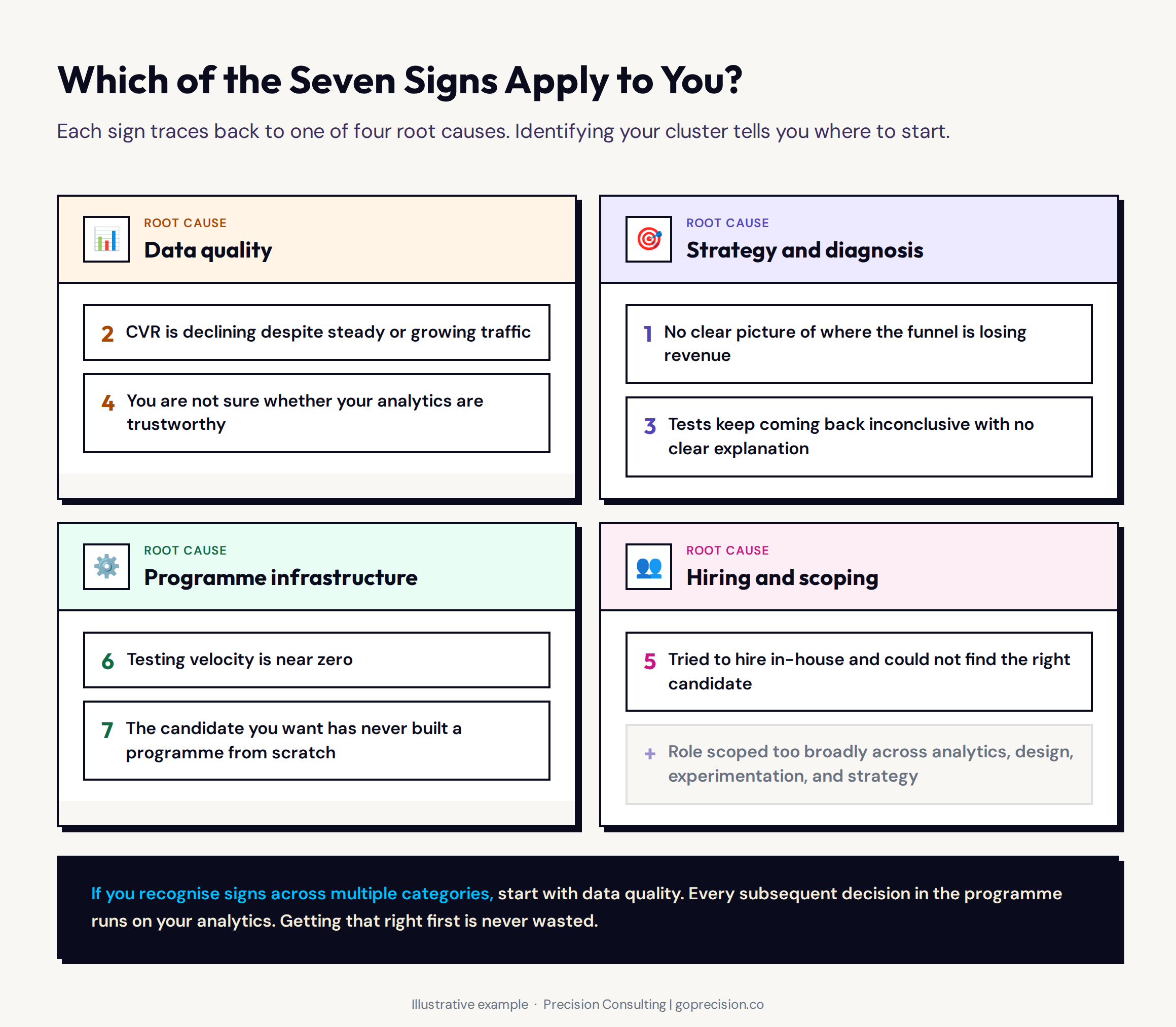
Seven programme readiness gaps that indicate CRO consulting should come before an in-house hire.
Sign 1: Do you know exactly where your funnel is losing revenue?
If you cannot point to the specific funnel steps where conversion is dropping, with data to support that view, you are not ready to hire someone to fix those problems. You are ready to find them first.
An in-house CRO specialist needs a diagnostic foundation to work from. Without it, they spend the first several months doing exactly the foundational work that an experienced external team would complete in six to eight weeks: auditing the analytics, mapping the funnel, validating the tracking, and building a prioritised hypothesis backlog. You have paid a full-time salary for work that could have been scoped and delivered faster, with more experience behind it.
Think of it like a new chef joining a restaurant kitchen with no mise en place and no menu. They can cook. But they will spend their first month setting up the station rather than serving food. The consulting engagement is the mise en place. The in-house hire is the chef who runs the service once it is ready.
Sign 2: Is your conversion rate falling while traffic holds steady?
This sign needs a precise definition, because a common version of it is not actually a sign at all. If traffic is growing and CVR is holding roughly flat, that is generally fine. New visitors convert at lower rates than returning ones, and a 0.1 to 0.2 percentage point dip as you scale is normal. It is not a programme problem.
The sign is a meaningful CVR decline while traffic holds steady or grows. That almost always points to one of three things: the traffic mix has shifted toward lower-intent sources, a funnel step has broken quietly without triggering an alert, or a structural friction point has been accumulating long enough to become visible in the numbers. Each has a completely different fix. The first is a traffic problem, not a CRO problem. The second may be a one-day technical fix. The third is where a structured programme earns its place. Understanding what a meaningful conversion rate decline looks like for your category tells you which problem you are actually solving before you commit to a response.
Sign 3: Why do most of your tests come back inconclusive?
Inconclusive tests are not a failure. They are a signal. The signal they usually send is that one of two things went wrong before the test was designed: either the business was testing at a traffic volume too low to reach statistical significance in a useful timeframe, or the tests were not targeting the right friction points in the first place.
The traffic volume problem is more common than most founders realise. A test run on a page that receives 2,000 sessions per month will take three to four months to reach 95% confidence on even a modest expected effect size. Most businesses do not have the patience to run tests that long, so they call the result inconclusive at week six and move on. The test was not inconclusive. It was incomplete. The programme needed a methodology adjustment, not more tests. How statistical significance actually works is the first thing a structured programme establishes before any test goes live.
How a testing calendar built from best-practice lists misleads you
The second failure mode is a testing calendar built from industry best-practice lists. Someone read that CTA copy, hero images, and button colours were high-leverage tests, so those became the calendar. Six tests were run. Five were inconclusive. One lifted CVR by 0.1%, which sat inside the margin of noise. Meanwhile, the checkout was losing 60% of buyers between the payment step and order confirmation, because the payment error messages were unhelpful and no mobile wallet options were available. Nobody had looked.
A consultant identifies the friction hierarchy and the viable testing methodology before any tests are run. Both change which tests go on the calendar and whether the programme can actually produce results at your current traffic level.
Sign 4: How confident are you that your analytics data is accurate?
Broken analytics is the most expensive and most invisible infrastructure problem in CRO. It does not announce itself. The dashboards look normal, the charts have numbers, and the reports produce findings. They just do not reflect reality.
The most common version of this: a checkout funnel showing a 40% drop at step two, when the real number is closer to 22%. The discrepancy comes from duplicate tracking events firing on page reload, and nobody has validated the implementation since the site was rebuilt eight months ago. Every decision made based on that funnel data has been made on a fiction. Every intervention has been targeted at the wrong step.
An external team audits the analytics implementation before drawing any conclusions. An in-house hire who inherits broken analytics without knowing it will spend months optimising for the wrong problems with confidence. A structured CRO audit includes the analytics layer as the first step, not an afterthought.
Not sure whether your tracking is giving you an accurate picture? Request a free audit and we will validate your analytics setup before drawing any conclusions from it.
Sign 5: Why is it so hard to find the right in-house CRO candidate?
This is one of the clearest signals that the role definition has a problem. Most job descriptions for in-house CRO roles are written as a combination of everything the business currently lacks: analytics, UX design, copywriting, experimentation, and strategic direction. That combination describes a team of four people, not one hire.
The resulting job post attracts candidates who are strong in one or two of those areas and credentialing-adjacent in the others. Interview after interview produces the same outcome: someone who can run tests but has never designed a programme, or someone who can produce strategic frameworks but has never shipped a variant. Neither is wrong as a hire. Both are wrong as the first hire.
The consulting engagement narrows the role. Once the programme exists, the in-house hire needs to manage and iterate on it. That is a much more achievable job description, and it attracts a much clearer candidate profile.
Sign 6: What is keeping your testing velocity near zero?
A CRO programme without velocity produces no results. Two to four meaningful tests per month is a reasonable minimum for a well-structured programme at an adequate traffic volume. Fewer than that, and the compounding mechanism never activates.
Near-zero testing velocity is seldom a capability problem. It is an infrastructure problem: no clear process for moving from hypothesis to design to development to launch, no established relationship between the growth function and the engineering team, and no prioritised backlog to pull from. Every test becomes a negotiation. The negotiation takes longer than the test.
An external team establishes that infrastructure: the workflow, the prioritisation framework, the relationship with engineering, and the process for documenting results. An in-house hire who joins without that infrastructure has to build all of it before running a single test. That takes three to four months. The business needed results before the hire started.
Sign 7: Has your prospective hire ever built a CRO programme from scratch?
There is a meaningful difference between a CRO specialist who has run tests inside a programme that already existed and one who has built a programme from the diagnostic foundation up. Both are valuable. They are not the same skill set.
The first is excellent at managing a testing calendar, iterating on a working programme, and generating hypotheses against a known friction hierarchy. The second can do all of that and also design the diagnostic methodology, validate the analytics infrastructure, and make the strategic decisions about where the programme focuses first.
Most CRO hires at growth-stage businesses are the former. Not because they are less capable, but because the latter is a rarer profile and commands a different market rate. If your business needs someone to build the programme and then run it, the honest question is whether one hire can do both well, or whether the right sequence is external expertise to build and a focused in-house hire to run.
What does the right consulting-to-in-house sequence look like?
The right order for most growth-stage businesses is: consulting to diagnose and structure, followed by in-house to execute and iterate. The consulting engagement should produce four things: a validated analytics implementation, a documented funnel diagnostic with specific friction points and their estimated revenue impact, a prioritised hypothesis backlog, and a documented testing methodology. The in-house hire inherits all four and runs the programme forward from a standing start rather than from zero. What a structured CRO engagement actually delivers is that foundation, not a slide deck with recommendations.
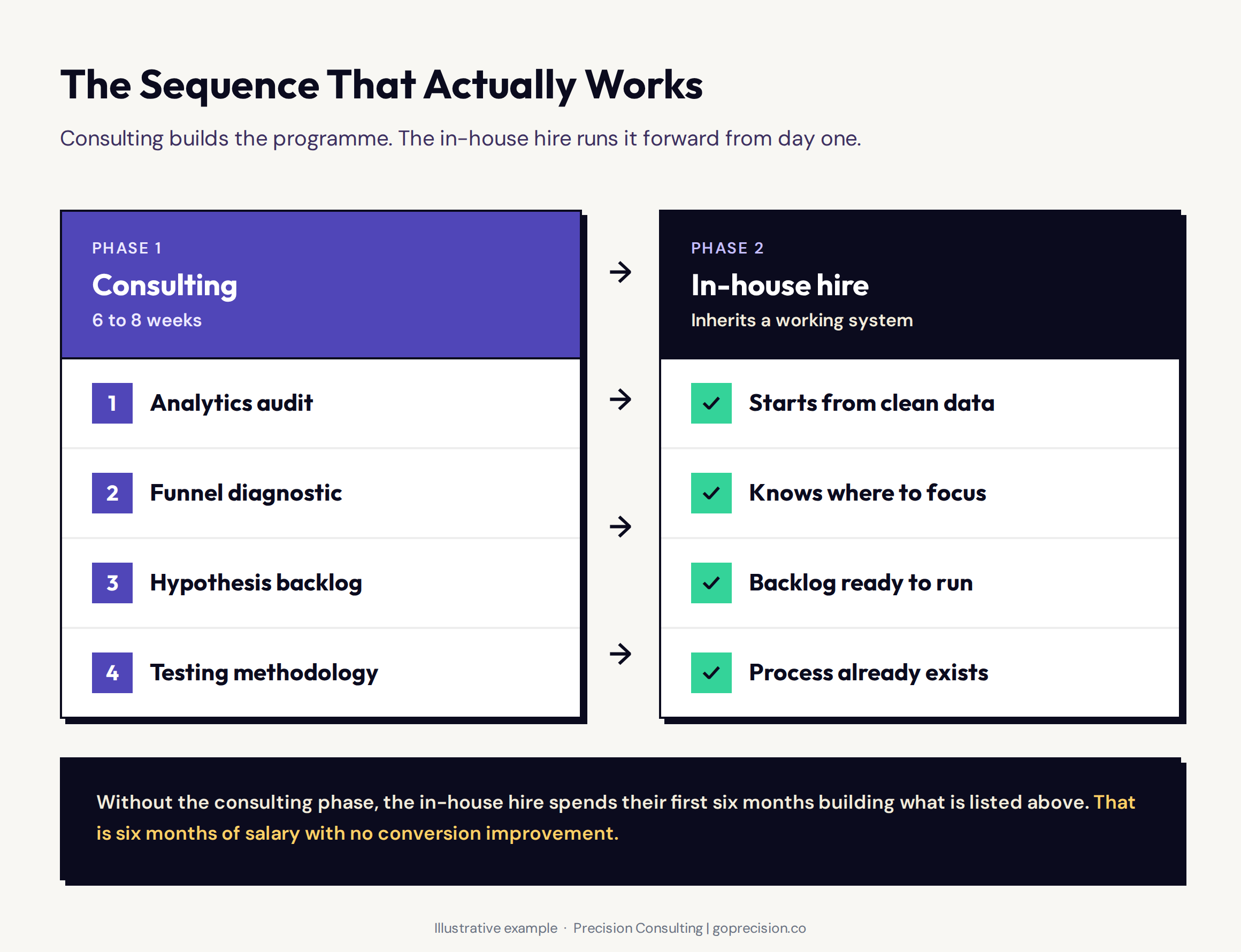
The consulting-to-in-house sequence: consulting diagnoses and structures, the in-house hire executes and iterates on a validated foundation.
When in-house first is the right answer
There are genuine cases where hiring in-house before bringing in external help makes sense. The clearest one is a business that already has a validated analytics infrastructure, a clear picture of its funnel friction hierarchy, and an experienced growth team that can support the programme. This is typically a business that has already been through an external CRO engagement and is now scaling what was built.
High testing velocity requirements also justify in-house first. A large e-commerce business running simultaneous tests across ten category pages cannot be served by a single external relationship at the pace required. At that scale, a dedicated in-house function is the right operational model. The full agency versus in-house decision covers where each model fits across different business stages.
The four-question test
Before posting the role, answer these four questions with data:
1. Where in your funnel is the biggest drop-off?
2. What is the specific friction causing it?
3. Which intervention is most likely to address it?
4. How will you know whether it worked?
If you can answer all four, you are ready to hire someone to run the programme. If you cannot answer one or more, the consulting engagement answers them first.
If several of these signs describe where your business is right now, the next step is a structured diagnostic rather than a job posting. Our CRO consulting engagement is designed for exactly this stage: build the programme foundation, identify the highest-revenue friction points, and hand over a system your in-house team can run forward. The sequence that gets this right is consulting first, then in-house. Not because in-house is wrong, but because it works better when the programme already exists.
Don't Make Me Think, Revisited by Steve Krug is the clearest guide to usability and friction: why visitors abandon before converting and what removes the barriers between intent and action. Predictably Irrational by Dan Ariely covers how buying decisions are made in ways that are systematic but not rational, which is the underlying logic behind every CRO programme worth running. Influence by Robert Cialdini is the foundational text on persuasion principles, all of which underpin the friction and trust signals that CRO addresses at the funnel level.
Key Takeaways
- Most growth-stage businesses need CRO consulting before an in-house hire because the programme foundation does not exist yet. That foundation is what consulting builds.
- If you cannot identify your top three funnel friction points with supporting data, you are not ready to hire someone to fix them. You are ready to find them.
- Inconclusive tests are a diagnostic problem, not a capability problem. A programme built without a friction hierarchy produces inconclusive results regardless of who runs it.
- Broken analytics is invisible from the inside, and it sends every subsequent decision in the wrong direction. Validate the implementation before drawing any conclusions from it.
- The most common failure mode in in-house CRO hiring is a role scoped too broadly. Consulting builds the programme. A well-scoped in-house hire runs it forward.
- Near-zero testing velocity is an infrastructure problem, not a headcount problem. Fix the infrastructure before adding the headcount.
- The right sequence for most growth-stage businesses is consulting to diagnose and structure, followed by in-house to execute and iterate. That sequence is faster and produces more durable results.
Frequently Asked Questions
What does a CRO consultant actually do?
A CRO consultant diagnoses where a business is losing revenue in its conversion funnel, builds a prioritised testing roadmap based on that diagnosis, and either runs the testing programme directly or hands the structured foundation to an in-house team. The core deliverable is a clear picture of which friction points are costing the most revenue and what to do about them.
When should I hire a CRO specialist in-house?
Hire in-house when you have a validated analytics implementation, a documented funnel diagnostic, and a structured testing programme that needs someone to manage and iterate on it. The in-house hire works best as the second step in the sequence, not the first. The first step is building the programme, which is typically better done externally.
What is the difference between a CRO consultant and a CRO agency?
A CRO consultant typically works directly with the client team, owns the diagnostic and strategic direction, and produces the programme architecture. An agency often has a broader team structure with analysts, designers, and developers, which is appropriate for larger testing programmes with high velocity requirements. For growth-stage businesses, a consultant engagement is usually the right starting point before moving to an agency model.
How much does CRO consulting cost?
CRO consulting engagements vary significantly based on scope. A focused diagnostic audit typically ranges from a few thousand dollars to $10,000 or more, depending on the complexity of the funnel and the business size. An ongoing consulting relationship with active testing programme management is priced differently. The relevant comparison is not consulting cost versus zero: it is consulting cost versus the cost of six to twelve months of a poorly structured in-house hire producing inconclusive results.
Can a CRO consultant work alongside an in-house team?
Yes, and this is one of the most effective models. The consultant provides strategic direction, runs the diagnostic, and designs the testing framework. The in-house team handles implementation, development coordination, and ongoing iteration. The handover point is defined at the start of the engagement, and the in-house team is involved throughout so that institutional knowledge transfers effectively.
